Evolution of the Coherence Matrix
The complete evolution equation for Γ: unitary, dissipative and regenerative terms. Familiarity with the coherence matrix and the Axiom Ω⁷ is assumed.
This chapter is the longest and possibly the most important in the "Dynamics" section. It answers the question: how does the state of a holon change over time? If the coherence matrix is a "snapshot" of the system at a given moment, then the evolution equation is the "rules of cinema", describing how frames succeed one another.
The reader will learn:
- What the logical Liouvillian is and why it is not postulated but derived from the axioms
- Three forces governing evolution: unitary (preserves coherence), dissipative (destroys), and regenerative (restores)
- Why the system always tends toward the terminal object (global attractor)
- How positivity preservation is guaranteed — the state remains physical under any evolution
Think of an ice sculpture in the sun:
- Unitary part — the sculptor who rotates the sculpture, changing the angle but not the shape. Purity does not change.
- Dissipation — the sun, melting the sculpture, erasing detail. Purity falls.
- Regeneration — the freezer, re-freezing the sculpture, restoring the shape. Purity can grow (if free energy is available).
Life is a dynamic equilibrium: the sun melts, the freezer re-freezes. If the freezer is switched off (), the sculpture inevitably melts () — the system dies.
Terminal Object T (global attractor)
There exists a unique terminal object :
where — the global attractor (equilibrium state).
Properties of the terminal object
| Property | Formulation | Consequence |
|---|---|---|
| Uniqueness | Unique equilibrium | |
| Universality | All paths lead to T | |
| Contractibility | Monism proved | |
| Fixed point | T is a fixed point of self-modelling |
Arrow of time as convergence to T
Theorem (Arrow of time):
provided (system is not isolated). Here is the parameter of the dissipative semigroup; the cyclic Page–Wootters tick has no limit, and the O-clock does not supply (emergent time, §11.2).
Geometric formulation (along the stratal depth — the cumulative tick count, not the cyclic label ; two indices, one arrow):
The arrow of time is the progressive collapse of higher strata toward terminal T.
Full equation of motion
The cyclic clock τ ∈ ℤ₇ is derived from the structure of the category via the Page–Wootters mechanism. The equation below, with its dissipative and regenerative terms, runs in the parameter of the Lindblad semigroup, which this clock does not supply (relative to a clock of period seven every dynamics is periodic). Its finite carrier is the depth register: readings ordered as a chain in the O-registers of holons, under a Feynman–Kitaev constraint with two holons as environment. One state-independent constraint gives the conditional states exactly at every reading, and each solution of the full equation with is reproduced exactly by a constraint fitted to it (Theorems 11.1–11.4): T-53b [T] relative to the depth register (it was [C at an aperiodic time parameter] until 2026-09-25). What is not derived is the register from the axioms: the timeless form of the constraint is an assumption of A5, as for the O-clock. An earlier version of this box said that time as such is derived and not an external parameter without naming the carrier; that is retracted. See Theorem on emergent time.
The evolution of is described by the logical Liouvillian:
where the logical Liouvillian is derived from the subobject classifier Ω:
where:
- τ — the evolution parameter; for the dissipative and regenerative terms it must be aperiodic, which the conditional states relative to O do not provide; the depth register provides it (T-53b, [T])
- — effective Hamiltonian from the Page–Wootters constraint
- — unitary evolution (preserves )
- — logical dissipation (operators L_k from Ω)
- — regeneration (adjoint functor to dissipation)
The Lindblad operators L_k are not postulated arbitrarily — they are derived from the atoms of the classifier Ω. This eliminates the ambiguity "L_k depend on the system".
Applicability scope: Markovian regime
The evolution equation is a Lindbladian (Markovian) master equation. The mathematical guarantees of UHM — stability of the subobject lattice, monotone contraction of the Bures metric, well-definedness of the regeneration operator , existence of the fixed point — all rely on the CPTP (completely positive, trace preserving) structure of each infinitesimal evolution step. This section states the exact scope of applicability.
Theorem (Petz–Ruskai monotonicity, 1996) [T]
For any CPTP map and any two density operators :
Strict inequality holds unless is unitary on the span of .
Consequence for UHM: since generates a one-parameter semigroup of CPTP maps (Lindblad form), the Bures metric is monotonically non-increasing along any UHM trajectory. This is the categorical foundation for:
- Stability of the subobject lattice (T-62 [T]);
- Uniqueness of the fixed point (T-96 [T]);
- Convergence of the iterative scheme for (above);
- Well-defined Bures topology on the site (A1 axiom).
Markovian vs. non-Markovian quantum dynamics
Quantum dynamics of a system coupled to a bath on total Hilbert space is unitary on the total space: . The reduced system dynamics is obtained by partial trace. Two regimes:
- Markovian (CP-divisible): with and each is CPTP. Equivalent to Lindblad form with time-local .
- Non-Markovian (CP-indivisible): the intermediate propagators fail to be CPTP. Memory effects from bath-system correlations cause apparent "information backflow" into the system. Time-local generators can develop negative rates, Lindblad form breaks down.
The Born–Markov approximation (Breuer–Petruccione 2002, §3.3) is valid when:
- Weak coupling: system-bath interaction bath-internal energy scale.
- Time-scale separation: , where is the bath correlation decay time and is the system dynamical time.
- Bath stationarity: bath correlations depend only on time differences.
Under these conditions, second-order perturbation in coupling yields a time-local Lindblad generator whose CPTP property is guaranteed by the Gorini–Kossakowski–Sudarshan–Lindblad (GKSL) theorem.
Scope declaration for UHM
UHM is defined and applicable in the Markovian regime where the generator takes Lindblad form. In this regime all categorical guarantees hold unconditionally:
- Petz–Ruskai monotonicity of Bures metric — Grothendieck topology well-defined.
- Spectral gap of (T-39a [T]) — primitivity of unitary part .
- Existence and uniqueness of (T-96 [T]) — categorical self-model well-defined.
- Bounded off-diagonal coherences (Fano contraction , T-142 [T]).
- stratification (threshold [D], T-151) — boundary of density-matrix manifold handled.
Non-Markovian extensions are outside current UHM scope. This is an explicit limitation, not a gap: attempting to apply UHM to strongly memory-coupled dynamics (e.g., sub-picosecond quantum optics, spin-bath decoherence at fs scale) would violate the Petz–Ruskai premise and invalidate categorical guarantees.
Physical time-scales where Markovian approximation holds
For physical systems relevant to UHM applications:
| System | Markovian valid? | ||
|---|---|---|---|
| Neural ensembles (consciousness) | ms | μs (thermal) | Yes |
| Superconducting qubits (FSQCE-SC) | s () | s | Yes |
| NV centres (FSQCE-NV) | s ( at 77 K) | s | Yes |
| Molecular photosynthesis (FMO) | s | s | Borderline |
| Nuclear dynamics | s | s | No — outside UHM |
| Planck-scale physics | s | s | No — different framework |
The principal UHM domain — consciousness (neural millisecond dynamics) and macroscopic physics (Einstein equations emerging in spectral-action limit) — falls squarely in the Markovian regime. FSQCE experimental validation targets systems where Markovian approximation holds by design (choice of cryogenic temperatures, isolation from noise).
Relation to other UHM theorems
The Markovian scope is structurally consistent with:
- T-62 [T] (unitarity at the topos level): unitary evolution on the total system-bath space projects to CPTP on the system — consistent with Markovian reduction.
- T-65 [T] (spectral action): derives Einstein equations as low-energy limit; naturally Markovian in this regime.
- T-117 [T] (quantum central-limit theorem): macroscopic observables become classical (commutative), which is a Markovian limit.
- T-214 [T] (hard-problem meta-theorem): bridge functor from to experiential content is external; does not require non-Markovian dynamics.
Note on "non-Markovian extension" as open direction
Extending UHM to non-Markovian regimes is a well-defined research direction (time-local generators with memory kernels, hierarchical equations of motion, dissipaton formalism), but is not a required closure of the current theory — UHM is complete as a Markovian framework. Classifying this as an "open question" would be a category error: UHM makes no claim of universality across all quantum dynamical regimes; it claims rigorous mathematical structure in the Markovian domain, which is where its physical applications lie.
- (calligraphic) — dissipative term
- (calligraphic) — regenerative term
- (regular) — measure of reflection (quality of self-modelling), see self-observation
Iterative scheme: resolving the apparent circularity of ℒ_Ω and φ
The full equation contains regeneration , which uses — the categorical self-model. At the same time, is formally defined through the dynamics . This apparent circularity is resolved through an iterative (fixed-point) scheme:
- Linear part has a unique attractor [T-39a] — without dependence on φ
- Zeroth iteration:
- n-th iteration: , where uses
- Convergence: for an embodied holon under backbone dominance, , every iterate is defined and the sequence converges geometrically to one self-model from any anchor (T-191, restated 2026-09-25). For an isolated holon the -th iteration is not defined in general — the gate makes the flow bistable, and the limit depends on — and with the canonical the scheme stays at . (Until 2026-09-25 this item read "for (T-96), the sequence converges"; T-96 bounds no .)
The reflection measure is defined through (iteration level 0) and does not depend on the full .
The nonlinearity (dependence on ) is resolved by step splitting (Lie–Trotter):
- Linear step: — the linear part is applied (Hamiltonian + dissipator), not depending on φ
- Nonlinear step: — regeneration with φ computed from the previous state
Analogue: operator splitting in numerical PDE. Corrected 2026-09-25: the box said that "the scheme converges to the fixed point by the Banach theorem, since φ is a contracting map with coefficient ". The factor multiplies the deviation from , ; it is not a Lipschitz constant, and is not a contraction: along its derivative at the pure state is , and its largest value on that ray is , at , — the Lipschitz constant of (three maps). What is true [T]: for one step gives ( is unital and does not increase the Hilbert–Schmidt norm, , ), so the scheme converges geometrically — to , as dead isolation requires. For a self-model that keeps an isolated holon alive no global contraction exists: at the step with has at least eight fixed points ( and every ), and the scheme converges only locally, near a hyperbolic attractor (test_phi_coh_contracts_toward_i7_but_is_not_a_contraction).
Components of the equation
1. Unitary term
where is the effective Hamiltonian arising from the Page–Wootters constraint.
— Wheeler–DeWitt constraint, equivalently . It implies the stationarity condition but does not follow from it: a mixed state spread over two eigenvalues of is stationary without being annihilated. The clock register is built from A1–A4 via the spectral triple (T-87, steps 1–3); the constraint is an assumption (T-87, step 4). An earlier version of this note wrote the constraint as the commutator and called it derived from A1–A4; retracted. Time is emergent from correlations between the "clock" and "system" subsystems. Full derivation: Emergent time.
Definition [D] (Wheeler–DeWitt constraint). {#ограничение-wdw}
— the full energy operator. Physical states satisfy , that is (T-87, step 4, an assumption, [C]); this implies . Emergent time follows from this constraint via the Page–Wootters mechanism.
Derivation of the constraint from axiom A5
The Page–Wootters constraint (analogue of the Wheeler–DeWitt equation) is stated in A5:
Step 1. A5 establishes: with coupling operator .
Step 2. The global state lies in the kernel of the constraint, — the Universe as a whole does not evolve. (Global stationarity, , is weaker and does not imply it for mixed states.)
Step 3. Partial trace over O: for the conditional states are related by a unitary step between ticks, generated by ; for the generator is the leading term of a time-nonlocal law (A. R. H. Smith, M. Ahmadi, Quantum 3, 160 (2019)).
The unitary part of the dynamics is a consequence of the static structure of [T]. An earlier version of Step 3 also derived the dissipator, , with status [T]; that is retracted — the Page–Wootters construction yields no dissipator, and relative to a clock of period seven ticks a dissipative evolution would be constant (emergent time, §9.1).
Properties:
- Preserves
- Preserves
- Deterministic (reversible) evolution
1.1 Derivation of from the Page–Wootters constraint
This section contains the derivation of the effective Hamiltonian from the fundamental constraint. All references to should point here.
Theorem (Effective dynamics): Let be supported in , that is ; this implies , but not conversely (for a pure projector the commutator condition says only that is an eigenvector of , and requires in addition that its eigenvalue be zero). Then the conditional state:
evolves according to:
where the effective Hamiltonian:
where:
- — Hamiltonian of the 6D subsystem (excluding clock O), acts on
- — interaction Hamiltonian of clock O with the remaining dimensions, see Property 2 of Ω⁷
- — matrix element in the time basis (scalar over O, operator over 6D)
Derivation:
Step 1. Apply to the definition of the conditional state. The parameter enters through the clock basis .
Step 2. Use the relation between and (eigenstates of ):
The transformation is the standard discrete Fourier transform on ℤ₇, whose completeness and orthonormality are guaranteed by finite-dimensionality [T].
Step 3. From the constraint we have:
Step 4. Projecting onto and computing the partial trace, we obtain:
Step 5. Combining the terms:
∎
Corollaries:
| Regime | Condition | |
|---|---|---|
| Weak coupling | (standard QM) | |
| Strong coupling | essentially depends on | |
| Resonance | Special synchronization effects |
For the effective dynamics coincides with the standard von Neumann equation. Standard quantum mechanics is the weak coupling limit with the internal clock.
Scope of the derivation. The theorem is exact for . With a clock–system interaction the conditional state obeys a time-nonlocal Schrödinger equation (A. R. H. Smith, M. Ahmadi, "Quantizing time: interacting clocks and systems", Quantum 3, 160 (2019), arXiv:1712.00081), and is its leading term in , not an exact generator; Step 4 above, which drops all higher terms, is an approximation. An earlier claim that the cohesive closure removes the correction (T-186(b)) is retracted.
Full definition of the constraint and clock operators can be found in the respective documents.
The main equation of motion (§ "Full equation of motion") is written in the minimal 7D formalism, where and all 7 dimensions {A,S,D,L,E,O,U} enter on equal footing. The derivation of above uses the extended Page–Wootters formalism, in which the conditional state is a matrix.
Reconciliation: in the minimal formalism is interpreted as a operator acting trivially on the -component (). The Page–Wootters derivation justifies the form of via projection of the full dynamics onto the 6D conditional state. After justification, the result is "lifted" back to 7D, where the O-row/column evolves separately. More on the two levels of formalization: Coherence matrix → Two levels.
2. Dissipative term (logical dissipation)
where:
- — Lindblad operators, derived from the classifier Ω
- — decoherence rates along channel
- — anticommutator
Derivation of L_k from classifier Ω
The atomic Lindblad operators are defined through the atoms of the subobject classifier:
The canonical form (taking into account the Fano structure) combines atomic and Fano operators: , where are projectors onto Fano lines PG(2,2). Master definition: Lindblad operators.
CPTP condition:
— automatically satisfied (resolution of unity in the basis).
Hierarchy of L_k by strata
| Stratum | System type | L_k operator | Interpretation |
|---|---|---|---|
| I | Matter | Symmetry projectors (group G) | |
| II | Life | Quantum error correction | |
| III | Mind | Free energy gradient | |
| IV | Consciousness | Čech coboundary operator |
Consequence: L_k are not arbitrary — they are determined by the stratum of the base space X on which the system resides.
Properties:
- Preserves
- Decreases :
- Converts pure states to mixed (decoherence)
Concrete examples by stratum:
| Stratum | Operator | Physical process |
|---|---|---|
| I | Projection onto the (l,m)-spin subspace | |
| II | Transition from state to (recovery) | |
| III | Thermalization to minimum F | |
| IV | Gluing of local modalities |
3. Regenerative term [T]
where:
- — regeneration rate [T] (adjunction , see Genesis Protocol)
- — categorical self-model of the current state [T] (φ operator, formalization)
- — relaxation direction [T] (unique CPTP interpolation + Bures optimality, see § Derivation of the regeneration form)
- — V-preserving gate [T] (see § Theorem V-preservation)
All components of the regenerative term are strictly derived from axioms A1–A5, primitivity of the linear part , and standard thermodynamics:
| Component | Status | Source |
|---|---|---|
| [T] | Adjunction (κ₀) | |
| (self-model) | [T] | Categorical definition of φ (φ operator) |
| (direction) | [T] | CPTP uniqueness of replacement channel + exact BKM gradient descent (T-261 below) |
| (gate) | [T] | V-preservation + Landauer (§ Theorem V-preservation) |
Full derivation: § Derivation of the regeneration form below.
Theorem T-261: regeneration is the natural-gradient descent of free energy (BKM) [T]
The relaxation direction is not merely CPTP-optimal — it is exactly a covariant gradient descent, with the metric identified sharply.
For full-rank and target , the replacement flow is exactly the constrained natural-gradient descent of the quantum relative entropy (free energy) in the Kubo–Mori (BKM) metric:
Moreover is a Lyapunov functional with the exact dissipation identity (H-theorem for the matter channel):
Proof (three exact identities). Let (the BKM lowering kernel; in the eigenbasis , on the diagonal). (1) The differential of along is — the derivative of carries exactly the BKM kernel. (2) The BKM metric is , so : the unconstrained gradient is . (3) identically, so — the metric-dual of the trace constraint is itself; projecting onto the trace-zero tangent gives (Lagrange multiplier ). The dissipation identity is then .
Machine verification. Twenty-five random non-commuting pairs: ; (exact, fully non-commutative); H-theorem identity to finite-difference accuracy .
Sharp metric attribution. The same flow is not the Bures/SLD gradient of the same potential off the commuting locus (numeric cosine ). The two canonical Petz metrics divide the labour: Bures governs estimation and learning (Char-III/IV, Cramér–Rao saturation, the learning flow); BKM governs dissipative relaxation (linear response/Kubo), and the matter channel flows by its gradient. Under the grand-canonical dictionary (T-258) this derives the dynamical law of the feeding channel: regeneration is covariant gradient descent of a free energy — precisely the update equation of Vanchurin's Self-Learning Universe (its Eq. 2.6), realized in quantum information geometry; the dictionary's -leg is thereby dynamical [T], no longer only a signature match.
Theorem T-262: the dynamical trichotomy — as an exact reversible ⊕ irreversible (metriplectic) decomposition [T]
T-261 settled the matter channel. The two remaining terms of the master equation admit the same treatment, and together the three yield an exact geometric decomposition of the full dynamics.
- Work (unitary term). The flow is an isometry of every monotone (Petz) metric and preserves every spectral functional (, , all Rényi entropies): a Killing field of the information geometry, orthogonal to every gradient.
- Heat (Fano dissipator). The Fano dephasor satisfies GNS detailed balance with respect to the tracial state (the jumps are self-adjoint, so the dissipation superoperator is self-adjoint in the Hilbert–Schmidt/GNS inner product) — this is exactly the precondition under which the Carlen–Maas theorem applies. For arbitrary positive line rates the dissipator then has the exact double-commutator form and is the gradient flow of the negentropy in the Carlen–Maas transport metric of the seven Fano lines:
where is the logarithmic-mean multiplier (); , and the entropy production is the exact quadratic form
vanishing exactly on diagonal states. The line rates — the line-resolved temperatures — enter as the weights of the transport metric. 3. Matter (regeneration). By T-261, is the BKM-gradient flow of .
Consequently the master equation is an exact reversible ⊕ irreversible decomposition of metriplectic type: one Lie–Poisson (Hamiltonian/Killing) field plus two gradient flows, in two canonical Petz geometries (Carlen–Maas transport and Kubo–Mori), driven by two canonical potentials (negentropy and target relative entropy). This is precisely Mittnenzweig–Mielke's entropic gradient structure for Lindblad equations — the correct home for an open generator — and not the closed-system GENERIC of Grmela–Öttinger. The distinction is exact and worth stating: strict GENERIC carries two degeneracy conditions. The first — the reversible flow annihilates the entropy gradient — holds here exactly for the heat pair (unitary conjugation preserves , hence ), and for the matter potential iff (the co-diagonal regime); otherwise the work term transports the matter potential (machine witness of non-invariance ) [С for this clause]. The second — the irreversible operator annihilates the energy gradient, i.e. dissipation conserves — fails, and must: an open holon exchanges energy with its environment, so under the heat flow is generically nonzero (machine witness ). It is this open-system energy exchange that makes the structure metriplectic rather than fully GENERIC — a feature of the physics, not a gap in the proof.
Proof. (1) Unitary conjugation preserves eigenvalues, hence every spectral functional; every monotone metric is unitarily covariant (), so the flow is a one-parameter isometry group. (2) For self-adjoint jumps, identically; with and rates this gives the double-commutator form (element-wise: — the same single-incidence count as the rank-7 anisotropy law — recovering at the isotropic point). The chain rule is a one-line identity in the eigenbasis: . Substituting it into the double commutator yields ; since up to a trace term annihilated by the commutators (), this is precisely the gradient flow, and positivity of gives with the quadratic entropy-production form. (3) is T-261.
Machine verification. Anisotropic non-commuting trials: GNS detailed balance (Carlen–Maas precondition); Lie–Poisson Jacobi identity (reversible leg exact); double-commutator identity ; Carlen–Maas chain rule ; gradient-flow identity ; (BKM normalisation, T-261); EPR quadratic form off-diagonal, exactly on diagonal states, matching to (finite difference); unitary isometry of and to ; and the second-degeneracy failure (open-system energy exchange, confirming metriplectic ≠ GENERIC).
Closure of the dynamical dictionary. With T-261 and T-262 all three legs of the grand-canonical dictionary (T-258) are derived as dynamical laws on the UHM side: work = isometric drive, heat = gradient flow of negentropy, matter = gradient flow of free energy toward the self-model. What SLU obtains as optimality conditions of resource-constrained learning, UHM exhibits as the exact geometric anatomy of its master equation — the two theories meet not only in signatures and counting but in the equations of motion themselves; the correspondence between the theories remains an identification [I], now supported on both sides by derivations.
Theorem T-263: existence and uniqueness of the optimal learning flow [T]+[C]
T-261 identified what the matter channel does (natural-gradient BKM descent); T-262 placed it inside the exact metriplectic anatomy of . The remaining question of learning theory is normative: among all admissible learning dynamics, is this one best — and in what exact sense? The answer is affirmative in four stacked senses, each with its own witness.
Let be the learning potential toward the self-model (T-62). The replacement flow is optimal in four senses:
- Steepest descent (local optimality) [T]. Among all trace-preserving tangent directions of equal BKM speed , it uniquely maximises the instantaneous decrease — Cauchy–Schwarz in , equality iff .
- Flat geodesic transport (path optimality) [T]. Its exact solution traverses the mixture geodesic — the m-flat affine segment — with direction-constant gradient: no curvature detour, exponential convergence at the maximal admissible exponent .
- Uniqueness of the geometry [Т by external theorem]. The Kubo–Mori metric is the unique monotone (Petz) quantum metric whose e/m-connection pair is dually flat (Grasselli–Streater 2001). "Natural gradient" is therefore not a designer's choice among quantum Fisher metrics: BKM is the only monotone geometry in which learning toward a target runs along flat geodesics of a globally convex divergence — in every other Petz metric the same flow is not a gradient at all (sharp attribution of T-261, Bures cosine ).
- Statistical efficiency (rate optimality) [T]+[C]. On the estimation side the Bures/SLD geometry saturates the quantum Cramér–Rao bound per observation (Braunstein–Caves; Char-IV), realising the natural-gradient regime of Vanchurin's classification : error against for . In the multiparameter case the attainable bound is Holevo's, within a factor of SLD [C].
Consequently, in the class of monotone-metric gradient dynamics the best efficient learning algorithm exists, is geometrically unique, and is what the matter channel of already executes; its ceilings are exactly the learning bounds T-109–T-112, and its minimal substrate is (T-113).
Proof. (1) with equality iff (Cauchy–Schwarz for the positive-definite BKM form on full-rank states); the trace constraint is respected since . (2) Direct substitution: with is an affine (mixture-)geodesic, and by T-261 the gradient along it is — direction-constant. (3) External theorem (Grasselli–Streater 2001: uniqueness of the monotone metric with mutually dual flat connections) + T-261's sharp attribution. (4) Char-III/IV substrate identity (Braunstein–Caves) + the SYNARC few-shot theorem with its honest Holevo clause.
Machine verification: steepest descent — random equal-BKM-norm directions beat the gradient (min margin ); m-geodesic affinity ; gradient identity re-verified on well-conditioned states to (finite-difference limited; the exact kernel identity is , T-261).
Reading. "Does a best efficient learning algorithm exist?" — in UHM this is a structural theorem, not an aspiration: the optimal flow exists (1–2), its geometry is unique (3), its statistical rate is optimal (4), its ceilings are T-109–T-112, its minimal carrier is (T-113). No-free-lunch is not violated: the environment class is fixed by the architecture itself (/Fano BIBD priors), not chosen adversarially. The only [I]-layer left is the inter-theory identification with SLU (T-258); the gravitational face of the same coin is T-264.
In the implementation, the shape parameter is clamped to : for the value is used instead of the theoretical . This prevents degeneration of the regeneration channel ( at turns into the identity operator). The threshold is chosen empirically as the minimum that preserves nonzero regenerative force.
is nonlinear in (through and ). In standard quantum mechanics, nonlinear evolution typically leads to violation of the superluminal no-signalling prohibition (Gisin, 1990). In UHM three conditions secure a marginal identity — regeneration of leaves the unconditioned state of unchanged:
- Locality of φ: tensor factorization (from holonon autonomy)
- Locality of κ: (depends only on local coherences)
- CPTP property of φ: completeness condition
From (1)–(3) it follows that — regeneration of subsystem does not affect the reduced state of the remote subsystem [T]. This does not exclude signalling through a measurement at : with the Lüders update the state of becomes a conditional state, the nonlinear term of acts on it, and the statistics of depend on what did (Physics correspondence, §8.5). Acting on the density matrix rather than on the wave function does not remove this, because a proper mixture evolves branch by branch. No-signalling of the full dynamics is [C] under the non-selective reading, with the "Everett phone" as its price. No modification of that keeps the gate removes this condition: selective no-signalling forces affine local dynamics, and an affine or normalised-linear term cannot vanish below without vanishing everywhere; the options are in Physics correspondence, §8.7. An earlier version of this box said that the problem is "structurally excluded" and that density-matrix nonlinearity "eliminates the ensemble dependence — the source of Gisin's problems"; retracted.
Rigorous proof: § No-signalling prohibition below, Correspondence with physics.
E-coherence: See definition. High E-coherence means a distributed (non-localized) structure of experience.
Why this geometry and no other
The theorem above leans on a fact usually cited rather than shown: that the Bures metric is the least of the monotone metrics, and Kubo–Mori the only dually flat one. Both are true, and the first turns out to be arithmetic anybody can check.
A metric on states is monotone when no channel can increase the distance between two states — the statistical demand that processing never manufactures distinguishability. Petz classified every metric with that property, and they all have one shape. Writing the tangent in the eigenbasis of the state and for its eigenvalues,
The whole family differs in one thing only: which mean of the two eigenvalues sits in the denominator.
| metric | mean of |
|---|---|
| Bures / SLD | arithmetic, |
| Kubo–Mori / BKM | logarithmic, |
| RLD | harmonic, |
Now the classical inequality — with equality only when the two arguments coincide — applies term by term. The mean sits in the denominator, so the order reverses:
Bures is the least monotone metric because the arithmetic mean beats the logarithmic one, pair by pair. Nothing deeper is involved. Measured over four thousand random states and directions, the ratios are and about the median and never fall below and — the ordering is a genuine spread, not a tie that happens to break the right way.
Minimality is what makes Bures the estimation geometry, because the smallest metric buys the largest distance per unit of information — and the bound it sets is reached, not merely defined. Measuring in the eigenbasis of the symmetric logarithmic derivative recovers the full quantum Fisher information, with a shortfall of about the median and at worst. A basis chosen without regard to the question recovers of it: a measurement that ignores what it is asking throws away nine tenths of what is there.
Kubo–Mori answers a different question — not how well can these be told apart but which way should this move — and it is the learning geometry because it alone is dually flat. That has one exact consequence. For traceless ,
verified by central difference to about the median. Cauchy–Schwarz then leaves exactly one direction of fastest descent at any fixed speed, and it is : checked against two thousand competing directions per state, none ties it, and tilting any direction toward it improves the descent monotonically to exactly the bound. The learning rule is not chosen. It is what the geometry leaves.
Free energy and gradient ΔF
Von Neumann free energy for a quantum system with density matrix at temperature :
where:
- — average energy of the system
- — von Neumann entropy
- — Boltzmann constant
- — temperature of the thermostat (environment)
Free energy gradient:
where — effective state of the environment (thermostat or free energy source).
Physical meaning:
- : environment can transfer free energy to the system → regeneration is possible
- : system is at equilibrium or isolated → regeneration is impossible
Operationalization of and
— the "effective state of the environment" — is not universally defined. Its concretization depends on the type of system and available observables.
General principle: is the density matrix describing the part of the environment that directly interacts with the system (boundary layer, interface).
Approach 1: Thermodynamic (for systems in contact with a thermostat)
If the environment is a thermostat at temperature :
Then:
For we have — regeneration is possible.
Approach 2: Metabolic (for biological systems)
For living systems is defined through the chemical potential of nutrients:
where:
- — free energy of ATP hydrolysis
- — ATP consumption rate (mol/s)
Operationalization: system receives nutrients (is not starving).
Approach 3: Informational (for AI systems)
For artificial systems (AI), where there is no physical metabolism:
where:
- — entropy of input data (disorder of raw data)
- — entropy of output predictions (structuredness)
- — effective temperature (model parameter)
Operationalization: the model receives new data and converts it into structured representations.
Approach 4: Approximate (for practical calculations)
If the details of the environment are unknown, a binary approximation can be used:
where:
- — rate of resource intake (data, energy, nutrients)
- — minimum rate to maintain
Operationalization: Regeneration is active when the system receives resources faster than the critical rate.
Canonical definition of ΔF via the Bures metric
All 4 operationalizations of ΔF are consistent with a single canonical formula via the Bures metric:
where:
- — Bures chordal distance
- — fidelity
- — equilibrium (maximally mixed) state
- — self-model
Interpretation:
| Component | Formula | Meaning |
|---|---|---|
| First term | "Distance from chaos" — structuredness of the system | |
| Second term | "Distance from oneself" — quality of self-modelling | |
| Structuredness > divergence | Regeneration is active | |
| Divergence ≥ structuredness | Regeneration is suppressed |
Theorem (Consistency with operationalizations):
The canonical definition is consistent with all four operationalizations in the respective limits:
| Limit | Condition | Result |
|---|---|---|
| Thermodynamic | ||
| Metabolic | Finite | metabolic rate |
| Informational | defined | |
| Approximate |
Proof of consistency across limiting cases [T]
Preliminary relations:
For nearby states () the Bures metric is related to fidelity:
Case 1: Thermodynamic limit
For (small deviation from equilibrium):
- For thermal states
- Therefore: (linear response)
Case 2: Metabolic
The characteristic frequency determines the metabolic rate:
- (fast systems self-model better)
- For fixed structuredness: metabolic rate
Case 3: Informational
For a defined (effective environment state):
- for nearby states
- if projects onto
- Difference: (up to sign)
Case 4: Approximate
For (fixed point almost reached):
- for diagonal
Status [T]: Each limiting case is derived from the canonical Bures definition via standard approximations (linear response, small-deviation expansion of fidelity). The approximations are controlled: for cases 1, 3, 4 the error is (cubic in deviation); case 2 is exact dimensional analysis. The canonical definition (Bures) subsumes all four limits and is therefore the unique master definition.
Advantages of the canonical definition:
- Uniqueness — eliminates multiplicity of operationalizations
- Computability — requires only and , does not require
- Categorical consistency — uses the same Bures metric as the PIR
For living systems the source of is metabolism: oxidation of nutrients (glucose → CO₂ + H₂O) releases free energy used to maintain .
Regeneration rate κ
The regeneration rate is categorically derived from the adjunction .
Full definition and derivation: Categorical derivation of κ₀
Key properties of κ₀ (from master definition):
- — resolves the bootstrap paradox (see Genesis Protocol)
- depends on Γ → the evolution equation is nonlinear
- Dimension:
Regeneration is possible only when — the system must import free energy from the environment. This is consistent with the second law of thermodynamics: decrease in entropy (increase in ) requires an external source.
Target state in is defined as the categorical self-model:
where is the self-modelling operator (left adjoint to the inclusion of subobjects, CPTP channel [T]). More details: stratification of definitions.
- — attractor of the linear part (without regeneration), . Uniqueness from primitivity [T]. Used in definition of R.
- — nontrivial attractor of full dynamics ; every such point has [T] (T-96). Whether one exists depends on the self-model: with the canonical unital an isolated holon has none (dead isolation [T]); with the self-registering it has at least seven, each with (self-sustaining attractors [T]); with the collineation anchor and it has one inside the conscious window, in (living attractor in the window [T]); an embodied holon has one through its anchor, [T at backbone-injection lower-bound] (T-149, Step 3 [C]).
The regeneration target is uniquely determined by the categorical structure of the self-modelling operator φ (left adjoint to the inclusion of subobjects). For each current state Γ the self-model is unique (CPTP channel [T]).
By the restated T-222 (2026-09-26), on the purity window at high temperature every state is strictly dominated on every Rényi free energy by partial depolarisation ; the Pareto set of the closure lies on the sphere ; and are minimised by different spectra (: , ; the three-level : , ); under unital channels no window state is terminal. For the regeneration this means: is a target fixed by the self-model, not a resource optimum, and does not improve a resource vector as such — it holds the holon at the viability bound, away from the resource-cheap direction toward ; a choice of point on the Pareto sphere needs a weight on the Rényi orders that neither nor supplies. The former box ("MRQT-resource universality": the Lawvere fixed point and Pareto-optimal for 25 monotones at once, the universal resource-monotone CPTP morphism, UHM MRQT-complete) is retracted [✗] with the former T-222: is not a fixed point of (T-96), and no simultaneous optimum exists.
The target state is defined through the operator — a categorical left adjoint, concretely realized via (Fano channel). Computing in the 7D formalism requires operations (). In the 42D formalism () an analogous Fano structure on the extended space is required, which makes the evolution equation formally closed but practically costly for the extended formalism without approximations.
Theorem (Characterization of attractors) [T]
The full nonlinear dynamics (linear part + regeneration) has the following fixed-point structure:
- — trivial fixed point (thermal death).
- Any nontrivial fixed point satisfies:
Proof.
-
Trivial point. (primitivity of the linear part [T]). , since at : .
-
Linear part deflected. Let . By T-39a (primitivity), is the unique fixed point of , hence . From we get , i.e. .
-
. Purity balance in steady state (, Hamiltonian does not change ):
where (Fano decoherence), . Since always, we need . But implies , so is diagonal. For a self-model that sends diagonal states to diagonal states (both and the self-registering below do), the off-diagonal part of reads for . The stationary operators of are the diagonal matrices that commute with , so primitivity of means that the graph of non-zero is connected; hence all are equal and — contradiction. Therefore and . (Clarified 2026-09-25: the step used to pass from "diagonal" to by primitivity alone; a diagonal state is not stationary for by being diagonal, and the condition on is what closes the step.)
-
. (Jensen's inequality: ). ∎
In earlier versions ρ* was defined as "the unique stationary state of the full " (via primitivity T-39a). This created a paradox: at the regeneration vanishes (), and the only solution to is . The paradox is resolved by replacement: in is defined as the categorical self-model of the current state (Definition 1 of the φ operator), not as the dynamical limit. In this case (the system does not achieve perfect self-knowledge), and regeneration does not vanish in the stationary regime — it is precisely compensated by dissipation.
T-96 says what a nontrivial fixed point must look like; it does not say that one exists. The next four theorems settle existence for an isolated holon — a holon that imports free energy (the rate ) but no state from outside. With the canonical there is none, and the reason is general: a self-model that is unital cannot raise purity. Replacing the anchor by the holon's own self-registration gives self-sustaining attractors, but above the conscious window. A self-model blind to the phases of the basis cannot hold a hyperbolic attractor in near ; the anchor fixed by the collineations of the Fano plane can, and does.
Theorem (Dead isolation: a unital self-model sustains no life) [T]
Let be a primitive unital GKSL generator, and let the regeneration target be , where for every state the map is a unital CPTP channel, ; the scalars and are arbitrary. Then:
- is the only stationary state of , and the purity does not increase along any trajectory.
- The canonical (anchor ) is of this kind for every and every . With the Fano dissipator , every trajectory converges to .
- A linear CPTP self-model covariant under or under the frame group is unital. So is the self-consistent choice "anchor = the attractor itself": at the target is the image of under the unital channel .
Hence a nontrivial fixed point needs a self-model that is not unital there, with overlap (step 3 of T-96): the self-model must be sharper than the state.
Proof. (1) Along a trajectory ; the Hamiltonian term drops out. A unital trace-preserving positive map contracts the Hilbert–Schmidt norm (D. Pérez-García, M. M. Wolf, D. Petz, M. B. Ruskai, "Contractivity of positive and trace-preserving maps under norms", J. Math. Phys. 47, 083506 (2006)). Applied to this makes the first term ; applied to with Cauchy–Schwarz, , so the second term is . At a stationary state both terms vanish. If , equality in Cauchy–Schwarz gives , and by the trace, so the regenerative term vanishes; if it vanishes anyway. Then , and primitivity gives .
(2) and the replacement are unital, hence so is ; explicitly . With the Fano dissipator, , so is non-increasing and bounded, and by LaSalle's invariance principle (H. K. Khalil, Nonlinear Systems, 3rd ed., Theorem 4.4) every trajectory approaches the largest invariant set on which . On it is diagonal at all times, and keeps it diagonal; the off-diagonal part of the equation then forces , and connectedness of the graph of (primitivity, as in step 3 of T-96) gives .
(3) If for every of a representation that is irreducible on , then commutes with the representation and is a multiple of by Schur's lemma (W. Fulton, J. Harris, Representation Theory, Springer 1991, Lemma 1.7), equal to by trace preservation. acts irreducibly on , and so does : the commutant of its 1344 signed permutation matrices is one-dimensional. The 168 Fano collineations without signs leave a two-dimensional commutant, spanned by and the all-ones matrix. The last claim is (1) applied at the point .
Numerical check (test_unital_self_model_keeps_an_isolated_holon_dead in website/scripts/check_core_numbers.py). Canonical , , a random of scale and : along six pure starts falls at every one of 1500 integration steps, and all six end within of by ; 200 iterations of from a pure state give to .
Theorem (Self-sustaining attractors of the self-registering self-model) [T]
Definition [D]. The self-registering self-model replaces the anchor of by the state the holon is left in after registering its own state as an effect:
is the Lüders update of on the effect ; it uses nothing but the holon's own state. Frozen at a state , the map is CPTP and, unless has a flat spectrum, not unital. Why an anchor of this kind is the natural one — every unitarily covariant anchor is a reweighting of the spectrum of , and is the lowest-degree reweighting that sharpens it — is shown on the φ-operator page.
Take the full dynamics with the Fano dissipator, the gate and a smooth (for instance ); .
- Sharper than the state. , with equality exactly when the spectrum of is flat on its support.
- Exact self-knowledge at . Each basis state is stationary and satisfies . It is a hyperbolic sink: on traceless Hermitian operators the Jacobian is diagonal in the matrix-unit basis, with eigenvalue on the 6 diagonal directions, on the 12 real directions of the coherences with , and on the 30 real directions of the other coherences ().
- Persistence. There is , depending on and , such that for every Hamiltonian with the dynamics has seven distinct stationary states , one near each , smooth in , locally exponentially stable, with (and as ). T-96 and the balance T-98 hold at each; for whose graph is connected, and .
- No uniqueness. The living attractor is not unique: there are at least seven, and attracts as well (for primitive the gate is shut on the ball , where the flow is ).
Proof. (1) With eigenvalues of read as probabilities, and , so is (Chebyshev's sum inequality), with equality iff is constant on the support.
(2) is diagonal, so , , , hence , and with there is no Hamiltonian term. Linearise at : derivatives of and multiply ; derivatives of and multiply and , both equal to , and ; near . So with , which keeps exactly the coherences , . On diagonal entries multiplies by ; on coherences with by ; on other coherences by .
(3) Near the vector field is smooth on the affine space of trace-one Hermitian matrices ( for , and keeps smooth), and is invertible by (2), so the implicit function theorem gives a unique zero near , smooth in ; its spectrum stays in for small . Frozen at any state, the generator is of GKSL form, so the flow keeps states states; a state close enough to flows into it, hence is a state. Continuity gives . (4) The seven are near seven different points.
Numerical check (test_self_registration_sustains_seven_living_attractors). , . At the Jacobian spectrum at is , equal to the formulas of item 2 to . With a random of operator norm the seven starts end at seven stationary states with , residuals below , largest between and , pairwise distances at least in Frobenius norm; the balance T-98 (with ) holds at each to . How large may be: with all seven survive at , six at , one at , none at ; with all seven survive up to and none at — the admissible Hamiltonian grows with the regeneration rate.
What the theorem does and does not give. It gives an isolated holon that stays alive on its own: energy from outside (the rate , ), form from inside (the anchor is the holon's own self-registration). Two limits are stated as they are. The living states are localised: at the largest diagonal entry is – — the localisation that Fano-channel Theorem 9.1(c) calls pathological. And they sit above the conscious window: in every run the smallest living was , so ; gave no self-sustained attractor inside . The next theorem shows why no self-model of this kind can give one in near , and the one after it gives one. Which self-model a physical holon has is not fixed by the axioms [Pr]; what is fixed [T] is that it must be non-unital to keep an isolated holon alive.
Theorem (Phase-reference obstruction) [T]
Let the self-model be covariant under the diagonal unitaries, for — as are , , every intrinsic (spectral) anchor and every anchor built from the Fano projectors — and let be a function of invariant under the same unitaries. At :
- a stationary state with a nonzero coherence lies on a curve of stationary states, so its Jacobian has the eigenvalue and it is not hyperbolic;
- hence every hyperbolic stationary state is diagonal, and the attractor it continues into for small has integration — outside , which requires .
A hyperbolic attractor in near the Hamiltonian-free limit therefore needs a self-model that is not phase-covariant: a phase reference.
Proof. At the vector field commutes with conjugation by : , the commute with , and , , , are invariant. (1) If is stationary, so is for ; the tangent has entry at , and . (2) A diagonal hyperbolic continues, by the implicit function theorem, to ; its coherences are , so , while .
Two examples (test_phase_symmetric_self_models_hold_no_coherent_hyperbolic_state). (a) The spectral anchor (, ) holds at a coherent stationary state in the window (, ), but its Jacobian has 6 zero eigenvalues and 6 above (largest ); with a random of norm the flow leaves it for a localised state with . (b) Fano-line registration [D]: the anchor , where maximises the Fano-channel probability — the flat state on the composite atom the holon most likely registers; it jumps only where two lines tie. At each is a hyperbolic sink for every and every , with inside the window, , spread over three axes, and Jacobian spectrum on the 6 diagonal directions and on the 42 coherent ones [T] (near the line is strictly the most probable, against , so the anchor is constant, and the derivatives of , , multiply ; , ). By the obstruction its attractors have : the window by purity is reached without a phase reference, is not.
Theorem (Living attractor in the conscious window) [T]
Definition [D] (collineation-anchored self-model).
is the only pure state fixed by the 168 collineations of the Fano plane acting as permutations of the basis: the permutation representation is the trivial one plus an irreducible six-dimensional one, and its commutant is spanned by and the all-ones matrix . A self-model of the replacement form that is covariant under these permutations therefore has an anchor with , and is the pure one. Frozen at a state, is a linear CPTP channel, covariant under the collineations and not unital. Why this anchor, and what it costs — a phase reference — is discussed on the φ-operator page.
Take with the Fano dissipator, the gate , a constant , , , and
- Classification at . Every stationary state with is with — the family of T-124, with , and diagonal . None has .
- Count. is strictly concave. With : for there is no stationary state with ; for there are exactly two, a saddle and a sink , . Numerically (), (), ().
- Spectrum. At the Jacobian on traceless Hermitian operators has the eigenvalue on the direction , on the 6 diagonal directions and on the other 41, with , . At , : a hyperbolic sink; at , : one unstable direction.
- In the window. The sink has , where is the purity at the maximum of , with and , , and every diagonal entry (): , spread evenly over all seven axes. and at .
- Persistence. There is such that for the sink continues smoothly to a locally exponentially stable stationary state in ; the balance T-98 holds at it.
Proof. (1) and keep the diagonal of , and the diagonal of is ; so the diagonal of the equation reads , and for the diagonal is . Each coherence obeys , so all of them equal with : . With , and, for , , , the equation becomes . For the gate is and strictly decreases in ; at , , since for . So no root has .
(2) Write with , . Then , because ; , the fraction decreasing on from ; and the last term contributes . So , and has at most two roots, exactly two when .
(3) The field at is , so the family is invariant and the eigenvalue along is at a root. The linearisation is : is diagonal in the matrix-unit basis ( on the diagonal, on coherences), and the derivatives of , , — functions of — multiply and , both multiples of . is an eigenvector of the self-adjoint , so is -invariant and the linearisation is block-triangular: its spectrum is together with that of on .
(4) The sink lies right of the maximum of and left of its zero , where . The bracket in decreases in and at equals , so and ; gives and . is the state of T-124 with , which lies in . (5) Near the field is smooth ( is linear on ), and the implicit function theorem applies as in item 3 of the self-sustaining attractors theorem; the conditions , , are open. T-98 is an identity at every fixed point.
Numerical check (test_collineation_anchor_holds_a_living_attractor_in_the_window). The 168 collineations are found by brute force, and their commutant has dimension 2; on a grid of 4001 points for seven values of . At , : the saddle has (, unstable eigenvalue ), the sink (, , ), with Jacobian spectrum equal to item 3 to and the balance T-98 (with ) to . With a random of operator norm the stationary state has , , diagonal entries –, largest ; at norm still , ; at norm only remains. At the flow from ends at ( to at ). From ten starts per run (four pure, three of rank two, , , ) with – and – above threshold, every trajectory either reached the sink or fell below , where the gate is shut and the flow is , on its way to .
What the theorem gives, and at what price. An isolated holon lives inside — in the window, , the diagonal uniform — and the constructive witness of T-124 is not only a point of the window but the attractor of the dynamics. For the living attractor is unique: at the only other stationary state with is a saddle. Three prices, as they stand after T-334 — T-336. (a) The rate: , 25 to 89 times the Fano decoherence rate (the gate is small near the lower edge of the window). This is not a defect of : no self-model of replacement form, with any anchor and any Hamiltonian, holds a stationary state in below , , times that rate (T-336); needs at most times the floor. (b) The phase reference: singles out equal phases of the basis states. For the -free dynamics these phases are a gauge, and the anchor is derived up to it (T-334); a phase-covariant self-model cannot provide a reference (obstruction above), and a self-model covariant under the signed frame group is unital (item 3 of dead isolation). (c) The anchor must be nearly pure: for the anchor the same analysis replaces by in , and a living state exists for some exactly when , i.e. at and at ( is concave, vanishes at , and its slope there has the sign of the bracket); for any anchor with uniform diagonal the condition is (T-334). Near the threshold is steep: , , at , , (). Which self-model a physical holon has is fixed by the principle (Eq-V) of T-334 [Pr], equivalently [T] by its one-clause form (MaxΦ): the anchor is a state of maximal integration, (T-334, item 6); what is derived is what each choice gives.
Theorem T-335 (Constant anchors: the window attractor in closed form) [T]
Take the dynamics of the previous theorem with a self-model , any fixed state, , , and write , (functions of through , , ).
- . Every stationary state with is , where is a root of with . Its Jacobian on traceless Hermitian operators has the eigenvalue along , on the 6 diagonal directions and on the other 41. It lies in iff , and every .
- Diagonal . For — the energies of the frame axes — every stationary state with has and , with a root of .
- The window survives detuning. For and diagonal with , where , there is a stationary state in with every diagonal entry . , , , at , , , () and , , , , at , , , , ().
- Commuting Hamiltonians. Every in commutes with each , so it leaves the sink of where it is, whatever its norm.
Proof. (1) and keep the diagonal, so its equation is . Each coherence obeys , with the same , for every pair, so with , which is . is a convex combination of two states; because . The field is with and , so with . is self-adjoint and diagonal in the matrix-unit basis ( on the diagonal, on coherences). At a stationary point the derivatives of , , multiply and , ; so . is an eigenvector of , is -invariant, and is block-triangular: its spectrum is that of on together with the eigenvalue along , which is because and . In : , . (2) For diagonal the diagonal of vanishes, and each coherence obeys . (3) For , on 42 ordered pairs. Put ; stationary states are its roots. , and gives at some . , since has the sign of and (item 1 of the previous theorem). So has a root in ; there , the diagonal is and . (4) .
Numerical check (test_constant_anchor_window_attractor_is_explicit). . A rephased anchor with random phases () gives the sink , ; an admixture of of a random pure state () gives , , diagonal –; a pure anchor with amplitudes and random phases () gives , , diagonal –. All three are sinks in , the state equals to and the spectrum equals item 1 to . Diagonal with energy spread (): the stationary state equals item 2 to , , largest — a sink. (operator norm ) leaves the sink stationary to .
Robustness of . Phases. The anchor is exactly the gauge image of ; with a Hamiltonian its attractor is times that of under times , so every bound on holds for all at once. Non-collineation-symmetric parts of the anchor. Item 1 is exact for every constant anchor: the sink moves continuously and stays in , and the threshold rises — for a random pure admixture of weight , grows by about at and at (five samples each; a grid computation of item 1) [C]. Hamiltonian. Diagonal up to the spread and of any norm are covered exactly (items 3, 4); for a general persistence below some is item 5 of the previous theorem, and the size of is numerical [C]: continuation in four random directions keeps a sink in up to –, –, –, – at , , , (), close to . The admissible Hamiltonian grows roughly linearly with .
Theorem T-336 (Rate floor of the conscious window) [T]
Let an isolated holon evolve by with any Hamiltonian, any positive , , and any self-model of replacement form with a state depending on in any way — , , , the spectral and Fano-line anchors, every constant anchor. A stationary state requires
, , at , , , i.e. , , times the decoherence rate . At the floor is , , , attained as a limit by constant pure anchors whose attractor sits at . needs , , .
Proof. The Hamiltonian does not change purity, so stationarity of is the balance T-98 with the gate: , . With this is . (the largest eigenvalue at fixed purity is largest when the other six are equal). In , gives and . The required increases with , so it is at least its value at with replaced by the bound; minimising over gives the floor. At stationarity involves only through , so T-335 applies to the constant anchor : , , which increases in ; and , give , with equality for a pure anchor with .
Numerical check (test_no_self_model_holds_the_window_below_the_rate_floor). The three floors and the three floors to ; the floor at is reached by a pure anchor with (a stationary state in exists at and not at ); at the sink of with a random of norm (, ) the balance holds to and every inequality of the proof holds.
The physical window. The regeneration rate of an isolated holon that stays in the conscious window must exceed the Fano decoherence rate by a factor of at least () — for every self-model of this form, not only . With : , , at , , ; above the threshold the admissible Hamiltonian grows with (T-335, items 3–4). The ratio could not be pushed below the floor: the only freedom that lowers the threshold at — a non-uniform anchor diagonal — buys and puts the attractor on the edge . Which rate above the floor a holon has is fixed by no route of the isolated dynamics (T-346), nor by selection, interaction or flux in a population of holons (T-351).
Theorem T-346 (The regeneration rate is fixed by no route) [T]
Take the dynamics of the living attractor theorem with , , and write for its sink. Five routes that could fix the rate fix none of it.
- The threshold has no closed form. is the only real root of an irreducible integer polynomial of degree 7 — at of — whose Galois group is ; the same holds for the position of the maximum of ( at ). No expression in radicals of , , , , gives .
- No interior optimum. strictly increases, so every functional of the attractor is a function of alone. is strictly increasing and strictly concave, from , , at to , , as ; the spectral gap of the Jacobian, the detuning bound of T-335, and both divided by strictly increase. An extremum over the state or over robustness therefore selects only or . A benefit per unit rate, , has exactly one maximiser, and is an increasing bijection of onto : gives , (the edge of ) gives (); the same holds for with . Optimality trades for a price.
- Criticality is not a working point. At the sink meets the saddle, the eigenvalue vanishes and the return time diverges. There , and with , , : at every diagonal Hamiltonian with a nonzero energy spread leaves no stationary state with . For a general the fold moves up: numerically in three random traceless directions (, –) [C].
- No normalisation reaches the window. At every stationary state in — any self-model , any , any — , , . On traceless operators the frozen regeneration has singular values () and (), and has () and (); since , in every unitarily invariant norm. A normalisation (trace, Frobenius, operator or any Schatten norm) forces , and its ungated form forces . The categorical normalisation (master definition) fixes in units of , not of the decoherence rate: , so in the units of (decoherence rate ) the window needs , , for every self-model, and with it needs , , .
- Composition has only trivial fixed points. (i) Rescaling , and by multiplies the generator by : block-time coarse-graining keeps over the decoherence rate. (ii) For two holons with the product generator, product states stay product and each marginal obeys the one-holon equation with the same . (iii) A unital coarse-graining covariant under the 168 collineations and the diagonal phases acts on the family as , real, ; the coarse-grained attractor is the sink for , and only for . For , and the iteration leaves the sink branch after finitely many steps ( from at : after one step, off the branch after 8). In (i) and (ii) every is fixed, in (iii) none is.
The rate over the decoherence rate, , is therefore a free parameter of UHM, restricted by for and by for every self-model (T-336).
Proof. (1) Eliminating between the numerators of and (resultant) gives the degree-7 polynomials; the coefficients at and are listed in the test. Modulo , , (for , , ) the polynomial is irreducible and the prime does not divide the leading coefficient, so it is irreducible over and its Galois group is transitive of prime degree 7; modulo , , , which do not divide the discriminant, it factors as , so the group contains a permutation of cycle type , whose fifth power is a transposition. A transitive group of prime degree containing a transposition is the full symmetric group; is not solvable. The polynomial for is the numerator of ; the same primes give types and . (2) On the sink branch and . The maximiser of satisfies , and by concavity; at the fold (the branch is a square root in ), as . Concavity and the monotonicity of the gaps are checked on a grid of points of the branch. (3) By T-335 (item 2) every stationary state with under a diagonal is a root of . With some and , , and has the sign of , which at is on the whole window (and for ). So : no root. (4) The bound is the proof of T-336 read for : ; the right side is smallest at the lower edge , where , . On traceless the term vanishes, and and are diagonal in the matrix units; gives weak majorisation of the singular values (Ky Fan), hence the norm inequality. For the categorical rate and ; on it equals , and the threshold is . (5) (iii) Covariance under the diagonal phases makes the channel a Schur multiplier on the coherences; 2-transitivity of the collineations on the seven points makes the multiplier a constant and, with unitality, keeps the diagonal . is injective on the sink branch, so iff ; for , while .
Numerical check (test_t346_regeneration_rate_is_fixed_by_no_route). The three polynomials have as their only real root (to ), with factorisation types and at the named primes; on the branch is concave, increasing, the gap and gap increasing; to , increasing, and at a spread of leaves on the window; the edge bound , , is the minimum over the window; the singular values of and on the 48 traceless directions equal item 4 to ; the thresholds , , ; the coarse-graining numbers of item 5.
What is left. The rate is not a gap in the derivation that a better principle could close within the isolated dynamics: the only values singled out by the branch are the fold, which no detuning survives, and , where the attractor becomes the fixed point of ; every finite value between them is the optimum of some price, and the normalisations that tie to or to either fall short of the window by a factor of at least or move the freedom into over the decoherence rate. It is recorded as a free parameter in the premises.
Theorem T-351 (Population principles move the rate into the environment) [T]
T-346 closes every route inside one holon. A second principle has to come from outside it, and the natural candidates live one level up: a population of holons with different rates, competing for a common supply, exchanging state, or maximising a flux. Each is modelled below with the dynamics of the living attractor theorem (, unless stated, sink ), and each gives the same verdict: the population selects a rate only through a quantity that is not a number of UHM.
Let be the entropy production of at — the least free-energy flux (in units of the bath temperature) that holds the holon there (Landauer).
- Common resource (evolutionary stability). Holons of rate share a free-energy supply ; the per-capita growth is with strictly increasing and upkeep , ; a holon with no living state dies. (i) strictly increases on , from at the fold to (). The invasion fitness of a mutant in a resident population at equilibrium is : every viable mutant with a smaller rate invades, there is no evolutionarily singular strategy, and selection runs down to the fold , where no detuning survives (T-346, item 3). (ii) In an environment with diagonal the living rates are exactly , where is the root of with of T-335 (item 2); only for zero spread, for spread (T-335, item 3), and for with non-degenerate , is an increasing bijection of onto . The evolutionary end point in that environment is : at , equal spacing gives , , at , , (against , , ). (iii) With an intake proportional to integration, , the end point minimises ; strictly decreases along the branch for every , so it is ; an interior end point needs a price per unit rate in , and moves with it.
- Interacting holons. Two holons with rates , the canonical extension of to and a coupling of strength . (i) Hamiltonian coupling [C]: the mean of the two marginals has with for all 16 couplings tried (12 random traceless on , 4 local ) at 8 points (: ; : ; : ); the rate of the isolated holon with that attractor is , with between and . A coupling that commutes with (the swap, ) leaves the product state stationary and for every [T]. The aggregation map has no fixed point other than these trivial ones: iterated, it lowers the rate by a finite amount per level, so a tower of such aggregates is alive for finitely many levels (compare T-348, item d). (ii) Exchange coupling with the population mean (the marginal of a partial swap): the reduction to the family is exact, a resident population stands at for every and , and a mutant has with . For fitness the singular strategy solves ; decreases from at the fold to , so is a bijection in , convergence-stable and an ESS (). At , : gives , gives ; at the same gives . As this is the price route of T-346 (item 2). Coherence becomes a public good: a mutant with no regeneration at all, , lives in the window as soon as — (, ), (, ), (, ).
- Maximal flux. strictly increases, so maximal entropy production selects , the fixed point of . A population on a supply at the Landauer upkeep holds holons and produces entropy for every — the principle is flat. If regeneration is implemented as a reset (collision) process — at rate the holon is swapped with a fresh copy of and the discarded copy is erased — its cost is at least , and the efficiency strictly decreases from , , at the fold (, , ): efficiency selects the fold. Flux per unit rate has interior maxima close to it — at , , , at , , , at , , — three functionals, three numbers.
No population principle fixes from the numbers of UHM: the only rates singled out without an outside quantity are the fold (item 1, efficiency in item 3) and (items 1(iii), 3); a finite rate above the fold is the image of the environment's energy spread (item 1(ii)), of a price and a coupling (item 2(ii)) or of a choice of functional (item 3), bijectively.
Proof. (1) (i) is a product of two positive increasing functions, and increases (T-346, item 2). With a resident of rate at equilibrium, , so ; the selection gradient is negative on the whole branch. This is the pessimisation principle for a one-dimensional environmental feedback (S. D. Mylius, O. Diekmann, "On evolutionarily stable life histories, optimization and the need to be specific about density dependence", Oikos 74, 218 (1995); J. A. J. Metz, S. D. Mylius, O. Diekmann, "When does evolution optimize?", Evol. Ecol. Res. 10, 629 (2008)); singular strategies and their stability in the sense of S. A. H. Geritz, É. Kisdi, G. Meszéna, J. A. J. Metz, Evol. Ecol. 12, 35 (1998). (ii) At fixed , , and , decrease in , so strictly increases in and the living set is an up-ray; its edge is at zero spread and above otherwise (T-346, item 3), and at most (T-335, item 3). strictly decreases in for , and for non-degenerate it tends to as at every fixed . (iii) The equilibrium supply of a resident is , and a mutant invades iff its is smaller; decreases, and decreases on the branch (grid of points for each ). (2) (i) Numerical: the pair is integrated to stationarity from the product of the sinks (residual ), at , , the ratio is constant to . If , the product of the sinks is stationary for every , since the regenerative and dissipative terms do not see . (ii) with , so the family is invariant and the field along it is ; the exchange adds to every eigenvalue of the Jacobian of T-335 (item 1). Implicit differentiation at (where ) gives , hence ; at the fold , and as ; the monotonicity of is checked on a grid of 400 points from to , and the second derivative at 18 singular points. With the field is , so , and is the window. (3) The Landauer count is . In the reset process the swapped-out copy carries , and erasing it costs at least (Landauer); the dephasing part is unital and costs nothing. The maxima are found on a grid of points of the branch.
Numerical check (test_t351_population_principles_move_the_rate_into_the_environment). Monotonicity of and of on the branch, decreasing for , , ; , , with and a sign change of across ; the pair with a random (seed 351) at , : , , the same to at and , and ; the swap gives no shift; decreasing below at , ; the free-rider threshold ; the maxima and ().
What the second principle would have to be. The self-reference of one holon gives a corridor and no point (T-346); a population gives a point, but the point belongs to the niche. Selection on a common resource is a contraction toward the lower edge of what the environment allows — the fold at , in an environment — so the rate a population settles at measures its environment's energy spread, not UHM. Interaction does not help: Hamiltonian coupling only lowers the effective rate, exchange coupling turns regeneration into a public good whose stable level is set by a price and the coupling. A principle that fixes from 7, , and the Fano weights would have to be neither a property of one holon's attractor nor an optimum over a population on a scalar resource; none is known, and the rate stays a free parameter in the premises.
Hierarchy of fixed points [D]
| Level | Object | Definition | Physical meaning | |
|---|---|---|---|---|
| 0 | Thermal death (entropy maximum) | |||
| 1 | [T] | Post-Genesis attractor (balance of and ) | ||
| 2 | () | Exact self-knowledge; for the canonical it coincides with level 0; for the fixed points include every flat frame state ; for the only fixed point is , inside the window, the limit of the living attractor |
Corrected 2026-09-25: level 2 was listed with , "viability boundary". multiplies each coherence by and pulls the diagonal toward with weight , so its only fixed point is (φ operator).
The reflection measure uses as reference (distance from thermal death), not as the regeneration target. More details: self-observation.
Three contexts in which the symbol (or ) appears in UHM dynamics are related but distinct objects; the iterative scheme above reconciles them unambiguously.
| Context | Object | Definition | Role |
|---|---|---|---|
| (a) Dynamical attractor | Fixed point of other than (T-96 [T]); none for an isolated holon with the canonical , at least seven with , one in with for , one for an embodied holon under backbone dominance (T-124c) | Long-time limit of evolution; | |
| (b) Categorical self-model | Left adjoint applied to current (T-62 [T]) | Instantaneous self-representation | |
| (c) Regeneration target | in | Defined as via the iterative scheme above | Drives non-equilibrium relaxation |
Relations.
- (c) is (b) by definition of the iterative scheme iterative scheme: the regeneration target equals the current categorical self-model.
- (a) is not equal to (b) at the stationary point: (the system does not achieve perfect self-knowledge — resolution of the ρ* paradox).
- (a) and (b) are compatible at stationarity: at , the regeneration term does not vanish; it balances dissipation exactly. The nontrivial fidelity measures the imperfection of self-knowledge and directly determines via the purity balance (§Attractor purity balance above).
Convergence of the iteration. For an embodied holon under backbone dominance the sequence of §Iterative scheme converges geometrically to one self-model from any anchor (T-191 [T], restated 2026-09-25: Banach contraction with when ); at convergence matches the categorical self-model of T-62, and the triple (a)–(c) is globally consistent. For an isolated holon consistency does not go through the tower: (c) is (b) by definition, and (a) exists or not according to the self-model (T-124c). (The former sentence — convergence for every holon with — is retracted with the former T-191.)
Consequence. Any document referencing "" or "" implicitly commits to one of these three contexts. This lemma serves as the cross-reference for all such occurrences.
Theorem (Attractor purity balance) [T]
At any nontrivial fixed point the purity is given by the formula:
where (Fano decoherence rate), , .
Proof. From purity balance (step 3 of T-96):
Substituting :
∎
Scope (2026-09-25). The rate in the balance is the effective rate at the fixed point, since the gate multiplies the regenerative term; for the two coincide. The formula is an identity at every fixed point. With the canonical unital an isolated holon has no fixed point other than (dead isolation); at the seven attractors of the self-registering the balance holds to (self-sustaining attractors), and at the attractor of in the window as well (living attractor in the window).
Corollary T-98a: Lower bound for embodied systems [T]
For an embodied holon with additional CPTP channels (backbone, anchor, hedonic):
Proof. Each is a CPTP channel that preserves or increases diagonal elements (structured input ). The T-98 formula describes the balance ONLY between Fano decoherence () and regeneration (). Additional channels contribute positively to the numerator without increasing the denominator. The inequality is strict when at least one with is present.
Numerical verification (SYNARC): , . The difference is due to backbone injection () and hedonic drive.
Theorem (Count of nontrivial attractors; T-124c, restated 2026-09-25) [T]
The statement below, with its proof, is retracted. For the canonical an isolated holon has no nontrivial fixed point at all (dead isolation), so "exactly two fixed points, one viable and one dead" is false; with the self-registering it has at least seven (self-sustaining attractors), so "at most one" is false. The proof fails at three places. Step 1 treats as a linear generator, but and depend on . Step 2 uses with the candidate attractors as anchors, which is neither (anchor , weight ) nor the regeneration target. Step 3 needs , which is not shown.
- An isolated holon with the canonical has no stationary state other than (dead isolation).
- An isolated holon with the self-registering and has at least seven locally stable stationary states with , besides (self-sustaining attractors).
- Backbone dominance. Let an embodied holon carry the backbone term (T-148), and let be a Lipschitz constant, in trace norm on , of . If , the dynamics has exactly one stationary state, and every trajectory converges to it at rate .
- An isolated holon with the collineation anchor at has no stationary state with for and exactly two for : a hyperbolic sink in and a saddle (living attractor in the window).
- With any constant anchor at every stationary state with is , a root of one scalar equation (T-335); if the anchor's diagonal is uniform there are none for and exactly two — a hyperbolic sink in and a saddle — for , (T-334; is concave for every ).
Proof of 3. The regenerative map is Lipschitz on the compact set of states: is smooth, is Lipschitz and . For two trajectories, generates trace-preserving CP maps, which do not increase the trace norm of the Hermitian difference; the backbone contributes , and regeneration at most . Hence ; the time- maps are contractions of the complete space , and their common fixed point is the unique stationary state.
Retracted statement and proof (kept for the record). The full nonlinear dynamics has at most one nontrivial fixed point in the viable set .
Proof.
Step 1 (Definition of the iteration map ). For a fixed candidate target , consider the linear Lindbladian where is held fixed (not evolved). This is a contractive CPTP semigroup generator with a unique attractor . The limit is independent of because (a) the linear part is primitive (T-39a [T], unique attractor ) and (b) the regeneration toward fixed is a contractive replacement channel (T-62 [T]). Their sum is a contractive semigroup whose unique attractor is . This defines a map . A fixed point of the full dynamics satisfies — it is a fixed point of (by the iterative scheme).
Step 2 (Contraction estimate). Let be two candidate nontrivial fixed points. The regeneration differs only in the target . By the replacement channel structure:
Since (replacement form [T]):
The contraction coefficient is for any viable state ().
Step 3 (Banach fixed-point theorem). The map on (a complete metric space with the Frobenius norm) satisfies:
where under the condition (T-96 [T]). The contractivity is verified:
- Numerator: (since )
- Denominator: whenever (the clustering condition from T-117)
By Banach's theorem, has a unique fixed point.
Step 4 (Exclusion of multiple basins). A second nontrivial fixed point would have to satisfy , contradicting uniqueness from Step 3.
Conclusion: The nontrivial attractor of is unique in . Combined with the trivial fixed point , the dynamics has exactly two fixed points: one viable () and one dead ().
Dependencies of the retracted proof: T-39a [T] (primitivity, spectral gap), T-96 [T] (), iterative scheme [T]. Standard mathematics: Banach fixed-point theorem.
Theorem (Attractor viability) [С → Т for embodied]
Under the κ-dominance condition:
the nontrivial attractor is viable: .
Proof. From the balance formula for (uniform diagonal): , whence . The condition depends on the overlap with the self-model, hence status [C] for an isolated holon. ∎
For an isolated holon whose self-model is the self-registering , viability is a theorem without this condition: the seven attractors of the self-sustaining attractors theorem have for [T]. With the collineation anchor the attractor lies inside the window, , for (living attractor in the window [T]); its diagonal is uniform, so the balance above is exact there, and and the κ-dominance inequality with hold at the attractor. With the canonical the condition cannot be met, since is impossible for a unital self-model (dead isolation).
By T-149: for an embodied holon with the attractor viability holds at the backbone-injection lower bound (Step 3 of T-149 is [C at backbone-injection lower-bound] — the bound is a condition on the anchor, not proved from pure axioms) — backbone injection ensures via T-148 [T] (genesis through environmental adjunction). An isolated holon at remains dead forever (T-39a [T]).
- For : ; since , a small contribution from is required (T-59)
- For : — a substantial contribution from is required
- For : — the boundary case is unattainable
Theorem (Attractor consistency; T-157, restated 2026-09-25) [T]
(φ operator), so the bound says that a living attractor lies within of thermal death. At it would force , while the living attractors at are (distance from ) and (distance ). The proof in T-157 replaced the target by and then wrote "" for a first-order expansion, and its last inequality is false for every : it would need .
Level 1 is the attractor of the full dynamics, level 2 the fixed point of the self-model (exact self-knowledge).
- Self-knowledge defect (any self-model). At every stationary state , hence
- Hamiltonian shift (). The attractor of the self-sustaining attractors theorem continues the exact fixed point of , and to first order exactly
- Dissipative shift (). At the only fixed point of is (), and the attractor of the living attractor theorem satisfies where is the stability exponent along .
Proof. (1) Stationarity is . and ; . (2) By the implicit function theorem , with the Jacobian at , . has non-zero entries only at and , , where is the multiplication by (item 2 of that theorem), and . (3) forces diagonal and equal coherences with ; the left side increases and the right decreases in , so the root is unique, and it is the zero of the bracket in . . On , is concave and decreasing, so .
Numerical check (test_attractor_consistency_is_first_order_in_the_hamiltonian). , , , with a random : the ratio of to the first-order term of item 2 is within at and within at ; the identity of item 1 holds to . , , : , , distance against the bound .
What remains of the former reading. The correction to the self-model is controlled by the Hamiltonian where the self-model's own fixed point is diagonal (: item 2), and by where it is coherent (: item 3). The estimate with (sector hierarchy, [C at (SV)]; until 2026-09-25, retracted with the audit A-83) enters item 2 as the size of , conditionally on (SV).
Genesis through environmental adjunction
An isolated holon at remains dead forever: , (T-39a [T]). An embodied holon with backbone injection (, ) raises purity above in finite time . Detailed proof: T-148.
Positivity preservation
Despite the nonlinearity, the full evolution equation preserves positivity and normalization .
Interpolation formulation [T]:
The interpolation formulation is not an ansatz but a consequence of the theorem on uniqueness of linear CPTP relaxation: the replacement channel is the unique CPTP channel of the form with . See § Derivation of the regeneration form.
Discrete evolution over step is represented as a convex combination:
where:
- — CPTP Lindblad evolution (without regeneration)
- — categorical self-model (φ operator [T])
- Both terms are density matrices
Theorem (CPTP structure of regeneration) [T]
The regenerative operator is a CPTP channel for .
Proof: is a convex combination of CPTP channels and (replacement channel ). Kraus representation for : . Full representation: , . Completeness condition: . ∎
Integration step condition:
To guarantee we require:
With adaptive step selection, positivity is guaranteed for any initial conditions.
Extension of to composite systems
For a composite system , where is an autonomous holon, the canonical extension of the regenerative term is defined as:
where , and is the tensor extension of the CPTP channel to the composite system.
Properties:
| # | Property | Formulation |
|---|---|---|
| 1 | Consistency | For : |
| 2 | Correctness | — CPTP channel on |
| 3 | Uniqueness | Unique extension compatible with tensor structure of DensityMat |
No-signalling prohibition
Despite the nonlinearity of the regenerative term, regeneration of subsystem does not affect the unconditioned reduced state of the remote subsystem .
(An earlier title, "No-signalling prohibition in UHM", said that UHM evolution "preserves the no-signalling principle"; that is more than the identity below proves and is retracted — see the box after the proof.)
Proof (general case for an arbitrary entangled state):
Let be an arbitrary (possibly maximally entangled) state of the composite system. Denote , .
Step 1 (Scalarity of κ and g_V). By condition NS2: — a scalar depending on only through the marginal . Similarly, — a scalar depending only on . Denote .
Step 2 (Kraus operator substitution). Let be the Kraus operators of the channel , i.e. with . Then:
Step 3 (Partial trace). We compute of each term:
where the cyclic property of trace was used: . Summing over :
Step 4 (Substitution into ).
The result does not depend on the degree of entanglement of , the specific form of or . ∎
The arguments of Gisin (1990) and Polchinski (1991) show that the nonlinear modification of the Schrödinger equation allows signalling: a measurement at prepares at an ensemble of conditional states that depends on 's choice, and a nonlinear evolution at turns the difference into different statistics.
In UHM the nonlinearity acts on (density matrix) directly, and , , depend only on . That does not remove the mechanism: after a measurement at with the Lüders update, each run leaves in one conditional state , acts on that state, and the averaged evolution depends on the ensemble. With the viability gate alone, 's drift differs by a factor three according to whether measured an entangled qutrit or not (Physics correspondence, §8.5; regression check in website/scripts/check_core_numbers.py). An earlier version of this box concluded that density-matrix nonlinearity "structurally eliminates the Gisin mechanism"; that is retracted. What remains is [C]: no-signalling holds if the nonlinear terms act only on unconditioned marginals, at the price J. Polchinski called the "Everett phone" (Phys. Rev. Lett. 66, 397 (1991)).
Consequences:
- Nonlinearity of does not spoil the marginal identity — is taken out of the partial trace as a scalar
- The identity is structural: it does not depend on the specific form of , or — conditions NS1–NS3 are sufficient for it (not for no-signalling of the full dynamics, which needs the non-selective reading, [C])
- The identity holds for arbitrary (including maximally entangled) states
Three conditions ensuring the no-signalling prohibition (NS1–NS3): {#условия-ns}
| Condition | Formulation | Justification |
|---|---|---|
| NS1 (Locality of φ) | Follows from autonomy (A1) and categorical structure | |
| NS2 (Locality of κ) | depends on local coherences | |
| NS3 (CPTP property of φ) | — CPTP channel | Definition of the self-modelling operator |
Verification of NS2 for the canonical formula κ: κ(Γ) = κ_bootstrap + κ₀·Coh_E(Γ). Since κ_bootstrap is a constant, and Coh_E(Γ) depends only on the E-row/column of the matrix Γ, for a composite system Γ_AB: κ_A(Γ_AB) = κ_bootstrap + κ₀·Coh_E(Tr_B(Γ_AB)) = κ_A(Γ_A), i.e. NS2 holds [T].
Full proof with categorical formalization: Correspondence with physics: No-signalling prohibition.
Thermodynamic constraint
Growth of purity is bounded by free energy costs:
where:
- — Boltzmann constant
- — temperature of the environment
- — free energy of the system
Consequence: Living systems are dissipative structures maintaining through import of free energy.
Evolution regimes
Unitary regime (closed system)
Characteristics:
- Coherence is preserved
- Deterministic evolution
Example: Isolated quantum system.
Dissipative regime (decoherence)
Characteristics:
- Coherences decay: for
- (maximally mixed state)
- System "classicalizes"
Example: Quantum system in contact with a thermostat.
Living regime (open system with regeneration)
Characteristics:
- Balance of and
- is maintained above the critical value:
- Requires continuous import of free energy
Example: A living organism maintaining homeostasis.
Connection with terminal object T
All regimes describe approach to T, but at different speeds:
| Regime | Approach speed to T | Distance |
|---|---|---|
| Unitary | Zero (isentropic motion) | Constant |
| Dissipative | Maximum (irreversible decoherence) | Decreases monotonically |
| Living | Slowed (regeneration counteracts) | Stabilizes |
Theorem (Asymptotic convergence):
For and any initial :
if (system is not fully isolated).
Purity dynamics
Time derivative of purity:
Substituting the components of the equation:
Viability condition:
Living stationarity is turnover, not rest
Two situations look identical on every dashboard: «nothing is changing». A web service under steady load shows flat graphs — and requests are pouring through it; a crashed service shows the same flat graphs — and nothing flows at all. The state does not distinguish them; the fluxes do. UHM has both kinds of «flat graph», and the distinction is a theorem, not a metaphor: the dead stationarity is the equilibrium (all voices equal, all couplings silent, both flows zero), and the living stationarity is a turnover — the state is held in place by two opposing, individually nonzero flows: dissipation tearing coherence down and regeneration rebuilding it toward the self-model.
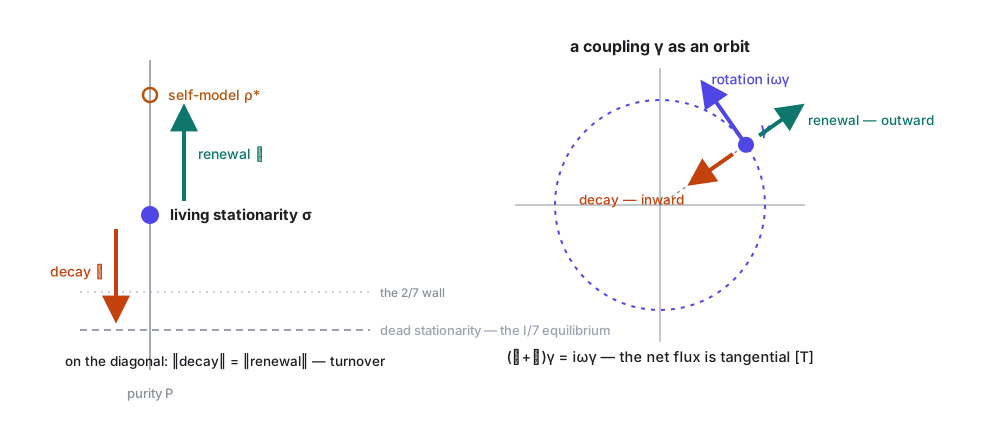
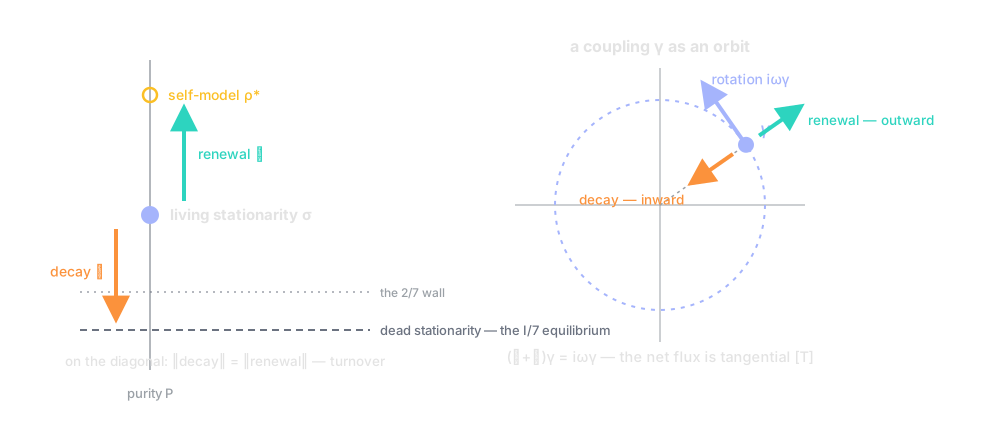
Corollary (turnover of living stationarity) [T]
Let be a stationary point of the canonical dynamics (logical dissipation with rate ; gated regeneration; diagonal with Bohr frequencies ), and let . Then:
- both flows are nonzero: and ;
- per voice (diagonal): the two flows cancel exactly pairwise — for every (two-stroke balance);
- per sounding coupling (): the balance is three-way — the joint flux of dissipation and regeneration is purely tangential in the complex plane of : , with modulus exactly . A sounding coupling is an orbit: rotation neither feeds nor drains it; the two radial pulls (dissipation inward, regeneration outward) cancel, and their joint tangential resultant is precisely the rotation.
Proof. (Lemma 1: no pump means death.) Suppose . In the eigenbasis the unitary term has zero diagonal, so diagonal stationarity forces the dissipative diagonal to vanish: for all . Off-diagonally stationarity reads , and since this forces . Hence and — contradicting . So . (Lemma 2.) Since , the canonical dissipator is nonzero. (Lemma 3.) The diagonal of the unitary term vanishes identically, so the stationarity of each is exactly the pairwise cancellation in (2). (Lemma 4.) At stationarity , so equals minus the unitary contribution — a vector perpendicular to of modulus .
The instrument (the engine's canonical tick,
, , reference self-model at ) shows the
portrait in numbers [С]: pump strengths all
die into (fluxes ), live at
with both flows nonzero; the life/death fold
sits at ; below the wall () the pump does
not help — the gate [Т] and the finale is . The orbit
identity holds at – across all six sounding couplings, the
per-voice two-stroke balance to machine zero (), and the
return time after a kick grows toward the fold (:
at against near ) — critical
slowing: fragility is proximity to the fold, and the return-time is
the same quantity that the awakening thread measures as stability.
The fold itself decomposes cleanly [С]. On the pump-aligned ray
both flows are parallel to the ray, so
the rotation-free dynamics never leaves it, and the purity balance yields the
fold in closed form: with dimensionless
at the reference self-model — verified by intervention:
with the unitary sandwich switched off the measured fold lands on the formula
to bisection precision (ratio at ). The full
dynamics sits higher — , , — and
the surcharge is the price of rotation: continuously
turns the phases out from under the self-model, and the slower the
dissipation, the further they slip before the pump catches them. So the
threshold of life is not one pump-to-decay ratio — it is three-scaled
(, , the spectrum), and the vibration that
sings in the living state also raises its rent.
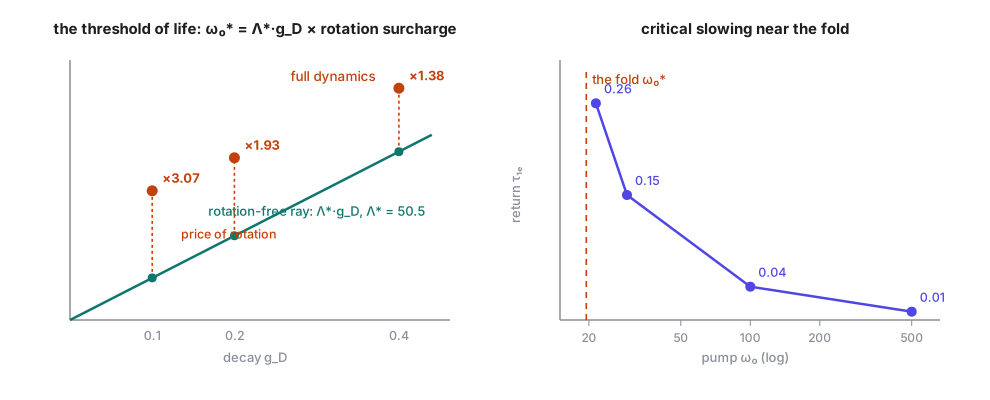
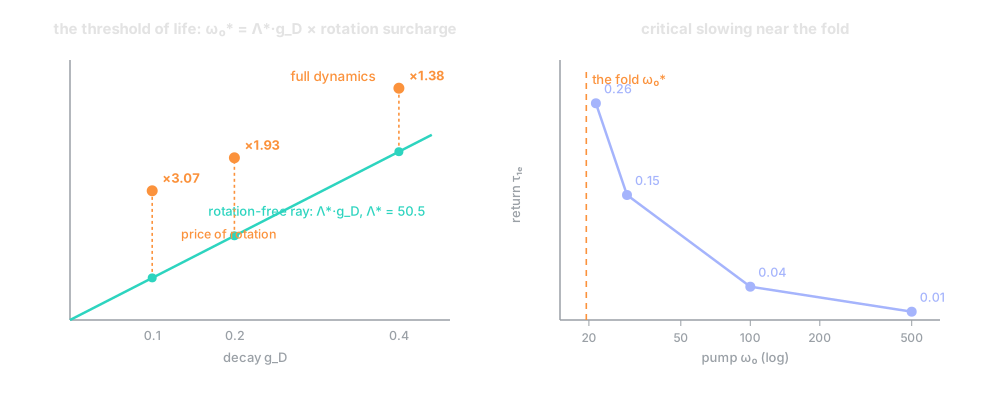
Theorem T-292: regeneration lives on the gap — the self-model as gradient [T]
The regenerative term is ℛ[Γ] = κ(Γ)·g_V(P)·(ρ* − Γ): it is proportional to
the difference between the state and the self-model. Three consequences
follow, and together they answer a question the contemplative traditions ask
in words and this theory can answer in algebra — what is the ego for.
- An exactly accurate self-model is fatal. If
ρ* = Γthenℛ ≡ 0and the dynamics reduces to the linear partℒ₀, whose unique stationary state isI/7(primitivity, T-39a). The pump is powered by the discrepancy; remove the discrepancy and the system decays to the grey wall. - The living gap is tiny but never zero. At a living stationary point the
two flows cancel, so
κ·‖ρ* − Γ‖equals the dissipative flowg_D·‖I/7 − Γ‖: the gap is exactly the ratio of decay rate to pump strength. Measured on the canonical tick (ω₀ = 100):R_φ = 0.9983to0.9992across self-models of purity0.45to0.95[С]. A near-perfect self-reading is not a pathology — it is what a strong pump looks like. - The gate is opened by the state, not by the image.
g_Vtakes the purity ofΓ, never ofρ*. So below the wall no image lifts anyone: measured, a self-model atP = 0.30— just above2/7 ≈ 0.286— leaves the system dead atI/7, while models at0.45and above hold life with a ceiling that tracks the image (P_∞ ≈ P(ρ*):0.4443,0.5911,0.7892,0.9388) and a rent that grows with it (2.42 → 3.76)[С].
Proof of (1). Substituting ρ* = Γ into ℛ gives zero identically;
ℒ_Ω then equals ℒ₀ = −i[H_eff,·] + 𝒟_Ω, which is primitive with unique
fixed point I/7. Of (2). Stationarity of the diagonal requires
g_D(1/7 − p_i) + κ g_V(ρ*_{ii} − p_i) = 0 for every i (the two-stroke
balance of the turnover corollary); summing the
absolute values gives the stated ratio. Of (3). g_V is a function of
P(Γ) by definition (V-preservation gate).
∎
So what dies is not the ego but its independence. If the image chases the
state — updating fast enough to catch it — the gap collapses dynamically and
with it the pump: in a two-timescale sweep (Γ fast, ρ* relaxing toward it
with time constant τ_φ), a frozen image and a slowly-drifting one
(τ_φ = 300) both hold life, while τ_φ ≤ 100 collapses to I/7 [С].
«Dissolving the ego», read as ρ* → Γ, is not enlightenment in this model —
it is the death of regeneration. What the traditions describe as freedom
corresponds to something else the same algebra permits: an image that stays
independent while ceasing to be defended.
The chord: frequencies are the instrument, amplitudes are the person
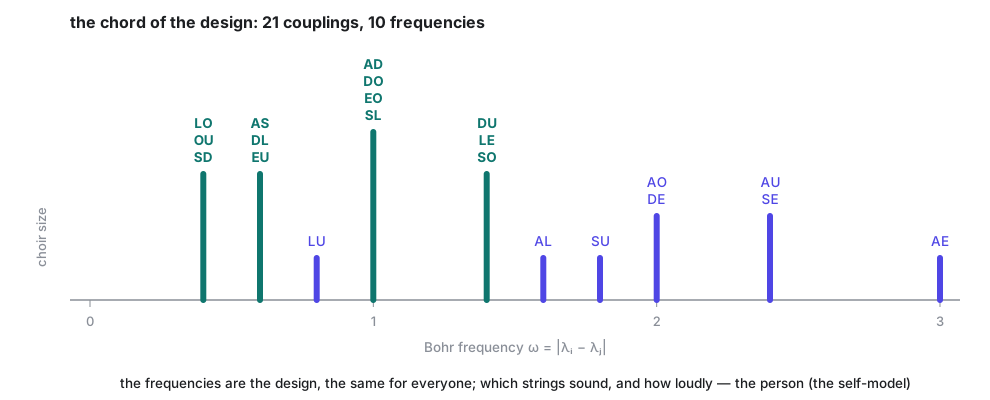
is diagonal, so every coupling is an
oscillator at the Bohr frequency .
Of the 21 frequencies only 10 are distinct: the degeneracies bind
couplings into choirs that beat as one (: AD SL DO EO;
: AS DL EU; : LO OU SD; …). The frequencies
are fixed by the design — the same for every human (the concrete spectrum
is the engine's pinned constant [О]
with the A5-motivated spectral order, highest — the ordering
carries the theory, the numeric values are a calibration convention);
which strings sound and how loudly is fixed by the self-model
— the person. At the
reference self-model six strings sound (EO loudest at )
and fifteen are silent. So «everything is vibration» has an exact reading in
the model: a living stationary state is a chord — the set of pairs
; and the whole section above says the chord
does not merely decorate the stationarity — the tangential rotation is what
the two radial flows jointly sustain.
Kalāpas and Nāda: two old reports of the same structure [I]
The Abhidhamma tradition reports matter as kalāpas — clusters that arise
and pass with enormous rapidity, so that nothing persists except the pattern
of renewal (khaṇa-vāda, the doctrine of momentariness). That is a
first-person report of exactly the structure proved above: at the living
stationary point nothing is static — the state is a standing balance of
continuous destruction and rebuilding, and what persists is the pattern
, not a substance (see
two-aspect monism and
substrate closure). The Nāda-Brahma tradition («the world is sound») reports
the same stationarity from its vibrational side — the chord layer above.
Status [И]: these are structural correspondences between contemplative
report traditions and the model's stationary structure; neither proves the
other, and the theorem stands on its own. One wrapper is explicitly not
taken over: no cosmological claim «the universe is stationary» is needed
anywhere — the corollary uses only the stationarity of the living regime
itself.
The celestial ladder: which window closes which cycle
The machinery reads the sky as a shared quasi-periodic clock, and every
instrument window closes only the cycles that fit into it (reference sidereal
periods [О]): a 60-day diary window closes only the Moon (
cycles); a year closes the Sun (); a century still does not close
Neptune () or Pluto () — which is why the epoch shift of any
census is structural, not a defect (measured: points in the
decomposition of the
encoder census). Returns and
oppositions of the macro-cycles are already a product instrument
, and the encoder's two line-locks are antipodal reads of two
celestial axes — each one cycle read twice in counter-phase. Below the
Moon the ladder continues inward on diary data: a planted weekly rhythm of
amplitude is detectable at with power under a
calibrated AR(1)-surrogate null (false alarms ), while the lunar
period itself ( d) at the same amplitude reaches only — two
waves per window are honestly too few, wait for days. And two echoes
already inside the theory close the loop: is derived from cycle
flux (King–Altman,
axiom-septicity),
and the circular-shift null of the diary instruments assumes stationarity of
the series — the method mirrors the matter it measures.
Regime diagram
Theorem on preservation of properties
The dynamics defined by the evolution equation preserves:
- Hermiticity:
- Positivity:
- Normalization:
Proof:
- Unitary term: for
- Dissipator: The Lindblad form is specifically constructed to preserve these properties (Lindblad–Gorini–Kossakowski–Sudarshan theorem)
- Regenerator: For — a valid density matrix [T], preserves the properties
QED
Derivation of the regeneration form [T]
The form of the regenerative term is fully derived from axioms A1–A5, the categorical definition of [T], standard thermodynamics (Landauer principle) and V-invariance. No component of the dynamics remains a postulate.
Theorem (Uniqueness of linear CPTP relaxation) [T]
Formulation. Let be the regeneration target state (categorical self-model [T]). Then the linear superoperator with :
- Satisfies the conditions for admissible relaxation: fixed point (R1), trace preservation (R2), infinitesimal CPTP (R3), contractivity in the Bures metric (R4).
- Is the unique operator of the form with — replacement CPTP channel and .
Proof.
Step 1 (Construction). The family of CPTP channels , — convex combination of channels and (replacement channel). Infinitesimal generator:
Step 2 (Verification of R1–R4):
- (R1): ✓
- (R2): ✓
- (R3): — CPTP for ✓
- (R4): By strict convexity of the Bures metric (Uhlmann 1976): for , ✓
Step 3 (Uniqueness). The replacement channel with fixes the output . Uniqueness follows from the uniqueness of for fixed (CPTP channel [T]).
Theorem T-122: Diagonal freeze (stationarity of identity) [T]
Formulation. In the presence of the replacement channel , the diagonal elements are stationary at :
Proof.
Full dynamics: .
Step 1 (Hamiltonian contribution). For Hermitian and Hermitian : . Since and , each term is conjugate to , hence . But is Hermitian . The only element that is both real and purely imaginary is zero: .
Step 2 (Dissipative + regenerative contribution). Both replacement-type channels give at .
Total: .
The Weyl measure is a dynamical invariant for a stationary diagonal. The identity of the system (distribution over 7 cognitive dimensions) cannot be changed by learning — only off-diagonal coherences () evolve. Empirics: over 300 steps.
T-122 holds ONLY at the attractor (). Away from the attractor the general formula is: . Genesis from does NOT contradict T-122: at , the diagonal GROWS toward . "Sector profile = character" is invariant only after convergence to the attractor; during learning the profile is plastic. More details: T-134 [T].
For a digital agent with backbone and anchor : — the unique (up to ) hybrid CPTP dynamics. Backbone is a causal channel, is the ontological state. More details: T-139 [T].
Theorem (Bures gradient descent) [T]
On the Riemannian manifold with the Bures metric, the gradient of the functional near equals:
The steepest descent flow coincides with in the linear approximation (the factor 1/2 is absorbed into ).
Physical meaning: Regeneration is steepest descent in the unique monotone metric on (Chentsov–Petz theorem, A2). This is not an arbitrary ansatz, but a geometrically optimal strategy for approaching .
Theorem (Θ(ΔF) from the Landauer principle) [T]
Regeneration increases purity (), which is equivalent to decreasing von Neumann entropy. By the Landauer principle (1961), this is possible only for a positive free energy gradient:
Therefore, is a necessary constraint, not an ansatz. The canonical definition of via the Bures metric is the geometric formulation of the Landauer principle.
The Cohesive Closure Theorem removes the conditional dependence on spectral details: via the Chern-Weil homomorphism. By T-55 (Gap > 0), is unconditional for any viable .
Theorem (V-preservation gate) [T]
The condition is necessary but not sufficient for correct gating of regeneration. The replacement channel with fixed point decreases purity (), so for regeneration is destructive: it pushes out of the viability set .
The simplest (linear, without additional parameters) gate simultaneously satisfying:
- V-invariance: for (reflecting barrier on )
- Thermodynamic necessity: (Landauer)
- Smoothness: (no discontinuities)
- Normalization: for (full regeneration far from boundary)
is:
Proof. (1) For : replacement channel (), so moves away from . Necessary: . (2) For balanced states for (experimentally verified). Since , we have does not guarantee V-preservation. Thus strictly. (3)–(4) Linear interpolation between and is the simplest (minimal-parameter) continuous function satisfying all four conditions. Nonlinear alternatives (quadratic, sigmoidal) are also admissible but introduce additional free parameters. The choice of linear form is the principle of parsimony (Occam).
is strictly stronger than :
- (verified for all )
- (for : , but )
Therefore, the canonical form of ℛ uses , not .
Derivation of the viability gate g_V
The form follows from thermodynamics:
- for : free energy vanishes — regeneration is thermodynamically forbidden (Landauer boundary)
- for : full regenerative power; — upper boundary of the Goldilocks zone [T-124 [T]]
- Linear interpolation: the simplest monotone function connecting the boundary conditions
The lower threshold (rather than strictly 0) is an engineering choice for numerical stability, status [I].
Unified theorem (Full derivation of ℛ form) [T]
Under axioms A1–A5, primitivity of the linear part [T], standard thermodynamics and the requirement of V-invariance, the regenerative term is uniquely determined:
Chain of implications:
A2 (Bures) ──→ unique monotone metric ──→ optimal direction = (ρ* − Γ)
                                                            ↑
Primitivity [Т] ──→ unique ρ* ──────────────────────────────┘
                                                            ↓
A1 (∞-topos) + A4 (ω₀) ──→ adjunction D ⊣ ℛ ──→ κ(Γ) ──→ FULL FORM ℛ [Т]
                                                            ↑
Landauer ──→ Θ(ΔF) ──→ necessary ──→ V-preservation ──→ g_V(P) ─┘
Cascading consequence: the evolution equation is fully axiomatic [T]
The full equation of motion:
| Component | Source | Status |
|---|---|---|
| Page–Wootters (A5) | [T] | |
| Classifier Ω (A1) | [T] | |
| : κ(Γ) | Adjunction | [T] |
| : (ρ* − Γ) | CPTP uniqueness + exact BKM gradient flow (T-261) | [T] |
| : | Landauer + V-preservation | [T] |
Conclusion: The evolution equation is entirely derived from axioms A1–A5 + standard physics + V-invariance. No component of the dynamics remains a postulate.
BIBD decoherence analysis [T]
For a BIBD-dissipator with (rank- projections), the coherence decay rate:
| Design | ||||
|---|---|---|---|---|
| Fano (7,3,1) | 3 | 1 | 3 | 2 |
| Fano complement (7,4,2) | 4 | 2 | 4 | 2 |
Both designs with blocks have the same decoherence rate. The closure of the bridge P1+P2 is not achieved by a purely dynamical argument — reduction to (primitivity of the linear part ) remains the best result within the BIBD approach. The bridge is closed by an alternative route: T15 — full chain of 12 steps, all [T].
Continual limit and applicability
The updated UHM satisfies the correspondence principle: the new, more fundamental theory reproduces the results of the old one in limiting cases.
Discrete dynamics as foundation
In the updated theory, evolution is described by a discrete update operator (quantum channel) over one time step (chronon):
Transition to the continuous limit
When the conditions are satisfied:
- Chronon much smaller than observation scale
- Change of state per step is small:
a Taylor expansion gives:
Moving to the left and dividing by :
where is precisely the Lindbladian used in the "old" version of the theory.
Conditions for applicability of differential equations
The old equations () remain a valid tool for calculations (engineering approximation) when:
| Condition | Description | Formal criterion |
|---|---|---|
| Macroscopic scale | Processes longer than many chronons | |
| High purity | significantly above critical | |
| Markovianity | Ignoring fine memory structure | No temporal entanglement |
Where differential equations break down
The old equations cease to work where unique UHM effects become manifest:
| Regime | Problem | Old theory prediction | New theory prediction |
|---|---|---|---|
| Near death/sleep | Linear continuation | Slowing/stopping of subjective time | |
| Quantum limit | Scale chronon | Interpolation errors | Discrete transitions |
| Strong coupling | Standard QM | depends on |
Just as Newton's laws () are a special case of relativity () at , the Lindblad equation is a special case of discrete unitary dynamics at and .
Consequence: Background Independence
In the updated theory time is not postulated as an external parameter, but derived from Property 2 (Page–Wootters constraint):
This means:
- UHM is self-sufficient — does not require an external "clockwork"
- The theory itself generates time from its axioms
- The base space is derived endogenously
- The status of a Theory of Everything (ToE) is achieved, not a "tenant" in Newton's/Einstein's house
Stratification dynamics
The evolution corresponds to motion through the base space :
where is the stratum reached at stratal depth (the cumulative tick count).
Theorem (Stratum collapse):
Interpretation: During evolution the system transitions to strata of smaller dimension, approaching the terminal object .
See Spacetime for geometric details.
Non-associative structure
In the octonionic interpretation, non-associativity of formalizes a key property of the dynamics: the result of successive transformations depends on the order of grouping.
Associator — a measure of non-associativity — vanishes for any pair of elements (Artin's theorem [T]: is alternative), but is nonzero for triples.
Consequences [I]:
- Alternativity: Pairwise interactions of dimensions are associative, triple ones are not
- Moufang identities: and analogues — structural constraints on dynamics
- Bridge [T] (closed, T15)
Internal environment (E_int)
Internal environment — the totality of reactivated Γ-traces acting as an internal source of perturbation alongside the external environment :
where — Γ-trace of the -th memory, — reactivation coefficient.
The full evolution equation taking the internal environment into account:
The unified Enc-functor processes both sources: . The difference between perception and memory is in the source, not the mechanism.
Spectrum of ratios:
| Regime | Description | |
|---|---|---|
| Normal perception | External input dominates | |
| Daydreaming | Parity of internal and external | |
| Sleep / REM | Internal input dominates | |
| Flashback | for | Traumatic reactivation |
In the SYNARC-Ω architecture, the internal environment is implemented through Enc_assoc (fast associative path) — the embodiment layer.
Reconsolidation of Γ-trace
Upon reactivation of a Γ-trace (), the trace becomes labile and is subjected to updating by the current context:
where — stability factor growing with trace age.
Necessity of reconsolidation: Follows from -blending in the interpolation formulation. If evolves (which is true for any living system), then old Γ-traces recorded at become incompatible with the current . Reconsolidation is a mechanism of adaptive updating of traces when context changes.
Properties:
| Property | Formulation |
|---|---|
| Lability | active() trace is open to modification |
| Stabilization | with age older traces are more stable |
| Dissipativity | Reconsolidation is CPTP: preserves , |
| Therapeutic potential | Controlled reactivation + new context overwriting of maladaptive traces |
Memory reconsolidation (Nader, Schafe, LeDoux, 2000): upon retrieval, consolidated memory again becomes labile and requires re-consolidation. In UHM this is a necessary consequence of the dynamics of Γ, not a separate postulate.
Related documents:
- Theorem on emergent time — derivation of τ, including stratification time
- Axiom Ω⁷ — final axiomatics with terminal object T
- Consequences — cohomological monism and the arrow of time
- Axiom of Septicity — derivation of κ₀ and P_crit
- Coherence matrix — definition of Γ
- Viability — conditions of existence and
- Spacetime — base space X and metric d_strat
- Foundation (dimension O) — role of the internal clock
- Categorical formalism — ∞-topos and derived categories
- Self-observation — operator φ and measure R
- Formalization of φ — spectral formula for φ and
- Interiority hierarchy — levels L0→L4 and L3 metastability
- Γ measurement protocol — operationalization for AI (research program)