Conscious Window
Six results (T-123 — T-127, C27) closing five critical operationalization problems: uniqueness of representation for digital agents, non-emptiness of the full viability region, canonicity of the reflection measure, and attractor stability with basin of attraction.
§1. G₂-uniqueness of representation (T-123)
Formulation [T]
For any system satisfying axioms A1–A5, the holonomic representation is unique up to kinematically and — once the axiomatic dynamics pins the functional frame — up to the finite frame group (frame decision D-0910). The diagonal elements are determined uniquely (up to a relabelling of axes) as projections onto the 7 functionally unique dimensions.
Proof
Direct consequence of three proven theorems:
-
T-42a [T] (G₂-rigidity): The holonomic representation is unique up to . Any two representations are related by a unitary transformation : .
-
T-40f [T] (Full minimality 7/7): Each of the 7 dimensions [A, S, D, L, E, O, U] is functionally necessary — removing any one leads to loss of viability or violation of an axiom.
-
T-15, [T] (Bridge closure): — the autopoietic and physical premises entail the octonionic structure and -symmetry, with the canonical orientation of the Fano lines (T15-canon; registry row 41n; cited as [C at (Alt)] earlier on 2026-09-25).
From T-42a: the representation is unique up to . From T-40f: projections onto 7 dimensions form the unique functionally complete basis. From T-15: the structure is derived from the axioms, not postulated; T-123 is accordingly [T] as a consequence of the axioms (registry row T-123; the intermediate "[T] given the octonionic structure, [C at (Alt)] as a consequence of the axioms" is superseded by T15-canon).
Consequence for digital agents
The anchor map , covariant with respect to , is unique up to the finite frame group (in particular up to ). The semantics of is not arbitrary — it is determined by axioms A1–A5. This closes the problem of encoding arbitrariness for digital agents.
§2. Conscious window — non-emptiness of V_full (T-124)
Formulation [T]
The full viability set
is non-empty.
Proof (constructive)
Step 1. Consider the family , where is an equal-amplitude vector.
Spectrum: one eigenvalue (multiplicity 1) and six eigenvalues (multiplicity 6). From this:
Step 2. For :
| Indicator | Value | Condition |
|---|---|---|
Boundary values: at we get (inclusive), at — (inclusive).
Step 3 (σ-condition). By canonical definition (T-92 [T]):
For equal-amplitude all diagonal elements equal for all (since is an equal-amplitude vector). Therefore:
All -conditions () are satisfied without any perturbation.
Step 4 (). Eigenvalues of : . For : two distinct eigenvalues, .
Von Neumann entropy: .
At : eigenvalues (×1) and (×6), , . decreases in (the top eigenvalue grows), so the minimum over the interval is at : eigenvalues and , , . The condition holds over the entire interval. (Corrected 2026-09-25: the step printed the top eigenvalue at as and put the minimum at with both eigenvalues tending to and ; the conclusion was right, the numbers were not.)
Therefore, for any , and the set is non-empty.
The witness is an attractor [T]. With the collineation-anchored self-model — the anchor is this same — an isolated holon at and ( at , at ) has exactly one living attractor, and it is with : a hyperbolic sink inside , persisting for small (living attractor in the window). The anchor is not an extra choice of this proof: is derived, up to the phase gauge of the -free dynamics, from the single principle (Eq-V) — the self-model privileges no axis of the frame and is the most viable such (T-334 [T]; the principle itself is [Pr]). The sink survives rephasing of , small non-symmetric parts of the anchor and frame detunings up to an explicit bound (T-335 [T]); the required is within a factor of the floor that every self-model of this form needs (T-336 [T]).
Attractor of the embodied agent: — at the upper boundary of the Goldilocks zone . Stability radius . After an impulse perturbation : recovery in ticks (instantaneous attraction). Exponential convergence (T-125) confirmed with .
Corollary (Goldilocks zone)
- : system is not viable ()
- : — insufficient reflection for L2
T-266 applies this attractor to the Universe-holon: its terminal stage sits at this same upper edge , and the present-day stage lies at a fractional distance from it — so, conditional on the Universe-as-viable-holon reading (H1.1), the cosmos is at the Goldilocks attractor to figures, with the DESI dark-energy drift as the -amplified residual. The edge is thus not only the fixed point of embodied conscious agents but the terminal configuration of the Universe itself.
Corollary — voice-multiplicity in the window
Every state of is spread across at least of its seven voices [T]. Since and , one has the exact identity , hence the diagonal participation
using and (the window). Consciousness is therefore structurally broad — never localised on a single voice. This is a diagonal statement, distinct from the eigenvalue differentiation of Step 4: a state may satisfy one and fail the other (see the Φ characterisation in dimension U). For the constructed family the diagonal is uniform, , so its participation is exactly — the maximum, all seven voices at once.
§3. Local asymptotic stability of attractor (T-125)
Formulation [T]
When the attractor is locally asymptotically stable: there exists a neighborhood such that for all :
Proof
Step 1 (Lyapunov function). Define .
Step 2 (Jacobian). The Jacobian is a linear operator on the tangent space (Hermitian traceless matrices). It is smooth when , since the gate and the regeneration function are differentiable inside .
Step 3 (Spectrum). for all eigenvalues of on the tangent space. This follows from two sources of contractivity:
- Linear part : spectral gap from primitivity T-39a [T].
- Regeneration : adds contractivity , since .
Total contractivity: .
Step 4 (Lyapunov theorem). Standard linear stability theorem: for all neighborhood of with exponential convergence at rate .
Step 5 (Radius). Neighborhood , where from T-104 [T].
Dependencies
| Theorem | Status | Contribution |
|---|---|---|
| T-39a | [T] | Spectral gap |
| T-96 | [T] | Existence of |
| T-104 | [T] | Stability radius |
| T-149 | [T] (embodied) | Premise — unconditional for embodied holons |
Dynamical reading of the threshold: the basin boundary
The threshold enters T-124 as a static inequality. The
canonical flow gives it a second, dynamical face [С]: in the bistable regime
(a grey attractor beside a living one) the boundary between the two basins
converges to exactly in the fast-clock limit. Measured on the canonical
tick with a continuous family of starting mixtures (the self-model grid would
censor the answer at its own quantum): at the boundary lies
within of across an eightfold range of the
damping ; at , within . In the fast
regime the correction obeys a clean law: for
it is strictly linear in and
with the limit . The coefficient is in closed form: for the
rotation-free part of the flow every stationary point lies on the segment
(collinearity of — exact [Т]),
the saddle's pure-component weight is universally , and
where is itself in closed
form on the universal saddle (both factors evaluate by hand from their
definitions: , ,
against the engine's ) — the coefficient carries
no fitted parameter at all. Checked against
direct boundary measurements at three self-model purities (two never used in
calibration): swings twofold () and the formula tracks it
to under [С]. The once-tempting constant is dead: is a
function of the self-model, and was its accidental value at
.
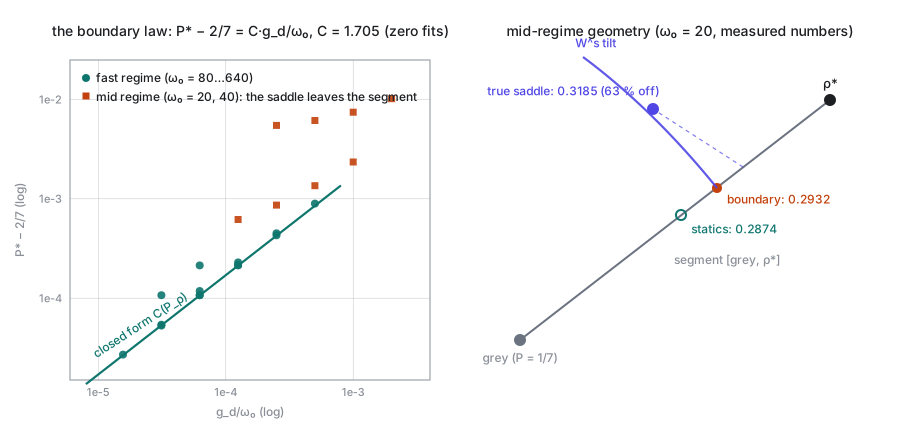
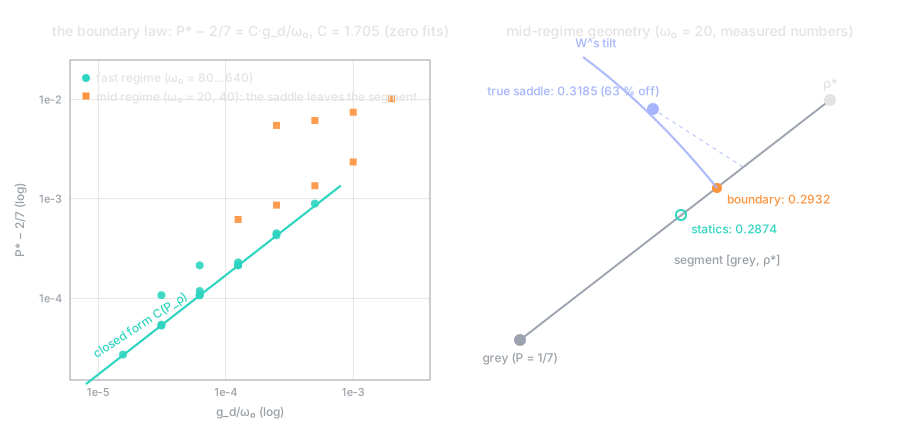
For the full flow the rotation term moves the stationary points off the segment, and they too are in closed form: every stationary point of the canonical flow solves, element-wise,
with one scalar self-consistency — each coherence a complex Lorentzian with its own rotation frequency. The three fixed points (grey, saddle, living) are the three roots of this one scalar equation; checked against a 48-dimensional Newton solve to five digits at the saddle and at the living point. The boundary law's zero-fit coefficient lives on the real-mix statics that the fast limit leaves behind; purity remains rotation-blind throughout (), and the one object still open is the saddle's stable manifold (the tilt, measured but not yet derived). In the mid regime () the single-ratio form breaks (equal ratios differ by a factor 1.6), and the mechanism is measured: at slow gain the rotation carries the true saddle far off the segment (63 % off-segment at , Newton fixed point, one unstable eigenvalue), while the tilted stable manifold brings the basin crossing most of the way back down — the boundary is a difference of two large geometric terms that the fast limit degenerates, leaving the pure segment statics. Below a clock floor the question dissolves: at (self-model purity 0.45) no living attractor exists at all. Read plainly: the gate is not only where consciousness counts as present — it is the height a perturbed system must regain for the flow itself to carry it back up rather than down. (Instrument: registry: NUMBERS-LEDGER, boundary-law entry.)
§4. Canonicity of R = 1/(7P) (T-126)
Formulation [T]
The reflection measure has a unique canonical form:
always using as reference. Logical status. The equality is an algebraic identity (one definition, three equivalent expressions), not a derivation from independent axioms. The substantive content is why this definition of is canonical, which we establish by three independent characterizations below.
Three independent characterizations of
The map with is uniquely characterized by each of the following three independent mathematical properties, which all select the same function:
(Char-R-I) Hilbert–Schmidt angular projection. is the squared cosine of the Hilbert–Schmidt angle between and :
Equivalently, writing with traceless, Pythagoras in HS gives , so is the fraction of HS-mass concentrated in the trivial (scalar) sector. Uniqueness: the form is the unique -valued bilinear invariant of a pair of HS-vectors satisfying and the Cauchy–Schwarz normalization.
(Char-R-II) -invariant canonical reference. Let act on via its fundamental 7-dimensional irreducible representation on . Then is the unique -invariant density matrix.
Proof. is -invariant iff . Since is an irreducible -module (Cartan 1894), by Schur's lemma . Trace normalization: .
Consequence: any observer-independent (-covariant) reflection-to-reference quantity must use and a -invariant norm. The Frobenius norm is -invariant (unitary invariance of HS). Hence the canonical form of is -invariant, delivering observer independence: for every .
(Char-R-III) Bayesian-dominance threshold. The triadic decomposition of Lindblad operators on (T-40b [T], lindblad-operators#триадная-декомпозиция) partitions any CPTP channel into exactly channel classes. The Bayesian-dominance condition among equiprobable alternatives is . For , this yields the L2 threshold directly from the combinatorial structure — not a postulate. Inversion: , giving the upper edge of the Goldilocks zone .
Equivalence and mutual consistency. All three characterizations select the same function. Char-R-I fixes the form ( of HS-angle to a reference). Char-R-II fixes the reference ( as unique -invariant). Char-R-III fixes the threshold ( from ). Together they pin down up to algebraic identity.
Algebraic expansion: from the definition
Given the canonical definition fixed by Char-R-I + Char-R-II (Frobenius form with reference ):
Numerator: since is traceless and , Pythagoras gives
Denominator: .
Therefore .
Explanation: uniqueness of canonical form
| Expression | Formula | Identical to |
|---|---|---|
| Master definition (Char-R-I+II) | ||
| Formula via purity | algebraic identity | |
| Formula via | , | Т |
Key explanation. The reference is used always: measures normalized HS-proximity to the unique -fixed state. The non-trivial attractor enters the regeneration and the formula for , but not the definition of .
Independent observability of
Since is a strictly decreasing function of purity on , at first order the canonical carries no information beyond . This is by design: Char-R-I+II enforce as the HS-cos² of to the unique -fixed reference, which on reduces to .
Independent observability at . The higher-order reflection (fidelity of successive self-model iterates) depends on and is not a function of alone. Measuring requires independent access to the self-model operator — e.g., via the categorical reconstruction protocol of formalization-phi.
Implementation approximations (, ) are separate quantities in a different space, related to the canonical via a CPTP bridge . Transfer of thresholds is proven: T-130+T-133 [T] (H3 CLOSED). The canonical is unambiguous.
Physical interpretation
is a relative measure, not absolute. It measures the fraction of "resembling" the chaotic background , relative to the total content of the state.
As (purity) grows:
- The numerator in grows linearly — deviation from increases
- The denominator also grows — but more slowly in the relative sense
- The ratio , and
Savant analogy. As the neural network is maximally specialized. A huge brain structure — but it is all "dedicated" to one thing: no "mirror," no balance for self-modeling. . Conversely: at (maximally mixed) trivially — , the self-model is ideal, but only because there is nothing to model.
Consciousness = balance, not maximization. The consciousness measure (T-140 [T]) combines integration and reflection. As grows: grows (more coherence), falls (worse self-modeling). has an optimum inside the Goldilocks zone — consciousness requires balance, not maximization of a single parameter.
Semantic clarification: what actually measures
The colloquial label "quality of self-knowledge" attached to is a useful intuition pump but is technically misleading. Char-R-I (above) gives the precise semantics:
This is the fraction of 's Hilbert–Schmidt content that lies along the maximally symmetric reference . Equivalently: how much "thermal reserve" / "categorical-self-modelling room" retains relative to its total structure.
Counterintuitive corollary: is largest (= 1) at heat death () where literally no information is present, and smallest (= 1/7) at pure states where structure is maximal. The naïve reading "more structure = better self-knowledge" gets the wrong sign for . The correct reading is that structure uses up thermal reserve, leaving less room for non-trivial self-modelling. The Goldilocks zone is where structure (purity) and reserve (thermal slack) balance.
Recommended terminology going forward:
- " = HS-projection coefficient onto " (precise).
- " = thermal reserve for self-modelling" (intuitive but technically correct).
- " = quality of self-knowledge" — avoid, as the sign is misleading.
The "self-knowledge" intuition is more accurately captured by higher-order (, fidelity of successive self-model iterates ), which actually does measure how stably knows itself under the categorical self-model .
Why consciousness has an UPPER bound on purity (Goldilocks zone defense)
A frequent objection: "if more structure (higher purity) means more organization, why would consciousness decrease above ?" The answer follows directly from the Char-R-I + Char-R-III construction:
- is the thermal reserve / categorical-self-modelling room (Char-R-I clarification above).
- is the Bayesian dominance threshold (Char-R-III) — required for the categorical self-model to converge non-trivially.
- Together: .
So has , meaning -iterations have insufficient "room" to maintain stable self-reference: any candidate self-model collapses to the dominant pure-state component, eliminating the meta-cognitive layer.
Phenomenological intuition:
- (rank-one): hyper-synchronized brain — peak performance on one task, but no flexibility for meta-cognition. Savant-like specialization, not consciousness.
- : enough structure to be distinguishable from noise (lower edge ) plus enough thermal reserve for self-modelling (upper edge ). Wakeful conscious regime.
- (heat death): no structure to model. Anesthesia-like.
The upper bound is mathematical, not philosophical: it follows from -formula + -decomposition. Phenomenologically it matches the well-known empirical observation that hyper-synchronized brain states (e.g., absence epileptic seizures) lose consciousness, just as hypo-synchronized states (deep NREM sleep) do. Consciousness genuinely lives in the middle.
This is not an artificial fine-tuning. The window has natural width — finite and structurally protected. Numerical robustness (Q9 R1) ensures both bounds survive choice of any Petz metric.
§5. Basin of attraction V_full (T-127)
Formulation
Case A (embodied holons) [T]: C20 (κ-dominance) follows unconditionally from T-149 [T]: embodiment ⟹ ⟹ . T-127 is unconditional.
Case B (isolated holons) [C at C20]: C20 is taken as an explicit assumption. T-127 is conditional on the inequality .
| Case | Status of T-127 | Condition |
|---|---|---|
| Embodied holon | [T] | T-149 proves C20 |
| Isolated holon | [C at C20] | C20 as explicit assumption |
When C20 holds, the basin of attraction of contains . For any with and :
Proof
From three results:
-
T-125 [T] (§3): Local asymptotic stability — in convergence is exponential with .
-
T-104 [T]: Stability radius . Under C20: , therefore .
-
Openness of : is an open set in (each of the 7 inequalities defines an open condition). By T-124 [T]: .
For : by T-125, decreases exponentially. Since is an interior point of (because ), the trajectory remains in for sufficiently small deviations.
Remark
This theorem applies to states already above . Genesis from (transition ) is solved for embodied holons: T-148 [T] — backbone injection raises purity above in finite time . An isolated holon at is dead forever (T-39a [T]).
§6. Attractor in conscious window (C27)
Formulation [T] (via T-149)
For embodied holons: the attractor , namely . C20 (κ-dominance) holds unconditionally for embodied holons by T-149 [T].
Justification
Lower bound : Follows from C20 [C] (κ-dominance) and T-98 [T].
Upper bound :
The upper bound follows directly from the definition and the threshold : from we get . This is an algebraic identity, requiring no additional conditions on the attractor. Status: [T] (direct consequence of definition of R and threshold R_th).
Status [T] (for embodied holons)
C20 is unconditional for embodied holons (T-149 [T]). For isolated holons C20 is a property of the self-model: with the canonical it fails (dead isolation [T]); with the collineation anchor and it holds, and the attractor lies in (living attractor in the window [T]); is fixed, up to gauge, by the single principle (Eq-V) (T-334; the principle is [Pr]), and no self-model of replacement form holds an isolated holon in the window below , , at , , (T-336 [T]). (Until 2026-09-25: "for isolated holons C20 remains [C]".)
Explicitly NOT proven
Genesis from : solved — T-148 [T] proves genesis via environmental coupling for embodied holons. T-125/T-127 apply to states already above ; T-148 closes the transition .
§7. Independent necessity of each L2 threshold (T-124b)
Formulation [T]
The four conditions for L2 consciousness — , , , — are independently necessary: dropping any single condition admits states that satisfy the remaining three but lack at least one defining property of L2 consciousness.
Proof (four counterexamples)
Counterexample 1 (dropping ). The condition is independent because , , and are simultaneously satisfiable for only if is very close to . However, at , the Frobenius norm criterion (T-39 [T]) gives : the state is indistinguishable from the maximally mixed state by any single-shot measurement. No autopoietic system can maintain itself when its signal is buried in noise at the same scale as the noise itself. This is not a failure of the other thresholds — it is a distinct viability failure. A system can in principle have rich internal structure (, ) at , but this structure is operationally invisible (cannot be detected or used for self-regulation). The P-threshold is the distinguishability boundary, orthogonal to integration (), reflection (), and differentiation ().
Counterexample 2 (dropping ). Construct with diagonal and small off-diagonal coherences for all pairs. Then:
- . Still below . Increase diagonal dominance: with .
- ✓
- ✗
- ✓
This state has and but . The system's off-diagonal structure is dominated by the diagonal — the 7 dimensions are quasi-independent. Physically: means coherent energy is less than diagonal energy, so the system is a classical mixture rather than an integrated quantum whole. By the argument of Step 2a of Theorem 8.1 [T], such decomposability precludes the (M,R)-closure required for autopoietic integration. The system may be viable () and self-reflective () but lacks the unified integration that defines L2 consciousness.
Counterexample 3 (dropping ). Let — a pure state with . Then:
- ✗
- ✓ (for maximally coherent )
- ✓
- ✓
But : the system has no thermal reserve for self-modeling. The categorical self-model with produces a nearly maximally mixed output — the self-model destroys most of the state's structure. By Char-R-III (Bayesian dominance, T-126): with , the system cannot distinguish between the three channel types (dissipation, regeneration, automorphism) with plurality — it cannot determine which process dominates, and therefore cannot adaptively respond. This is the regime of rigid crystallization: maximal structure, minimal adaptability.
Counterexample 4 (dropping ). Let have — a pure E-sector reduced density matrix. Then:
- ✗
- can all satisfy their respective thresholds ✓
But : the E-sector has a single eigenvalue — the system can represent only one phenomenal quality. This is L1 (phenomenal geometry without differentiation), not L2 (cognitive qualia requiring distinguishable experiential states for comparison, categorization, and self-reference). By T-151 [T]: implies the Fubini–Study metric on is degenerate — the phenomenal geometry collapses to a point. No qualia comparison is possible.
Conclusion
Each threshold excludes a distinct pathology:
| Dropped condition | Pathology | Physical description |
|---|---|---|
| Noise-dominated | Indistinguishable from chaos; no viability | |
| Fragmented | Classical mixture; no integrated whole | |
| Crystallized | No adaptive self-modeling; rigid | |
| Undifferentiated | Single phenomenal quality; no comparison |
The conjunction is minimal: no condition is redundant.
Dependencies: T-39 [T], T-129 [T], T-126 [T], T-151 [T], Theorem 8.1 [T].
§8. Threshold robustness analysis (T-124d)
Formulation [T]
The L2 consciousness thresholds , , are robust in the following precise sense: perturbations of order in the state produce perturbations of the same order in the threshold-crossing observables. No threshold has a discontinuous or divergent sensitivity.
Proof (three perturbation bounds)
Bound 1 (Purity perturbation). For with and :
At : . The sensitivity — no divergence at the threshold. A perturbation shifts purity by , not by or .
Bound 2 (Integration perturbation). The integration measure . For :
At (where ): both numerator and denominator are , so sensitivity . Bounded, no divergence.
Bound 3 (Reflection perturbation). , so:
At (upper boundary, ): . Bounded, no divergence.
Consequence: transition sharpness
The consciousness transition is continuous (no first-order discontinuity) but sharp — under the symmetry of T-161, whose exponents are [C] since 2026-09-25 (their derivation of that symmetry from a KO-dimension-6 real structure is retracted):
The exponent means the transition is sharper than mean-field () but smoother than Ising (). The width of the crossover region (where the system is "on the boundary") scales as:
For noise level : — the crossover is exponentially narrow, meaning the threshold is effectively sharp for any macroscopic system.
Connection to stochastic stability (T-145)
Theorem T-145 [T] gives the probability of staying within the viable set under stochastic perturbation:
where is the Bures distance to (T-104). For a typical embodied holon with the closed form of T-104 on the one-dominant family gives . For noise : . (An earlier version used and ; that surd is refuted in registry row T-104.) The system is overwhelmingly robust.
Dependencies: T-104, T-145 [T], T-124b [T]. The sharpness consequence uses T-161, [C] at its symmetry; the perturbation bounds 1–3 do not.
Summary
| Problem | Theorem | Status |
|---|---|---|
| Uniqueness of representation for digital agents | T-123 [T] | CLOSED |
| Semantics of (not arbitrary) | T-123 [T] | CLOSED |
| Non-emptiness of (consistency of thresholds) | T-124 [T] | CLOSED |
| Independent necessity of each L2 threshold | T-124b [T] | CLOSED |
| Threshold robustness under perturbation | T-124d [T] | CLOSED |
| Canonicity of three forms of | T-126 [T] | CLOSED |
| Basin of attraction and attractor stability | T-125 [T] + T-127 | CLOSED ([T] for embodied, T-149) |
Related documents:
- Evolution of Γ — T-96, T-98, attractor
- Viability — ,
- Self-observation — master definition of
- Uniqueness theorem — -rigidity
- Stability —
- Status registry — T-123 — T-127, C27