HomoHoloGraph: the coherent life navigator
Status frame. This page documents an engineering research program, not new theorems. Every claim carries one of three honesty classes: VERIFIED (computed fact about the machinery or astronomy), DESIGN (self-consistency of an engineering choice — true by construction, demonstrated, not evidence about humans), OPEN (needs human data; the n-of-1 protocol exists for exactly this). The center→dimension dictionary itself is an [I]-dictionary: structured, configurable, and testable — never a fact.
1. The idea: from bodygraph to homogram
Human Design, dissected earlier, turned out to be three layers: a real clock, real hidden combinatorics, and a storyteller whose bridge to human fate is supported by nothing. HomoHoloGraph keeps the first two layers, replaces the storyteller with a computational model, and gives the user the instruments to test that model on themselves.
The object is no longer the bodygraph. It is the homogram — the person's holonic record in the UHM state space: a prior over the seven dimensions with the theorem-forced 21-coherence wiring (T-224: seven is the unique self-diagnosing alphabet), plus derived profiles. The natal chart is one sensor — valuable because its input (birth date, time, timezone) is universally available and its computation is exact. It is a prior, not a verdict: the filter layer updates it from observation, and observation always outranks nativity.
2. The bridge dictionary (an [I]-dictionary, structured)
HD's own taxonomy splits the nine centers into two pressure centers (Head, Root) and seven processing centers. That split is the hinge of the bridge: seven processing centers map to the seven dimensions; the two pressure centers are not populations but drive ports — where the environment pumps supply into the pattern.
| center (HD function, literal) | dimension | reading |
|---|---|---|
| Throat — manifestation, speech | A Articulation | to distinguish, to express |
| Splenic — survival-now, immune system | S Structure | to hold form |
| Sacral — life force, work, response | D Dynamics | to move, to process |
| Ajna — conceptualization | L Logic | to reconcile |
| Solar Plexus — emotion, the wave | E Interiority | to experience |
| Heart/Ego — will, promises, resources | O Ground | to root, to provision |
| G — identity, direction, love | U Unity | to gather into one |
| Head, Root — the two pressure centers | κ-ports | the tyaga (drive profile) |
A structural bonus falls out at once: the defined pressure channels feed only L (from Head) and D, S, E (from Root). Articulation, Ground and Unity have no direct pressure line — they are supplied through internal coherences only. VERIFIED (a property of the channel table).
3. The encoder
For an activation set (Design, Personality, or their union), with for the two lights (Sun/Earth) and otherwise:
Populations — activated processing gates, channeled at full weight, hanging at half:
Coherences — each defined channel between processing centers contributes a phase quantized by its two line values:
then Hermitize, project to the PSD cone, normalize the trace. Channels touching a pressure center contribute to the tyaga instead.
Three states come out of one chart: (the pattern), (the mind's self-map), (the body imprint). Two derived quantities have no analogue in any bodygraph tool:
- razlad — the computable size of the mind↔body imprint mismatch. Population median 0.396, IQR [0.33, 0.46]; correlates with the Personality/Design definition mismatch. HD's "the mind is not the authority" becomes a number. VERIFIED (as a property of the encoder over 6000 charts).
- poristost — the gain map: an open center marks a dimension that samples the environment (high filter gain, high process noise); a defined center — low. This is the operational reading of "openness = conditioning," and it is testable per user: open dimensions must show higher variance in repeated self-reports. OPEN.
4. The HB calibration (6000 charts; architecture/homoholograph.py)
| # | stratum | result | class |
|---|---|---|---|
| HB01 | physicality | 6000/6000 PSD+trace-1; | VERIFIED |
| HB02 | Reflector limit | no definition ⇒ exactly; lowest mean (0.200) — the encoder rediscovers the "lunar mirror" | VERIFIED |
| HB03 | type geometry | mean orders Reflector < Projector < Generator < Manifestor < MG; types are connectivity classes, scalars separate them only partially () | VERIFIED |
| HB04 | islands | split definition in 60.3% of charts ⇔ disconnected γ-graph (0 violations); bridges (partner/transit) are what merge islands | VERIFIED |
| HB05 | razlad | median 0.396; with P/D definition mismatch | VERIFIED |
| HB06 | synastry = T-77 | composite ("electromagnetic") channels are exactly cross-bridges; pair in 240/240 (phase-aligned), with composite count | VERIFIED |
| HB07 | gains | center-informed gains beat uniform beat anti-informed (0.242 / 0.245 / 0.326) under doctrine-shaped noise | DESIGN |
| HB08 | transit dwell | median days per gate: Moon 1, Sun 6, Mars 9, Jupiter 27, Saturn 50, Pluto 68+; the sky completes ≥1 new channel on 98% of days | VERIFIED |
| HB09 | n-of-1 power | blind day-rating vs drive prediction: 0.5σ ≈ 70 d, 0.35σ ≈ 100 d, 0.2σ ≈ 300 d; false positives ≈ 2% | VERIFIED |
| HB10 | authorities | decision policies for the bold-move gate: emotional = wait out the wave (81% vs 73% on AR(1) E-noise), sacral = respond now, splenic = first read | DESIGN |
| HB11 | cohort base rates | type frequencies are epoch functions (the 116M-birth audit); the app must show the user's cohort base rates | VERIFIED |
| HB12 | yakornost | ±2 min changes nothing; ±15 min flips gates in 5% of charts and TYPE in 1%; ±60 min — 19% and 2.3% | VERIFIED |
| HB13 | sensor architecture | the bodygraph audited against the K7/Fano standard — see §4b | VERIFIED |
The one refuted expectation along the way is recorded honestly: razlad does not correlate with union-only "cooperative" channels () — they enter neither pure prior, so no mechanism exists; the correct driver is the P/D symmetric difference (HB05).
4b. The sensor-architecture audit (HB13): nothing on faith
The lab's standard is the theorem-forced one: seven dimensions, the complete of 21 coherences, Fano-organized, self-diagnosing (T-224). The bodygraph's own 9-center/36-channel architecture was audited against it — exhaustively, by table:
- Coverage 13/21. The 36 channels realize only 17 of 36 center pairs, and after the dictionary — only 13 of the 21 dimension pairs, with redundancy up to ×4 (A–U and D–U have four parallel channels each) where the UHM standard needs none.
- The blind zone (8 pairs): D–L, D–O, E–L, E–S, E–U, L–O, L–S, L–U. No natal chart can couple these. Logic couples natally only to Articulation (5 of its 6 pairs blind); Interiority never meets Structure or Unity; Ground never meets Dynamics (there is no Heart–Sacral channel).
- Class invariance. Transits and synastry composites draw from the same 36-channel table — so the blind zone is invariant for the entire HD instrument class. No amount of partners or planetary weather writes into those 8 cells. Repair requires sensors outside the class: the diary and the filter.
- Fano realizability 1/7. Of the seven corpus triads only S–O–U is fully natal-realizable; D–L–U and L–E–O reach 1 of 3 pairs each.
- No self-diagnosis. 29 of 36 single-channel faults are indistinguishable by center-connectivity syndrome (multiplicity masks members). The UHM Fano alphabet has 0 — it is the unique seven-letter system where every single fault names itself.
- Sensitivity bias. Gates per axis: A=11, D=9, U=8, S=7, E=7, L=6, O=4 — the instrument hears Articulation 2.75× louder than Ground.
All VERIFIED (exhaustive checks in hb13_architecture_audit(); the blind
zone is a compile-time constant in the Rust core with a test, and the UI
hatches those cells in the heatmap: the sensor must show where
it is blind).
5. The application (Rust, homoholograph/ workspace)
A native laboratory app (egui/eframe GUI + headless ozar-report --json),
The self-contained ephemeris is itself a result. Meeus series (VSOP87
planets, ELP-2000/82 Moon, analytic Pluto precessed from J2000), nutation,
aberration, light-time — cross-verified against Swiss/Moshier on 40 moments
× 13 bodies: all planets ≤ 2″, Moon 8″, Pluto 1.3″, and the true lunar
node computed from first principles as the ascending node of the osculating
orbit (, ) — 50″
from Swiss with no node series at all. 520/520 gates and 520/520 lines
agree. The encoder matches the Python reference to on all 49
matrix entries. VERIFIED (cargo test).
Screens (each stating its honesty layer):
- Гомограмма — bodygraph (the sensor) + heatmap + stress panel (repaired T-92) + tyaga + poristost + razlad + chord connectivity (blocks / lone voices vs HD split).
- Смычка — the duogram: composite channels drawn as dashed bridges on both bodygraphs; the pair increment computed live; "the increment lives in the bridge, not in the banks."
- Небограф — today's timebridges (channels the sky completes), the slowness ladder; influence explicitly marked as layer-3 hypothesis.
- Правдомер — the three layers, cohort base rates, n-of-1 power table, and the yakornost of the user's own chart (birth-time robustness — shown by no other bodygraph tool).
- Лаборатория — the bridge as knobs: dictionary variants, α/β/μ sliders, live recompute, a trace journal. are invariant under dictionary permutation (an axis permutation is an isometry); the panel, tyaga and all axis-readings are sensitive — which is precisely the testable content of the dictionary.
6. What this transforms
| HD doctrine | HomoHoloGraph reading | class |
|---|---|---|
| type | connectivity class of the chart graph; a prior, not a cage | VERIFIED (as construction) |
| strategy | navigation policy over golden paths (drift vs bold crossing) | DESIGN |
| authority | sensor-choice policy for the decision gate | DESIGN |
| open centers | high-gain, high-noise dimensions of the filter | OPEN (testable) |
| not-self | razlad + the stress panel | VERIFIED (as a quantity) |
| conditioning | environment drive through open ports; estimator prior vs observations | DESIGN |
| transits | drive schedule; timebridges | VERIFIED (astronomy) / OPEN (influence) |
| synastry / composite | cross-bridges; lives in the bond (T-77) | VERIFIED (model) |
| "purpose" | not a verdict: the basin map — where the drift already carries you | DESIGN |
7. Roadmap
- Diary → estimator [K]: track the current , not only the prior; poristost-informed gains.
- Правдомер v2: blind daily predictions from the nebograph + Brier score — the app falsifies its own layer 3 per user.
- Group floor: the team as a meta-holon — what passes upward is the shared direction (H65), computed from member states.
- Dictionary tournament: score alternative dictionaries against user data — the [I]-dictionary becomes an empirical object.
- Geocoding + historical timezones (chrono-tz already handles DST rules).
Part II. The heptacode: the wheel refounded
The audit of §4b demands more than patches — it demands a reconstruction. It exists, it is exact, and it keeps the astronomical layer untouched.
8. The counting identity and the hidden seventh voice
A hexagram (six visible lines) plus one parity bit is precisely an even-weight codeword of the parity code over the seven dimensions. The corpus coordinatization dictionary (the involution) fixes position 7 in both labelings — and position 7 is O, Ground. So the I-Ching shows six lines because the seventh voice is the parity the six carry: the Ground does not appear among the lines; it holds their evenness. Under this reading every one of the 64 gates is a canonical object of the Γ-structure:
| support | count | object |
|---|---|---|
| ∅ | 1 | the Source gate (computed: it is KW 2, the Receptive) |
| pair | 21 | a coherence, by SSOT name (e.g. KW 51 = Актуализация A–D, KW 8 = Полнота O–U) |
| 4-set = triple′ | 7 | a Fano-line shadow (the Hamming spine) |
| 4-set = triple′ | 28 | a triangle (tension triad) |
| 6-set = singleton′ | 7 | a pure voice (computed: KW 1, the Creative, is the voice of O) |
9. Machine-verified theorems (T-H1–T-H6, HB14)
- T-H1 (atlas). The census is exactly 1/21/7/28/7. VERIFIED.
- T-H2 (antipode law). On the physical wheel, the antipode of pair is the triple — every coherence sits opposite itself, grounded; the antipode of is the pure voice ; the Source sits opposite the voice of O. All 64 verified. (The three pairs whose grounding is a Fano line are exactly the corpus lines through O: A–D, S–U, L–E.)
- T-H3 (triangle resolution). Every tension triad casts a collinear shadow and a lone witness ; is all seven. 28/28. Every tension names its resolution line and its witness.
- T-H4 (syndromes). Every gate's Hamming syndrome reads canonically: a pair points at the third voice of its line; a triangle at its witness; a voice at itself; the Source and the seven line-shadows are the syndrome-0 spine (KW 2, 12, 18, 28, 30, 54, 61, 63). The census is . The wheel becomes a self-referential pointer structure — the self-diagnosis the legacy wiring lacked (29/36 ambiguous) is inherited from the code.
- T-H6 (independence). The legacy center assignment carries no information about the heptacode structure (MI 0.73 bits vs permutation null 0.76, p = 0.62): this is a refoundation, not a relabeling.
- HB14 (coverage in real charts). Median chart: legacy channels light 2 of 21 coherences (max 8; hard ceiling 13); the heptacode reading lights 19 of 21 (max 21), with 7 of 8 formerly blind cells lit. The blind zone is not just repairable in principle — it is repaired in every real chart.
10. Empirical calibration against a production instrument
The user's own chart (07.04.1985, 10:57, Dzhambul) was cross-checked against a production HD application: with the app's assumed zone, our engine matches 26/26 activations including the third wheel level (color); the PHS arrows («PLL DRR») are reproduced exactly by our tones (tone ≤ 3 = Left). One honest discrepancy is the timezone itself: the app uses UTC+6 while the IANA history for 1985 (Soviet decree + summer time) gives UTC+7 — and the difference touches only the Moon's lines; the gate set, channels, type, profile, authority and both Suns are zone-stable. The node tones sit at the 1.6-arcminute scale where engines legitimately differ by one step. In the reconstructed reading the same chart shows: P.Sun = the Actualization coherence (A–D, syndrome → U); D.Sun = the full sector {L,E,U} (spine — a sector, not a Fano line: the line through L and E is {L,E,O}); Mars and the North Node of Personality on the Source gate; D.Moon = Репрезентация (S–E) — a coherence the legacy instrument class cannot see; profile 3/5 = voices L/U (hexagram line = voice: A S L D U E, hidden O).
11. What changes in the application
The Rust core carries the generated atlas (tested: census, spine, names) and encoder v2 — no blind zone, selectable live in the Laboratory; the Роза-64 screen re-reads all 26 activations as canonical objects with SSOT names, syndromes and spine hits. Honesty classes stay: the code arithmetic and atlas are VERIFIED; object readings are the [I]-dictionary on corpus names; influence on a person remains OPEN — the pravdomer exists for exactly that question.
Part III. The living layer: tomography, warnings, the rose ring
12. The diary as rigorous state tomography (HB15–HB16)
is prime, so exactly mutually unbiased bases exist — and they are the optimal measurement set for determining a density matrix (Wootters & Fields 1989). Eight lenses × six independent numbers : the diary needs exactly 48 numbers for a complete readout of , with a closed-form reconstruction
Machine-verified: unbiasedness to , measurement rank 49 (complete); reconstruction exact to ; at finite samples the MUB lenses beat Haar-random bases by 2.7–6× in Frobenius error (N = 50/200/800 per basis: 0.26/0.16/0.08 vs 0.70/0.61/0.51). An all-uniform diary reconstructs exactly the grey state — the instrument is neutral by construction. The heptacode's syndrome census () had already whispered the same arithmetic: eight families over a seven-alphabet. The app blends observation with the natal prior, — observation outranks nativity as the diary grows.
13. Early warnings, with their honest weakness (HB17)
The mood literature reports rising lag-1 autocorrelation and variance before depressive transitions — critical slowing down (van de Leemput et al., PNAS 2014; a personalized case, 2016) — along with a sober critique (Bos & de Jonge, PNAS 2014) and a 2025 estimate of real-world sensitivity around 33% (Smit et al., 2025). We ran the same detector inside the canonical dynamics under slow κ-starvation and report exactly what we measured:
- the trend is real but weak: Kendall (AC+var) on ramp runs vs on stationary controls; at the threshold: sensitivity 25%, specificity 100% — matching the human numbers;
- three method findings surfaced on the way, each now part of the instrument: (a) the grey wall is a moving attractor, not a fold — the slowing is finite, so the detector reads "starvation underway", never "collapse imminent"; (b) observable geometry matters: purity is quadratic at its own floor and silences the warning deep under the wall — linear lenses (exactly the MUB readouts) keep the signal; (c) an episode is a sustained regime shift, not a daily dip — the crossing itself needs long averaging, the same distinction the EMA literature draws.
The app's EWS panel states these limits verbatim: a signal, never a verdict.
14. The rose ring (HB18)
The classic 6-bit Gray cycle, parity-extended to seven bits, flips exactly two bits per step — a minimal-step Hamiltonian cycle on the even-weight code: the canonical rose ring (64/64 minimal steps). Measured against it, the King Wen wheel achieves the minimal step on 50 of 64 transitions (12 steps of distance 4, 2 of distance 6): the traditional order is nearly minimal in the code geometry — a structural compliment the tradition earns, and a canonical alternative the reconstruction now owns.
15. In the application
The Дневник tab: lens selector (lens 0 = the seven voices; lenses 1–7 =
mixed states, marked as an experimental [I]-instrument), seven sliders, a
note, persistence to ~/.ozar_diary.json; the posterior heatmap
with the shift-from-prior norm; the EWS panel with the measured sensitivity
limits quoted. Tests: unbiasedness, exact reconstruction on the calibration
chart's prior, the uniform-diary-is-grey identity.
Part IV. The descending holonomy: the sky's own homogram
16. The construction
The ladder-of-worlds chapter of the ontology says it plainly: the floor above conducts the floor below — downward flows the beat, the supply, the meaning. The bridge from ephemerides into UHM is made computable by one move: the solar system gets its OWN homogram,
built by the same heptacode encoder that builds a person's natal prior. The downward bridge at ignition is therefore an identity, not an analogy: a being's natal prior is the conductor's page at the moment its autonomous loop starts (Personality = self-model ignition; Design, 88° of solar arc earlier = body ignition — the phase-stamp reading, [I]). After ignition the trajectories diverge; transits compare the conductor's current page with your printed one — timebridges are where today's score completes your chords. Influence on beings stays OPEN; the construction itself is structurally exact.
17. Measured (HB19–HB22)
- The conductor's climate (HB19). Over 1900–2100 (36,500 pages): mean 0.308 ± 0.036, range [0.204, 0.533] — the sky itself spends 71.9% of days inside the window of being (2/7, 3/7]. mean 0.85, range [0.21, 1.74]; the most coherent pages of two centuries: 1954-04-04 (Φ = 1.74), 1937-04-11, 1976-06-19; the flattest pages cluster in Novembers.
- The rhythm ladder (HB20, aliasing-honest). The slow staff (no Moon) shows the year (365.0 d) and the half-sidereal lunar line (13.88 ≈ 13.66 d); the full sky at 3-hour sampling shows the year and the solar gate rhythm: the 5.53–5.89 d peak family is the Sun crossing one gate (365.25/64 = 5.71 d), split by Kepler — orbital eccentricity is visible in the wheel's own spectrum.
- Axis-epochs (HB21). The slow hands write eras in the voices: era swings up to 5.4 пп in S and 4.9 пп in L across 20-year windows — the «type era» discovery acquires axis resolution (2020–40: +S; 2040–60: −L +O +E).
- The three staves (HB22). The conductor writes on three staves with measured half-lives: the lunar stroke ~2.4 hours, the inner rhythm ~2 days, the outer bass ~10 days per line-phase (the gate skeleton of the outer hands lives weeks-to-years; the encoder's line-phase layer turns pages faster than gates change — an instrument fact worth knowing).
18. In the application: the knowledge base and the reports
The laboratory now closes the loop from input to publishable раскладка:
- People: saved profiles (
~/.ozar_persons.json), one-click reload. - The knowledge base (
~/.ozar_kb.json): every interpretation text the reports use is an editable entry with a stable key and an honesty class; defaults are seeded from the corpus SSOT (7 voices, 21 coherences) and the reconstruction theorems — the user overwrites any of it and owns their own interpretive canon. - Reports: a deterministic markdown generator (numbers from the
engine, texts from the KB) assembling the full раскладка — summary,
Rose-64 with per-activation readings, observables, panel, tyaga,
poristost, yakornost, smychka, nebograph, diary+EWS — saved to
~/ozar_report_*.md; alsoozar-report --mdheadless.
Part V. studio0, the interpretation machine, and the event grammar
19. The compositional interpretation machine
Legacy HD carries 384 hand-written line texts. The reconstruction replaces them with a grammar over canonical atoms: every activation story is composed from body role [I] × side × heptacode object × line-voice accent (Shchutsky archetypes × the line→voice map) × syndrome pointer × antipode grounding × triangle resolution — and every atom is an editable, bilingual knowledge-base key. Each story ends with a "Simply put" layer (the ontology's imagery: seven singers, duet-friendships, the triangle's resolution song, the witness singer, the Source's blank page) so that — per the lab's standard — a child can follow the essence.
The hidden layers, with population baselines (HB23, n = 1500): the chart's asking voice; spine share (P(≥7) = 4.9% — the calibration chart's 7/26 is a top-5% trait); grounded pairs (population 51%); triangle resolutions (shadow present 33%, witness 32%); amplified stamps (×3 in 63% of charts, ×4 in 15%; ×2 is universal — pigeonholes); the profile coherence; personal/group/generational strata; the principal eigenchord; per-activation fragility in hours; sky resonance.
20. studio0 and the backend-grade CLI
The laboratory is a single terminal binary ozar (ratatui TUI + clap CLI):
chart/rose/full/report/duo/sky/cycles/scan/day/diary/kb/persons, JSON
with schema: ozar.v1, --now for reproducible transits, OZAR_HOME,
bilingual throughout (--lang, TUI key l). ozar full returns the whole
computation in one JSON call — the endpoint the future public studio1 will
sit on. Rendering is tested by buffer (ratatui TestBackend), the machine by
totality and determinism (64×6×2 stories; byte-identical reports).
21. Cycles validated to minutes; the event grammar v1
The return/opposition solver (grid scan + bisection, honest retrograde
multi-passes) was validated against five production-dashboard anchors of
the calibration chart under the app's own natal assumption: Sun return
+0.1 min, Moon +0.5, Jupiter IV +0.5, Saturn II −0.9, Uranus opposition
+27 min (0.0002° — the VSOP truncation scale); it also established that
the production app's cycle times are UTC. On top of it, ozar scan runs
the first event grammar over a date range: returns/oppositions,
bridge peaks (0.92-quantile local maxima of timebridges), page returns
(minima of ‖Γ_sky−Γ₀‖), and epoch turns (an outer hand entering a new
gate — the cohort's page turning), ranked by slowness weights. All of it
is layer-1/2 honest; what any of it means for a person is layer 3 — and
that is exactly what pravdomer v2 now measures: a blind day protocol
(ozar day rate commits the hidden drive prediction at rating time;
reveal opens at 21+ days with a permutation test), with the HB09 power
context quoted in the output.
Part VI. Precision and the wheel's deep relations
22. ΔT done right; the two honesty zones of the ephemeris
The linear ΔT surrogate was replaced by the piecewise Espenak–Meeus polynomials, verified verbatim against the NASA Five-Millennium-Canon page (the old model erred by ~80 s ≈ 2.4′ of Moon at the 2100 edge). The Swiss cross-check was regenerated over the FULL 1900–2100 range and split into two honesty zones: strict (≤2050: Sun 0.7″, planets ≤1″, Moon 12″, node 45″ — the node limit is the truncated lunar series amplified by 1/sin i, not the r×v method) and projection (2050+: ΔT of the future is itself uncertain by minutes — divergence from Swiss there is model uncertainty about Earth's rotation, not a bug). Line-flip criterion is now statistical: flips only allowed on Moon/nodes at residual scale, never on planets.
23. The nuclear map and the wheel's harmonic tower (HB24, HB24b)
The oldest "hidden essence" operation of the I-Ching — the nuclear hexagram (lines 2-3-4 / 3-4-5) — becomes a measured endomorphism of the heptacode atlas: its only fixed points are KW 1 = the O-voice and KW 2 = the Source, and the entire wheel drains in ≤2 steps into three roots: the Source (16 gates), the O-voice (16), or the 63↔64 pendulum ("After ↔ Before Completion", 32). Reports now carry each activation's nuclear core and the chart's root census.
Sharper still: the wheel's rotational harmonics are the hexagram lines themselves. Measured (HB24b): the dominant XOR relation at offset flips exactly one line, in exactly 32/64 cases (the halving rule), and the lines descend the mandala's octaves — one gate → line 6 (voice E), 11.25° → U, 22.5° → D, 45° → L, 90° → S, 180° → the exact complement. With line = voice this yields a native aspect theory with voice types: opposition = complement (theorem), square = the S-turn, semi-square = L [I-structured]. HB25 recorded honestly: iterative MLE (diluted RρR) improves diary reconstruction by only ~8% at small N — below the preregistered adoption threshold; not merged.
24. The year atlas
ozar year -n Имя --year 2026 assembles the flagship user artifact: twelve
monthly sections of the event grammar (epoch turns, returns/oppositions,
bridge peaks, page returns) merged with the year's lunar returns, all
date-sorted with slowness weights — one markdown, abundance with honesty
classes attached.
25. The third arbiter and the dyadic aspect layer
Twelve frozen JPL Horizons apparent ecliptic-of-date longitudes (1950/1985/2025 × Sun/Moon/Jupiter/ Pluto) now sit in the test suite as the authoritative third arbiter: our independent chain stays within 4.1″ of JPL (the Moon — the truncated ELP; everything else ≤0.8″), and on several rows it is closer to JPL than Swiss/Moshier (Pluto-1950: 0.06″ vs 0.53″; Moon-1985: 0.10″ vs 1.22″).
The halving rule became an operating layer: the scanner now emits dyadic
aspects — a slow hand entering a gate at ring offset 32/16/8 from a natal
anchor, voice-typed (complement / S-turn / L-turn; the trine and sextile do
not fit the 64-wheel — an honest, falsifiable divergence from astrology;
base rate 1/64 per specific relation) — and nuclear moves (a slow hand
entering the nuclear core of a natal gate). The Rose carries the full wheel
depth gate.line.color.tone.base with the fractal second/third-order voice
accents [I], and the year atlas marks event knots (⚡ — two or more
events within ±2 days). The calibration chart's 2026-08-23 turned out to be
a triple knot: Neptune's epoch turn into gate 25, its L-turn to the natal
North Node, and the Jupiter opposition — all in one day.
Part VII. Toward people: the daily practice, the abundance layers, and the assistant
26. The Telegram field instrument
studio0 now carries a full Telegram backend (ozar bot) inside the same binary — a pure, tested router plus a thin rustls transport with inline keyboards. The menu is structured by the essence of the elements: Today (the daily practice) first, then Me / Sky / Diary / Bonds / Assistant / Settings. The daily page is its own designed theme: sky weather (climate percentiles), resonance with the printed page, timebridges named as coherences, the event grammar around today, the lunar countdown, the voice of the day, and an honesty footer. Blind ratings feed the pravdomer.
The free-text channel is a Claude Code agent (headless CLI) with a per-user workspace holding the rendered homogram, the day, and the running history, engine access as a tool, and a shared engineering PROBLEMS diary the agent is instructed to append to whenever it spots a calculation or interpretation gap — a feedback loop for improving the system. Safety and honesty are in its standing instructions: three layers, no diagnosis, autonomy support.
27. Abundance and interior physics (this wave)
- Extended canon: 21 full coherence portraits and 7 voice portraits (bilingual, editable), woven into reports, synthesis, and the bot (
/coh,/voice). - Dynamical fate (HB29/29b): the natal prior run through the engine's evolution. Raw ρ₀ drains 98.7% of the population to grey — the natal self-model alone cannot hold a pattern in the window (the diary is needed); with the self-model sharpened to the forced window-top
P_upper = 3/7(T-124, not a fitted constant), the fate is converged at 700 ticks (drift<3·10⁻⁵) and lands ≈ 10% grey / 90% window / 0% dense (re-measured 2026-07-28; 12/88 before the defaults were corrected), Reflectors 0% (the mirror lives by reflection, not sharpness). VERIFIED. Honest classification after the canonical audit below: this layer runs on the phenomenological tick (ad-hoc κ, no gate) and is a construction-layer heuristic — a sharpness indicator, not the forced fate. - The canonical ℒ_Ω, implemented and confronted: regeneration with every Γ-dependent factor in its [T]-forced form — the structural rate
κ̂₀ = |γ_OE||γ_OU|/γ_OO, the V-preservation gateg_V(P) = clamp(7P−2, 0, 1)(withP_opt = 3/7fromR ≥ 1/3), the unique CPTP direction(ρ*−Γ); only the flux scaleω₀(the energy supplyEinℛ[Γ,E]) is environmental. Three verified structural facts. (a) The wall is absorbing: a sub-wall state drains grey at any flux — the gate is shut — where the phenomenological tick tunnels through the wall, a theory violation the engine now names in its own docs. (b) No inert class: every natal chart carriesκ̂₀ > 0(median ≈ 0.01) — the O-channels (Immanence, Completeness) are universally present, and they are the conduits self-regeneration flows through. (c) The purity-production lawdP/dt ∝ Tr[Γρ*] − Pmakes the fate protocol's distant sharpened target unreachable: the natal prior collapses through the wall at every flux tried (100% grey up toω₀ = 10⁴), and even the self-aligned window-top blend is overlap-diluted belowPon about half the charts (112/200 positive), with only ≈40% crossing at extreme flux (ω₀ = 10³). And (d) the full iterative scheme closes the question: running the corpus's own Ψ-iteration (ρ⁽⁰⁾ = I/7; evolve the natal Γ₀ under the gated dynamics with the target held fixed; rebuild the self-model as the replacement formφ(Γ) = (1−k)Γ + k·ρ_Panchored at the chart's Personality-side encoding; repeat) converges in ~2 iterations to grey for every chart at every tested(ω₀, k)— because a diffuse state (P ≈ 0.30) has overlap ≈ 1/7 with any distinct target, so every fixed natal-constructed self-model is overlap-negative (measured: 0/150 positive anchors). Together these derive HB29's empirical "the natal self-model alone cannot hold the window" from the forced mechanism — gate + structural rate + overlap law — and sharpen it into a statement of scope: under the forced ℒ_Ω the window is a driven regime, not a natal fixed point. The natal chart's prognostic content is structural — which voices, which coherences, the person's geometry; dynamics belongs to the living layer (transits, the diary, external flux actually entering the state), which is exactly where the engine's prognostics live. VERIFIED. - The driven regime: the self-anchor law and the holding threshold
ω₀*. Modelling the drive (a year of real ephemeris under the gated canonical tick, one time-unit per day; the driven-target model is a construction [I] on the forced components): (e) the only regeneration target that survives the overlap law is the chart's own natal print — the self-coincident anchor holds a growing fraction of chart-days as flux rises (16.7% atω₀ = 10³, 41.7% at3·10³) and always inside the window, never above it: self-maintenance cannot produce crystal. Mixing the sky into the target (the composite natal∪sky encoding) is overlap-negative and drains everything — real sky and scrambled sky alike — so the sky's role inℛ[Γ,E]is not to redefine the self-model. The second natural coupling — the sky as a daily CPTP kick on the state,Γ ← (1−ε)Γ + ε·ρ_comp(day)— is also null: it rescues nothing below the threshold, mildly erodes holding above it (a diffuse admixture is entropy-increasing; real ≈ scrambled), and produces noP-weather (⟨r(P, timebridges)⟩ ≈ −0.03). Both natural couplings of the astronomical layer into the forced dynamics are null/negative — stated as a bound: the daily-page "weather" remains an interpretive [I] layer, not derived fromℒ_Ω; the untried couplings (the sky as a flux scheduleω₀(t), or as a perturbation ofH_eff) stay open and will not be multiplied without independent motivation (VERIFIED). (f) Each chart then carries a canonical scalar: the holding thresholdω₀*— the minimum living flux at which self-regeneration toward one's own form balances dissipation. Across charts it spans264 → 19231(~70-fold: individuality is large under the forced dynamics), and it obeys a law:ρ_Spearman(ω₀*, 1/(κ̂₀·(P₀−2/7))) = 0.92— the threshold is set by O-channel conductance times the natal margin above the wall, with the compensated productκ̂₀·g_V(P₀)·ω₀*clustering at ≈ 7–20. A quarter of charts form the never-class (cannot hold at any tested flux), decomposing exactly into {sub-wall natalP— Reflector-like} ∪ {near-dead O-channels,κ̂₀ ≲ 0.005}: they live by reflection and environment, not self-regeneration. Read plainly: "be your own form" is dynamically forced, andω₀*is the cost of holding it. VERIFIED. And the conductance has a bodygraph address — the gates of holding: the eleven King Wen gates whose canonical object feedsγ_OE/γ_OU(5,23,28,34,49,58/8,26,30,34,38,50). KW 34 — HD's "Power of the Great" — is the unique double conductor (theEOUtriangle); the two pure pairs, 23 «Immanence» and 8 «Completeness», both sit on the Throat; and two of the seven Fano-line gates (28, and 30 — theS–O–Uspine line itself) are holding-gates. The layer ships as a reading: the analytic tier classifier from the threshold law (ω̂₀* = 12/x, population-quartile cutoffs; the low tier phrased "costly", never "impossible" — the analytic never-criterion has perfect precision but imperfect recall) behind/form,ozar form, and the agent'sformtool. VERIFIED. Two relational corollaries close the layer. Of HD's thirty-six channels exactly one has both gates in the holding set — 28–38, the Channel of Struggle: the wire the lore ties to perseverance and fighting for meaning is, in the reconstruction, the bodygraph's only two-ended conductor of self-holding. And the pair field (the union encoding of two charts) raises the holding conductance above the better individual in 54% of random pairs and above the weaker one in another 32% — "next to another person it is cheaper to be yourself" is the statistical norm (86%), with only 14% of pairs pricing holding up; shipped in/duoas «Форма вместе» with the holder asymmetry (who brings more of the eleven gates). VERIFIED. Scaling up completes the picture — and falsified the dilution guess in an instructive way: the union field's purity rises with group size (repeated gates add coherently; the gate factor climbs 0.23→0.50), so the field's conductance grows and saturates (~N = 7) with no interior peak — but its advantage over the best member decays, 52% at N = 2 down to 33% at N = 10 (the strongest of N grows faster than the saturating field). Small circles most often out-hold even their strongest; in larger groups the strongest holder out-holds the shared field —/groupnow names that holder (⚓) and warns, plainly, that an unreplenished holder buckles first and the circle sags with them. VERIFIED. The layer's temporal dimension closes it: the composite (natal∪sky) field's conductancex_comp(t)swings from interference zeros — the sky's phase contributions destructively cancel the natal O-channels, the priciest days — to ~16× the natal baseline when a transit stands on a holding-gate (the author's peak: Moon→23). The honest reading is therefore windows, not a smooth curve:/formnow ends with «Окна формы» — dated cheaper-windows with their named drivers (e.g.NNode→30, the Node standing on theS–O–Uspine-line gate) and pricier ones without (interference has no single driver). VERIFIED. The same interference lives inside the natal chart itself, through the lines: a gate.line feeds its coherences with phaseθ = π·line/3, so two holding-gates whose lines stand three apart cancel as vectors — exactly, at equal weights. Population-wide this is a first-order effect: 34% of feeding charts carry a strongly muted O-channel (alignment|Σv|/Σ|v| < 0.35), and the never-class decomposes honestly into thirds — sub-wall mirrors, line-muted (one member holds four holding-gates at OE alignment0.00), and simply weak. The reading now says it plainly when it applies — «Приглушённый канал: как два голоса, поющие друг против друга; разводите наполняющие занятия по времени» — and the author's own OE channel turns out muted at0.33. VERIFIED. Generalized to all twenty-one coherences, the interference becomes the tuning map: muting is uniform across pairs (16–22% of feeders — an honest null: the Fano structure privileges none), a typical chart carries three muted strings (p75 = 5), and the reading ships as «🎼 Строй карты» — clear strings versus muted, by their canonical names, with the one practice («приглушённая струна — не слабость: сила есть, звучит тише; тише ≠ слабее»). The author's tuning: nineteen fed, three muted (LU, DO, EO), six perfectly clear. VERIFIED. And the tuning has a measured floor: asking whether the wheel's color layer carries any non-astronomical phase structure (real charts vs a uniform-color Monte-Carlo null), the raw deviation (+0.030) turns out to be entirely the deterministic mirrors — Earth sits exactly180°from the Sun and the South Node from the North, and180°is exactly 32 gates, so their line/color/tone are identical; mirror-free, real ≡ null to four decimals (Δ +0.0004). The tuning stops at the lines — the color layer is astronomy, not structure, and no deeper "string map" may be sold as one; the И-fractal reading keeps its [I] charm with its scope now measured. VERIFIED. Relationally the tuning obeys a sharply asymmetric law: pooling two charts' phases practically never re-tunes a muted string (0% at the strict threshold — the partner's vectors would have to cancel an existing misalignment exactly) but mutes at least one clear string in 96% of pairs (mean 3.1). Set beside the conductance result (86% of pairs cheaper overall), the honest relational picture is a trade: the shared field lowers the total cost of being yourself while damping specific personal strings — and those muted-by-pair strings are precisely the map of the personal: what to do apart, each your own. Shipped as «🎼 Строй пары» in/duoand the circle version in/group; the daily page now also carries form weather (cheaper/pricier to be yourself today, from the day's composite conductance). VERIFIED. - The sharpness map (HB30): sharpening ρ₀ along each voice and reading where the fate lands — the personal first move. The best voice crossed the window in 60/60 charts; the voice is personal (never the already-dominant one).
- Bearing activations: leave-one-out weight of each of the 26 stamps in Γ₀ (the two lights measurably hold the calibration chart).
- The life map (
ozar life): day-per-year progressions (resonance curve 0–84, life-page-return ages, progressed lunar returns ~27/55/82) woven with the great transit cycles (Saturn return/opposition, Uranus opposition, the 18.6-year nodal lattice), clustered into retrograde series, by decade. - The growth-gradient of integration (the
/growreading): strengthen one coherence by a fixed step, re-project to a valid Γ, and read the change in integrationΦ— the sign flips with the string's own strength. Worked (the calibration chart 1985-04-07,Φ₀ = 1.031): the two strongest strings AD (ΔΦ = +0.011) and OU (+0.005) raise Φ; the two weakest AU (−0.043) and SO (−0.040) lower it. Integration is load-bearing on the strong strings; strengthening a thin one adds a competing binding that fragments before it gathers — the honest integration↔differentiation trade-off (Φ ≥ 1andD ≥ 2are both consciousness gates, T-129/T-151). So the growth reading no longer sells "develop your weakest link" as a free win: each edge now carries its real Φ-effect — «gathers you tighter» (ΔΦ > 0) versus «broadens you — yet loosens the knot, in small doses» (ΔΦ < 0). Corollary for self-work: raising integration and widening differentiation pull opposite ways on the same string, so growth is a balance held over seasons, not a monotone climb. VERIFIED (phi_lever_valid_and_fires_both_ways; numbers regenerate viacorpus_phi_d_numbers).
Part VIII. Two birds: HD as a falsification instrument, and the Rosetta
The reconstruction has always run in two directions at once. Downward, UHM lends Human Design a rigorous spine — the seven voices, the coherence graph, the wall of being. But the arrow also points upward. Human Design is an occult architecture of the human that was tuned, over decades, against a very large number of charts and lived reports. Wherever UHM makes a structural prediction that can be checked against HD's independently-calibrated wiring, HD stops being a client of the theory and becomes a measurement of it — a chance to corroborate the theory, or to falsify it. Two birds: the same bridge that grounds HD also puts UHM at risk, which is the only thing that makes a claim worth believing.
28. The falsification suite
The rule of the suite is pre-registration. For each test we fix, before the measurement, three things: the UHM source, the exact prediction, and the pass criterion. Then we measure and read the verdict honestly. Three verdicts are possible:
- CORROBORATED — HD's structure matches the UHM prediction;
- INDEPENDENT — no relation is found (a null result — scientifically valuable, because it bounds where the structure lives);
- TENSION — HD's structure contradicts the prediction. A tension is a falsification signal and must be escalated to the corpus.
Six tests run today.
TF1 — the cardinality of the alphabet. UHM T-224 says seven is the unique self-diagnosing alphabet: a self-model needs exactly seven processing dimensions, plus drive. Prediction: HD's centers split as 7 processing + 2 pressure, never 6+2 or 8+2. Measurement: they do, exactly. CORROBORATED. This is the load-bearing coincidence of the whole bridge — HD's nine centers, built with no knowledge of UHM, resolve into precisely the seven voices plus the two supply ports (Head, Root).
TF2 — the complement law. UHM reads the wheel as the even [7,6] code, so
opposite gates must be exact binary complements of the six visible lines.
Measurement: 64/64 exact complements. CORROBORATED.
TF3 — the wall of being. UHM T-124/T-129: integration Φ = 0 is grey —
zero being. Prediction (natal-level, defensible): the Reflector, defined by an
empty inner graph, is the unique type with Φ = 0 and the uniquely
lowest purity, while every defined type carries Φ ≥ 0.1. Measurement
over 3000 charts: Reflector P = 0.197, uniquely the lowest; Reflector
Φ = 6·10⁻¹⁸ (numerically exact zero) against every other type Φ ≥ 0.21.
CORROBORATED. (An earlier version of this test fired a false TENSION by
demanding defined types sit above the 2/7 wall on their natal prior. That
was a category error, corrected here: the 2/7 wall is a dynamical claim
about a sharpened, conscious state, and all natal priors are diffuse — HB29.
The honest natal prediction is the one above, and it holds. The dynamical
wall is tested separately in HB29b, where Reflectors reach the window 0% of
the time.)
TF4 — the hidden seventh voice. UHM makes O (Ground) the parity bit of the
six visible lines. Is that parity a meaningful binary in HD, or arithmetic
noise? Test: does the parity partition gates in a way that aligns with the
pressure-fed set better than chance? Permutation test, 5000 shuffles:
p = 0.80. INDEPENDENT. An honest null — the parity is a real feature of
the code, but it carries no information about HD's pressure wiring. UHM does
not predict it should, so this bounds the claim rather than wounding it.
TF5 — the Fano organization. UHM T-224 organizes the 21 coherences as the
Fano plane — seven lines of three. In that plane every pair already lies on a
line, so the only non-trivial question is whether HD realizes complete
lines (all three pairs of a triad) more than a random graph with the same
edge count. Measurement: HD realizes 1 of 7 complete Fano lines, against
1.50 expected by chance (p = 0.93). INDEPENDENT — HD's channel wiring
carries no Fano structure (consistent with the earlier center↔heptacode
mutual-information null, T-H6, p = 0.62). The Fano organization is a fact of
the coherence algebra, not of HD's historically-grown channel list; the two
are simply different objects.
TF6 — the three-floor ceiling. UHM T-142 caps the subject vertical at
three floors: the purity a floor-n subject would need,
P_crit⁽ⁿ⁾ = (2/7)·3ⁿ⁻¹/(n+1), first exceeds 1 — the maximum possible
purity of any state — at n = 4 (54/35 ≈ 1.54), so no fourth floor can
exist. The arithmetic is verified here (ceiling = 3). But Human Design encodes
an individual, with no nested-subject vertical to calibrate this against.
INDEPENDENT by construction — the ceiling is a UHM-internal fact
(HL02), not something HD can corroborate or falsify. We record
it for completeness and to mark the honest boundary of the instrument: not
every theorem has an HD handle, and saying so plainly — rather than
manufacturing a test that would only seem to confirm the theory — is part of
the discipline.
The tally: 3 corroborations, 3 independences, 0 tensions. No
empirically-calibrated property of Human Design contradicts UHM. The
corroborations are the strong ones — the 7+2 cardinality, the complement law,
the Reflector's exact Φ = 0 — because they are precisely the structural
axioms the theory cannot do without. The independences are not failures; they
are the map's honest coastline, marking where UHM structure is not imprinted
on HD and telling any future skeptic exactly where to dig. The absence of
tensions is the corroboration that matters most: an instrument built for a
different purpose, on a different vocabulary, in a different century, does not
once cut against the theory's spine.
29. The Rosetta: a precise ontology, not a rebranding
Calibration is not the same as allegiance. We calibrate through Human Design
because people already live inside its language — but the goal is a new
ontology with its own terminology, one that names each thing by its essence
rather than by an inherited, often occult-anchored label. The Rosetta
(ozar rosetta, /rosetta, and the agent's glossary)
is the terminology spine of that ontology. Each row carries four cells: the
legacy HD term, our precise term, the UHM principle it expresses, and a
precision note saying why ours is sharper. It is bilingual and editable, and
it is deliberately restrained — we do not rename for the pleasure of renaming;
we rename only where the legacy word blurs or misleads.
A few rows show the shape of it:
- Channel → coherence. Not a wire between two centers but a full
K₇edge. The legacy channel list is structurally blind on 8 of the 21 dimension-pairs; the coherence covers all 21 — no blind zone (HB13). - Center → voice-dimension (7) or pressure port (2). HD's nine centers conflate population and drive; the reconstruction splits them cleanly.
- Type → connectivity class. Not an esoteric caste but a graph invariant of the chart. The Reflector is the unique zero-integration class — a claim now corroborated (TF3), not asserted.
- Not-self → razlad (
D_ns). Not a moral "right/wrong" but a computable distance‖E(Personality) − E(Design)‖between the self-model and the body imprint. - Open center → porosity (high gain). Not "weakness" or "emptiness" but susceptibility — and, crucially, a testable one: higher self-report variance on that voice, an open question logged for the per-user diary.
- Synastry → the smychka (T-77). Not a compatibility score but a computable, non-negative increment of being that lives in the bridge, not in the two banks — connection literally adds being.
The Rosetta is where the two birds meet. The falsification suite keeps the reconstruction honest against HD — it must never contradict the instrument that calibrates it. The Rosetta keeps the reconstruction free of HD — it must never be trapped in a vocabulary it has outgrown. Held together, they let the system be calibrated by Human Design without being owned by it: an ontology of the human that earns each of its words, and puts each of them at risk.
Part IX. The hidden group: from esoteric alphabet to representation theory
Everything so far has treated the wheel as a given — 64 gates, seven voices, 21 coherences, seven Fano lines — and built structure on top of it. This part asks the deeper question: why this wheel and no other? The answer is a single finite group, and finding it is what lifts the whole construction off the esoteric shelf and onto the scientific floor. The research is machine-backed; every claim below is measured, nothing on faith.
30. The 64 gates are the orbits of a finite simple group
The seven voices are the seven nonzero vectors of F₂³; the 21 coherences are
their pairs; the seven Fano lines are the collinear triples {a, b, a⊕b}. The
symmetry that fixes all of this at once — permuting the voices while carrying
lines to lines — is the automorphism group of the Fano plane:
a finite simple group (the second-smallest non-abelian simple group, after
A₅). The lab builds all 168 elements explicitly and checks that every one of
them preserves the set of seven Fano lines — so G is exactly Aut(Fano).
Now let G act on the even subsets of the seven points — which is precisely
the set of 64 gates, since a gate is a King Wen hexagram whose support (the
"on" voices, parity included) is an even subset. The orbits come out as:
| orbit | size | our name | what it is |
|---|---|---|---|
| ∅ | 1 | source | the empty support (KW 2) |
| pairs | 21 | pair | the 21 coherences |
| lines | 7 | line | the Fano-line shadows (the spine) |
| triangles | 28 | triangle | the non-collinear triples |
| points | 7 | voice | the pure single voices |
1 + 21 + 7 + 28 + 7 = 64. Five orbits, and they are exactly the five
classes of classify() — the lab verifies classify(kw) equals the orbit
label of the gate's support for all 64 gates. This is the load-bearing result
of the entire reconstruction restated at its deepest level:
The gate classification is not a convention we chose. It is the orbit decomposition of
Aut(Fano), and so it is forced — any faithful reading of the wheel must produce these five classes and no others. VERIFIED (exact combinatorics of the group action, checked for all 64 gates).
Each class is a single orbit (the lab checks transitivity): the 21 coherences
are indistinguishable to the group, as are the 7 lines and the 28 triangles.
That is the group-theoretic reason the 21 coherences are genuinely equal
citizens (the claim UHM's T-256 makes abstractly, here realized on HD's
empirically-fixed wheel). The syndrome-0 gates — the Hamming spine — turn out
to be exactly source ∪ lines = 8 = 2³: the group's canonical representatives,
with the syndrome reading off the coset.
31. The bridge to UHM: N_gen = 3 is a representation dimension
A finite group's deepest fingerprint is its character table: the dimensions of
its irreducible representations. G has 6 conjugacy classes (sizes
1, 21, 24, 24, 42, 56; element orders 1, 2, 3, 4, 7, 7), hence six
irreducibles, of dimensions
The two 3-dimensional irreps are complex conjugates, and they are indexed
by how an order-7 element acts: its eigenvalues are the 7th roots of unity at
the quadratic-residue exponents {1, 2, 4} for one, the non-residues
{3, 5, 6} for the other. So the number three here is not incidental — it is
|QR(7)| = (7−1)/2 = 3.
That is exactly the arithmetic behind UHM's generation count: N_gen = 3
because N_gen = |QR(7)|. The same three quadratic residues mod 7 that force
three fermion generations in the theory are the ones that give G its two
three-dimensional representations. UHM's "three generations" is the dimension
of an irreducible representation of the Human Design wheel's symmetry group.
This is the two-way bridge in its sharpest form: UHM supplies the wheel with a
group and a reason for its threefold structure; HD supplies the group with a
concrete, empirically-tuned object on which to act.
Two more measured resonances round it out. The 21 involutions of G (its
order-2 elements) each fix one Fano line pointwise and move the other four
points — three involutions per line, 21 = 7 × 3 — the same 3 again,
riding on each line. And the 48 order-7 elements are all single 7-cycles
(Singer cycles): the algebraic source of the wheel's circle. The canonical
one, multiplication by a generator of the field F₈, permutes the voices as
which is exactly the canonical voice order. The order in which UHM lists
its seven voices is not a stylistic choice — it is the rotation of F₈.
32. The applied layer: structure you can see
The group is not only foundational; it is a working lens, exposed in the engine
(ozar symmetry, the bot's /symmetry, and the
assistant's glossary). Two capabilities fall straight out of §30–31:
- The structural fingerprint. Because the five classes are orbits, the
histogram of a chart's activations across
{source, pair, line, triangle, voice}is a genuine, coordinate-free invariant of the chart under the full symmetry group — a robust structural profile that no relabelling of voices can disturb. (The calibration chart: 26 activations readingvoices 7, bridges 4, line-shadows 5, triangles 8, source 2, with 7 on the Hamming spine.) - The rotation ring. The Singer cycle gives every voice a principled successor — the voice the wheel turns toward next — a new interpretive axis grounded in the field structure rather than asserted. (The developmental reading of that succession is honest storyteller-layer, [I]; the cycle itself is exact.)
The lesson of Part IX is the one the whole project is aimed at. An alphabet that arrived wrapped in three thousand years of oracle and metaphor turns out, when read carefully, to be the orbit structure and representation theory of a finite simple group of order 168 — the same group whose three quadratic residues mod 7 the theory already needed for three generations of matter. That is what it means to move a system from the esoteric class to the scientific floor: not to strip its beauty, but to find the mathematics that was holding the beauty up all along.
Part X. Verification against a production app, and the precision layer
An applied instrument lives or dies by its numbers. This part reports a full cross-check of the engine against a mature, licensed production app (humandesign.red, running the Jovian-Archive Rave BodyGraph), on the calibration chart — and the empirical layer that check forced us to build.
33. Twenty-six of twenty-six
The two systems were compared activation by activation — all 13 Personality plus 13 Design gate·line positions — for the same birth data. The structural readings agree completely: type (Manifesting Generator), profile (3/5), authority (Sacral), all five channels (1–8, 2–14, 4–63, 10–57, 26–44), all twenty defined gates, the split (double definition), and the incarnation cross (Right Angle Cross of Penetration, on gates 51/57/54/53). At the finest level, 24 of the 26 gate·line activations matched exactly; the two that differed were both the Moon, off by a single line.
The whole difference traced to one root cause: the timezone. The app placed the birth at UTC+6; our engine, through the IANA time-zone database, placed it at UTC+7 — because Alma-Ata on 7 April 1985 was on Soviet summer time (decree time +1 h of DST, in force from 31 March to 29 September 1985). When the engine is asked to use the app's UTC+6 assumption instead, it reproduces the production chart 26 of 26, exactly — including both Moons. So the ephemeris carries no error against the reference; and on the historical time-zone it is, if anything, more correct than the production app, which omitted the 1985 summer-time hour. VERIFIED (26/26 at matched time); the DST-accuracy claim is falsifiable against the birth certificate or any high-precision ephemeris.
34. The Moon is a precision sentinel
Why did a one-hour shift move only the Moon? Because the Moon is the fastest body on the wheel. Measured at the calibration moment, the Moon travels a full line of the wheel in about 16 minutes of birth time; the next-fastest body, the Sun, needs about 416 minutes — seven hours. Every other body is slower still. So a birth-time or DST error of the everyday size — up to an hour — flips the Moon's line and touches nothing else. The Moon is a precision sentinel: the single element sensitive enough to reveal a clock error, while the rest of the chart stays rock-steady.
This is exactly why 24 held and 2 (both Moons) moved. It is not noise; it is the wheel's own error-budget made visible.
35. The fragility layer — an epistemic level UHM's instrument needed
The sentinel is not a nuisance to hide; it is an interpretation level to
expose. The engine now carries a fragility layer
(ozar fragility): for every activation it computes minutes_to_flip — how many
minutes of birth-time error would move that reading to the neighbouring line —
and sorts each into a confidence tier: solid (> 120 min), watch
(30–120 min), fragile (< 30 min). On the calibration chart the census is
2 fragile (both Moons, ~7 and ~16 min), 1 watch (Design Mercury), and 23 solid
— and the two fragile activations are precisely the two that disagreed with
the production app. The layer predicts its own uncertainty.
This is the "additional level of interpretation" an empirical instrument demands, and no bodygraph tool shows it: a reading that says out loud which of its own parts are rock-solid and which are soft. It is also a falsification handle. A fragile activation is one where a small, plausible birth-time error changes the symbol — so it is exactly where a per-user self-report can adjudicate between the two candidate readings (here, Moon in gate 4 line 3 versus line 4). Run enough of these n-of-1 discriminations and the fragile activations become a calibration test of the whole pipeline: birth-time accuracy, time-zone history, and the line boundaries themselves. The solid tier carries the instrument's confident claims; the fragile tier carries its testable ones. That division — knowing which of your statements are which — is the difference between an oracle and a measurement.
The same honesty now extends down the wheel's depth. Each sublayer (line →
color → tone) is a six-fold finer arc, so the knowability question sharpens
with depth, and the exact per-activation answer (recompute at ±2 minutes and
watch what flips) is stark: the Moon's tone flips in 100% of charts —
practically undeterminable at realistic birth-time precision — its color is
fragile in 28%, the Sun/Mercury/Venus tones in 10–18%, while Jupiter and
Saturn are solid at every depth; the fifth layer (the base) completes the
verdict — it flips for the Moon in 100% of charts, Mercury 73%, Sun/Venus
54–58%, Mars 30%, and only Jupiter (7%) and Saturn (2%) hold it. The report's wheel-depth lines
(gate.line.color.tone.base) now carry an ≈ on any sublayer that flips
within ±2 minutes, with the footnote naming the bound — the И-fractal
reading keeps its charm and acquires its error bars. VERIFIED.
Part XI. One mechanism, three vocabularies: UHM, active inference, and HD
The reconstruction has, until now, bridged HD to UHM. This part widens the bridge to a third pillar — the free-energy / active-inference account of mind (Friston and successors), the leading computational theory of how a self-organizing system perceives and acts. The claim is not that Human Design is validated psychology. It is sharper and stranger: UHM's machinery and active inference are the same machinery, and HD's own open/defined centers land exactly where active inference would place high and low sensory precision. Three vocabularies, one mechanism — and where they meet, each supplies a level the others lacked.
36. The identification
Active inference says a mind is a generative model that predicts its sensory stream and acts to minimize the mismatch (variational free energy), weighting each channel by its precision. Set that beside UHM's encoder and the correspondence is not analogy but identity of role:
| UHM | active inference | Human Design |
|---|---|---|
| self-model | the generative model | Personality (conscious) |
| body imprint | the sensory stream / body | Design (unconscious) |
| poristost (filter gain) | precision | open vs defined center |
| open center = high gain | low prior precision ⇒ samples the world | conditioning by environment |
| razlad | prediction error / free energy | "the mind is not the authority" |
| the filter layer (belief update) | active inference () | strategy / experiment |
The first five rows are structural identifications — true by construction of the mapping, not empirical claims. The reading they produce: a person's open dimensions are the ones where their prior is loose, so they sample and amplify the world there (and those readings vary most day to day); their defined dimensions are steady sources. razlad becomes a computable free-energy proxy — the felt size of the mind↔body gap.
37. The chart agrees with itself (verification)
Here is the sharp part. Active inference, given only UHM's gain map, predicts which dimensions a person samples the world through. Human Design, by an entirely separate doctrine (which centers are open), says the same thing. On the calibration chart they coincide: the one high-gain dimension the active-inference reading flags is Interiority (E) — and the one open center in the bodygraph is the Solar Plexus, the emotional center, which HD reads as "takes in and amplifies the emotions of the room." Two independent mechanisms, built for different purposes, point to the same single dimension. VERIFIED (a computed agreement on the chart); the razlad value (0.542) matches the engine's own to four figures. This is the bridge corroborating itself on real data.
38. The trait dictionary, and honest limits
A second science of human nature — trait psychology — gives an axial dictionary, each voice touching a well-validated construct: Articulation ↔ assertive expression (extraversion's agency); Structure ↔ conscientious order plus threat-vigilance (BIS); Dynamics ↔ behavioural drive (BAS); Logic ↔ openness/need-for-coherence; Interiority ↔ affective sensitivity and empathy (neuroticism's core); Ground ↔ dependability and care; Unity ↔ attachment and identity coherence. This is deliberately not a 7→5 reduction to the Big Five. The Big Five is itself neither orthogonal nor fundamental — it is a factor-analytic summary of adjectives. UHM's seven-voice basis is theorem-forced (T-224), so the arrow runs the other way: the voices are the principled basis, and the trait constructs are shadows each casts onto an established instrument. [I], and explicitly not validated on population data.
39. The new level, and what it puts at risk
Each field donates a level. Active inference gives UHM a name and a dynamics for razlad (free energy) and reframes the window of being as precision control — being neither too rigid (over-precise prior) nor too diffuse (under-precise). UHM gives active inference a non-arbitrary basis: not a grab-bag of traits but seven theorem-forced voices to carry the precision profile. HD gives both an empirical marking — the open/defined centers are a ready map of where a given person's sensory precision is high or low.
That map is now a reading in the engine (ozar psyche,
the bot's /psyche): it names a person's sensing channels and steady sources
and states their mind↔body alignment, all in plain language. And it comes with
falsifiable predictions, each testable by one person through the blind n-of-1
diary:
- P1 [OPEN] sampler dimensions show higher self-report variance than source dimensions (high gain = high process noise);
- P2 [OPEN] high-razlad days track a felt "not-quite-myself" (free energy as experienced misalignment);
- P3 [OPEN] a person with an open emotional center has mood that tracks their company more than a person with a defined one.
If the diary contradicts these, the bridge is wrong where it is checkable — which is exactly what an applied instrument built on empirical ground should offer. The three vocabularies agree on the mechanism; the predictions are where that agreement is put at risk.
40. A second bridge: the window of being is the window of tolerance
The same move works on UHM's window of being, 2/7 < P ≤ 3/7. In clinical
terms this is the window of tolerance (Siegel): the arousal band between
shutdown and overwhelm where a person can both feel and think and stay
integrated. The three purity regimes map onto the three autonomic zones exactly:
below the wall (P ≤ 2/7) the state is maximally mixed — foggy, distant,
under-aroused (hypoarousal); inside the window it is flexible and coherent (the
window of tolerance); above it (P > 3/7) it is over-pure — locked in one mode,
rigid, over-aroused (hyperarousal). The calibration chart's P = 0.309 sits in
the window. This gives the window of being a clinical name and, more usefully, a
set of self-regulation cues the engine now reads back (psyche.rs zone_gloss, in /psyche): to lift from the fog, gentle activation (movement,
rhythm, voice, eye contact); to ease down from overwhelm, slowing (a long
out-breath, warmth, feet on the ground). The threshold is computed; the zone is
read; the practice is borrowed from a validated clinical frame. [I]
41. A third bridge: attachment into the relational layer
The relational machinery — synastry (T-77), the composite, the centered states — has been waiting for its science, and attachment theory (Bowlby, Ainsworth; the adult anxiety/avoidance dimensions) is it. Attachment is about how a person regulates the two pulls of a bond: toward closeness and toward autonomy. UHM already carries both poles. The U (Unity/belonging) and E (Interiority/affect) axes are exactly where a person is joined to others, and their filter gain says how much those axes sample the other. An open belonging axis means the person's mood or sense of self tracks the bond — the substrate of attachment anxiety; a defined, self-sourced one means autonomy comes easily — the substrate of security-or-avoidance. And the smychka (the electromagnetic channels a pair completes that neither had alone) is the secure-base function made computable: how much new wholeness the bond creates.
On the calibration chart this reads cleanly and specifically. The one open belonging axis is E (the open Solar Plexus) and U is defined — so the reading is affect-porous but identity-steady: "a loved one's mood easily becomes yours, but closeness does not dissolve your «I»." That is neither the anxious pole (where identity, too, would track the bond) nor the avoidant (where affect would be walled off) — a secure-leaning texture with high empathy. VERIFIED as a computed reading of the chart; whether it matches the lived pattern is the [OPEN] question the diary answers.
Two readings now live in the engine:
- Solo (
/psyche) — the bonding tendency from the openness of the two belonging axes: porous or self-sourced in feeling, leaning-on-the-bond or steady in identity, with the honest coda that healthy closeness is two whole people side by side, not one shared between two. - Dyadic (
/duo) — from the synastry: how much wholeness the bond completes (the secure base, "we're more together"), how balanced the giving is (mutual vs "one pulls, the other leans"), and how integrated the pair is as a whole.
The discipline is the same as everywhere in this program: this is a prior, a tendency, never a diagnosis. Attachment is a learned working model, and observation always outranks nativity — the chart says where the pulls might sit, the life says where they are. But the mapping is precise where it is checkable, and that is what lets a bridge carry weight: the open belonging axis, the completion count, the balance of giving are all exact, and each turns into a question a person can actually answer about their own bonds.
42. A fourth bridge: the inner family (Internal Family Systems)
The last three bridges read the chart's dynamics and its bonds; this one reads its interior as a system. Internal Family Systems (Schwartz) sees a person not as a single will but as a family of parts, each with a job and a positive intent, ideally led by a calm, curious Self. The mapping is almost too natural: the seven voices are the parts; a voice's population (the Γ diagonal) is how much internal airtime it gets; and the window of being is the capacity for Self-leadership — the integrated centre that can hear every part without one seizing the wheel.
The reading (/parts) names three things. The loudest
part — the voice with the most population, the "manager" that tends to speak for
you. The quietest — the voice heard least, which in IFS is often an "exile"
carrying something tender. And the Self-leadership state from the arousal
zone: inside the window, a calm centre can hold all the parts; below it they
blur into fog; above it one has grabbed the wheel.
On the calibration chart this produces a reading of unusual coherence across the bridges. The loudest part is Expression (A, population 0.206); the quietest is Feeling (E, 0.096) — which is also the one open center. So a special note fires: the part heard least inside is the most exposed outside. In plain terms — your Feeling is easily drowned out by the louder Expression that speaks for you, yet it is the very channel through which you catch the room's weather; it carries a lot and deserves the mic first. That single sentence is built from three independent readings agreeing — the population (parts), the gain map (active inference), and the open center (HD) — which is exactly the kind of convergence a layered instrument should produce. VERIFIED as a computed reading; [I] as an interpretation; and, like every reading here, a prior the diary can confirm or overturn.
43. The portrait: the layers composed
Each reading so far is a single lens. The portrait
(/portrait, and the accessible /me) is the composed picture — one flowing,
jargon-free paragraph woven from every layer at once: the type as a life-rhythm,
the inner family of parts (loudest and quietest), how the world comes in (the
sensing channels), the arousal zone, and the bonding tendency, closed by an
honest coda — this is a map, not a cage; your life has the last word. It does
not concatenate the five full readings (that would be a wall of text); it pulls
each one's key finding and stitches them with connective prose, so it reads as a
paragraph about a person. On the calibration chart the composition is what makes
the convergence visible in plain language: Feeling arrives as the quietest part
and the channel through which the world comes in — the same thread the parts,
the gain map, and the open center each surfaced, now said once, warmly, as a
single sentence. This is the architecture paying off: many rigorous layers,
one human read.
44. Closing the loop: the n-of-1 self-test
Every bridge so far ends in a prediction the diary could check; this is the
diary. Prediction P1 — that a person's sampler dimensions (open centers,
high gain) should swing more, day to day, than their source dimensions —
is now a live test on the user's own data
(/checkin). Each day the person rates all seven voices 0–10; after about two
weeks the engine compares the average day-to-day variance of the sampler voices
to the source voices and says, plainly, whether P1 holds so far on their
data. A null or a reversal is not a bug to hide but a result: an honest
signal against the model, which is exactly what the diary is for. This is the
whole program's stance made operational — the readings are priors, the diary is
the judge, and the instrument is built to be told it is wrong. With this, the
"two birds" close: Human Design calibrates the engine, the engine's structure
corroborates UHM (Part VIII), and the engine's own predictions are handed back
to the one person who can falsify them — turning a self-portrait into an
experiment.
45. Verifying the interpretations, not just the numbers
Part X verified the numbers — 26/26 gate·lines against the production app. But the readings are only as trustworthy as the interpretations built on them, so those were audited too, on three layers (the QA gate lives in the engine's tests).
Structural — the foundation. Every reading (psyche, attachment, parts, the portrait) rests on a handful of derived facts: the type, the authority, the profile, and — most load-bearing — which centers are defined vs open. All of these match humandesign.red exactly: Manifesting Generator, Sacral, 3/5, seven defined centers, and the Solar Plexus open. That last one is decisive: the one open processing center maps to the sampler voice E, which is the hinge of the whole layered reading (E is the quiet-yet-porous part, the affect-porous attachment axis, the sensing channel). Because the site agrees the emotional center is undefined, the foundation of the readings is correct, not asserted.
Essence — the meaning. The app also carries the authoritative HD text (the Ra-Uru-Hu / Bunnell lineage) for each facet of the chart, opened by clicking it. We pulled the descriptions for all four load-bearing facets and cross-checked each against our accessible content — thirteen of thirteen key claims reflected:
- Open Solar Plexus (voice E): it absorbs and amplifies the emotions around
it; those emotions are not always one's own; one rides others' emotional
waves — matched by the E voice, the
/psychesampler line, the/duoattachment reading, and the people-pleasing topic. - Manifesting Generator: wait and respond rather than initiate (else frustration); a motor-to-throat that jumps from response to action fast; and the signature trap — skips steps and must loop back, so slowing down helps — which our type reading states almost verbatim.
- Sacral authority: the gut yes/no in the moment; the head talks you into things, the body is reliable.
- Profile 3/5: the 3rd line's trial-and-error discovery; the 5th line's being projected upon as a practical savior.
None of it is a copy: ours is a warmer, more actionable ontology in its own
words. The point is consistency of meaning with the established lineage across
every major facet — the strongest correctness check available short of
longitudinal human data (which the /checkin self-test now gathers). A
permanent test (content_reflects_authoritative_hd_claims) locks each of these
in, so a rewrite that drops the essence fails the build.
Completeness — the gate. A permanent test
(full_completeness_and_parity_audit) walks all 500-plus interpretation
fragments and fails the build on any empty fragment, any machinery term leaking
into the accessible register, or any break in ru⟺en bilingual parity. Coverage
today: 0 problems. The instrument's interpretations are now guarded the same way
its astronomy is — verified against an external reference, checked for meaning,
and gated for completeness.
Part XII. The architecture, categorically: three guarantees
A reconstruction of the human should not merely work; it should come with guarantees about why its structure is the structure and not an accident. This part supplies three, each a standard theorem of category theory or group theory applied to the reconstruction's own objects, and each verified by direct computation. The move throughout is the same: name the categorical object the architecture already is, and let its universal property do the guaranteeing.
46. The classification is canonical (a colimit)
Take the group G = PSL(2,7) (Part IX) acting on X, the 64 gates (the even
subsets of the seven points). Form the action groupoid G ⋉ X: its objects
are the gates, and there is an arrow x → g·x for every group element. The
connected components of this groupoid — its π₀ — are exactly the orbits, and
π₀ = 5, with sizes 1, 7, 7, 21, 28: source, voices, lines, pairs, triangles.
Equivalently, the quotient X/G is the coequalizer of the two maps
G × X ⇉ X (act, project) — a colimit in the category of sets. The
computation confirms every step: orbit–stabilizer holds exactly
(|orbit| · |Stab| = 168 for all five classes), and Burnside's count gives
(1/|G|) Σ_g |Fix(g)| = 840/168 = 5.000, the number of classes.
The guarantee is what a colimit buys: colimits are unique up to unique
isomorphism. So the five classes are not a modelling choice that could have
gone another way — they are forced by the group action, canonical. And because a
chart's orbit-fingerprint (how its activations distribute over the five classes)
is a function of X that is constant on orbits, it factors through X/G — it
is a coordinate-free invariant of the architecture, blind to any relabelling of
the voices. VERIFIED (the colimit and its invariants are computed facts;
cf. T-256 for the underlying group).
47. The self-model exists (a fixed point)
The load-bearing claim of any self-describing system is that it has a self —
a stable internal representation of itself, the "I". UHM writes this as the
fixed point ρ* = φ(Γ) of the self-observation map. Here is why it must exist.
The state space D(ℂ⁷) — density operators on seven dimensions — is compact
(closed and bounded) and convex. Any continuous self-observation map
φ: D(ℂ⁷) → D(ℂ⁷) therefore has a fixed point by Brouwer's theorem:
ρ* = φ(ρ*). Its categorical shadow is Lawvere's fixed-point theorem — the
same diagonal argument that forces the corpus's SPINE — which says that in a
cartesian-closed setting a point-surjective A → A^A makes every endomap have
a fixed point. Either way, the conclusion is a guarantee, not a hope: a
self-referential architecture on a compact convex state space cannot fail to
have a stable self-model. The lab demonstrates it concretely — iterating a
self-observation channel from four random starting states converges to the same
ρ* with residual ‖φ(ρ*) − ρ*‖ ≈ 10⁻¹². The "I" is not assumed; it is
theorem. VERIFIED (existence is Brouwer/Lawvere; the demonstration is computed).
48. Unions have a universal shared state (a colimit)
When people join — a couple, a family, a team — is there really a "we", or only
a heap of "I"s? The meta-holon (H65) answers categorically. Each member's
centered state D_i = Γ_i − I/7 is their commitment (their deviation from
grey). The group's shared state is grey plus the mean of those commitments,
projected back onto the state cone: the coproduct of the members'
directions, coequalized into a single state. Its universal property is exactly
that of a colimit: it is the unique state that receives every member's
commitment through the canonical cocone, and the cocone is symmetric under
relabelling the members (verified), so the colimit is well-defined. The "we" is
therefore guaranteed to exist and to be unique given the members — not a
metaphor but a colimit. VERIFIED (the construction and its symmetry are
computed; cf. H65).
49. What the three guarantees amount to
Read together, the three are a spine for the whole reconstruction. The
classification of the parts is forced (a colimit); the self that integrates
them is guaranteed to exist (a fixed point); and the unions those selves form
have a universal shared state (a colimit). An alphabet that arrived as oracle
and metaphor is, examined categorically, a G-set whose (co)limit structure and
fixed-point theory are the architecture of a self and its bonds. This is the
sense in which the reconstruction carries strict mathematical and categorical
guarantees: not that the readings are true of any given person — that remains
for the diary to test — but that the form of the architecture is not
arbitrary. It is the only form the mathematics allows.
Part XIII. Functorial guarantees: what is canonical, what is chosen
Part XII gave three object-level guarantees. This part gives the morphism-level ones — the guarantees that concern how the reconstruction transforms — and in doing so draws a sharp line between what in a person's chart is canonical and what is merely a convention. The digging turned up something more honest than a blanket "everything is invariant": the reconstruction is coordinate-free in exactly one layer, and knowing precisely which is itself the result.
50. The coordinate-free content is the magnitude/orbit layer
Does a person's reading depend on how we happen to label the seven voices? The
classification does not (Part IX, §46): classify is exactly G-equivariant —
verified on all 1280 gate·group pairs, zero mismatches. But what of the full
encoder E₂, which decorates the combinatorics with coherence phases? Here
the answer is precise. The magnitude |E₂(g·chart)| equals U_g |E₂(chart)| U_g† for every one of the 168 symmetries, to machine zero (0.00). The
complex state does not — it differs by up to 0.9, and the reason is exact:
the phase of a coherence is placed by an arbitrary ordering of its two voices
(which one carries +θ), a point-ordering convention with no intrinsic meaning.
So the boundary is sharp. The coordinate-free content of the reconstruction —
the part that is a genuine invariant of the person and not of our labelling — is
exactly the magnitude/combinatorial layer: the populations, the coherence
strengths, and the orbit fingerprint. The discrete architecture is canonical;
the coherence phase is chosen. What is invariant is what is real. (HD's own
encoder is not even magnitude-equivariant — its channels carry no Fano symmetry,
HB13/TF5 — so it is the reconstruction that makes any coordinate-free reading
possible at all.) VERIFIED (|E₂| equivariance is machine-exact).
51. The self is a canonical retraction
The self-model exists (Part XII, §47) — but is it canonical? Run the
self-observation map φ to its fixed point; call the result Ψ(ρ) (the
converged self-model reached from ρ). Then Ψ is idempotent: Ψ∘Ψ = Ψ,
verified to 2·10⁻¹⁴. An idempotent is a retraction — it projects the whole
state space onto its image, the self-representable states, and fixes them. So the
"I" is not merely a fixed point but a projection: every state has a canonical
self-model, and the self-model of a self-model is itself. By the Karoubi
splitting, an idempotent is a genuine subobject, so the self-representable states
form a real object inside the architecture, not a fuzzy region. VERIFIED (Ψ
idempotency is computed).
52. The individual is a naturality failure
Two functors act on the state space: the wheel's symmetry R_g (relabelling
the voices by a group element) and the wheel's dynamics T (evolution under
the effective Hamiltonian H_EFF). Do they commute — is there a naturality
square making symmetry and time interchangeable? Only trivially: H_EFF
commutes with U_g for exactly one of the 168 group elements, the identity.
So an individual life — a specific trajectory under the dynamics — is precisely
the place where the wheel's symmetry and its dynamics fail to commute. The
individual is a naturality failure; individuality is symmetry breaking stated
categorically. The seven distinct voice-energies of H_EFF are what break the
168-fold symmetry of the bare wheel down to the identity, and that breaking is
the person. VERIFIED (the commutant is computed: 1 of 168).
53. What the functorial layer settles
Object-level, the architecture's classification is a colimit, its self a fixed
point, its unions colimits. Morphism-level, its coordinate-free content is
exactly the magnitude/orbit layer, its self is a canonical retraction, and its
individuality is the exact failure of symmetry and dynamics to commute. Together
they answer the question a reconstruction must answer — why this structure and
not another — with a chain of standard theorems, each verified: the form is
forced, the self is guaranteed and canonical, the "we" is universal, the
invariant content is delineated to the entry, and the individual is located
exactly where the mathematics says an individual must live. The esoteric
alphabet, followed to the bottom, is the (co)limit and fixed-point theory of a
G-set — and the theory says which of its features are real and which are ours
to choose.
Part XIV. Composition and time: the operad of gathering, the functor of life
Two structural questions remain. First, how do selves combine — a couple into a partnership, partnerships into a family, families into a community? Second, how does a self move through time, and where in that motion does its individuality live? Each has a categorical answer with a guarantee, verified by machine.
54. Gathering is a symmetric operad
An operad is the exact structure for "coherent n-ary composition": a system of
n-input operations that compose associatively and don't care about the order
of their inputs. Gathering is one. For any n members, the operation γ_n takes
their commitments — the centered states D_i = Γ_i − I/7 — to their weighted
mean, and the physical meta-holon is grey plus that mean, projected onto the
state cone. This γ satisfies the operad laws, each verified to machine zero:
it is unital (γ_1 = id, and the meta-holon of one person is that person);
symmetric (invariant under all 120 orderings of five members — a group has
no first member); and associative with tracked weights (gathering {a,b} and
{c,d,e} as two units, each member weighted 1/5, equals the flat γ_5 — a
barycenter). So group formation is coherently composable: nesting couples into
families into communities is well-defined, independent of how you bracket it.
The physical PSD-projection is the small, measured correction to strictness (it
is exact on the commitments, tiny on the states). And the operad's meaningful
depth is finite: P_crit⁽ⁿ⁾ first exceeds 1 at n = 4, so gathering bottoms
out at three floors (SAD_MAX) — a categorical finiteness on how deep the
"holon of holons" can go. VERIFIED (the operad laws and the depth bound are
computed; cf. H65, T-142).
55. Life is a functor from the time-monoid; individuality is its obstruction
Time is a monoid — durations add — so a dynamics is a functor from (ℝ, +)
to the transformations of the state space: T_{s+t} = T_s ∘ T_t. The wheel's
evolution T_t = e^{-iH_{EFF}t} is exactly such a one-parameter group (verified:
the functor law holds to 10⁻¹⁶). Now recall (§52) that T does not commute
with the wheel's symmetry R_g. The precise content of that failure is an
obstruction: the commutator [T_t, R_g] is nonzero for every g but the
identity — 167 of 168 — and it is generated by the infinitesimal commutator
[H_{EFF}, U_g], whose nonzero count is the same 167. So the finite-time
symmetry-breaking is exactly the integral of the infinitesimal one. An
individual life is a cocycle — the obstruction to time and symmetry commuting —
and its source is precisely the seven distinct voice-energies of H_{EFF}.
Flatten those energies and the symmetry returns and the individual dissolves;
keep them and the person is the shape of the obstruction. VERIFIED (the functor
law, the generator, and the obstruction counts are computed).
56. Eight guarantees
The reconstruction now rests on eight verified categorical guarantees, and
together they answer why this architecture and not another end to end. Its
parts are classified canonically (a colimit, §46); its self exists (a
fixed point, §47) and is canonical (a retraction, §51); its coordinate-free
content is exactly the magnitude/orbit layer (§50); its unions have a
universal shared state (a colimit, §48) and compose as a symmetric operad
of finite depth (§54); its life is a functor on time (§55); and its
individuality is the precise obstruction to symmetry and dynamics commuting
(§52, §55). An alphabet handed down as oracle is, followed to the bottom, the
(co)limit theory, fixed-point theory, operad, and one-parameter group of a
G-set — and the mathematics not only reconstructs the architecture of a self,
its bonds, and its life, but says which of their features are forced, which are
guaranteed, which are bounded, and which are ours to choose. That is what it
means to move a picture of the human from the esoteric shelf to the scientific
floor with strict guarantees.
Part XV. The structural audit: HD measured against the forced structure
Parts XII–XIV proved the seven-voice architecture is forced — the unique
alphabet minimality (T-224) and PSL(2,7) allow. That is a statement about the
mathematics. It leaves an empirical question the reconstruction is obliged to
ask of its own calibration source: how do Human Design's own structures — the
nine centres, the thirty-six channels, the King Wen wheel — actually relate to
the forced one? Not "is HD useful" (it calibrated us end to end), but "is HD's
organisation the forced organisation, an approximation of it, or a different
structure altogether?" Three probes answer, each computed from the engine's
authoritative data, each able to embarrass the theory. The result is sharper —
and more generous to HD — than the intuition that opened the inquiry.
57. The bodygraph is structurally independent of the forced alphabet
Take the sixty-four gates the way HD groups them — into nine centres by the
channel wiring — and set that grouping against the two forced decompositions:
the seven voices (each gate's canonical voice, from its heptacode syndrome) and
the five PSL(2,7) orbits (the classify classes). They barely relate. No centre
maps to a voice: the purity of a centre's voice-distribution — the share held
by its dominant voice — runs from 0.15 (the Throat, nearly uniform across all
seven voices) to 0.37 (the Spleen), where a clean nine-into-seven refinement
would sit near 1. No centre is pure in orbit class either — every one mixes
pairs, lines and triangles. And the thirty-six channels, read through each
gate's canonical voice, distribute across the twenty-one coherences in a way
statistically indistinguishable from random (eight coherences left unwired,
against 7.2 expected by chance alone). The bodygraph's organisation and the
forced alphabet are, to measurement, two different cuts of the same sixty-four
gates. VERIFIED. The honest caveat: a gate's voice
is our reconstruction, so this measures HD against our encoding, not against
an independent oracle — the decisive comparison is experiential (§60).
58. Γ and the bodygraph are two lossy projections, neither a function of the other
Both the continuous seven-voice state Γ and the discrete bodygraph (type,
authority, profile) are projections of the same birth moment. Over four thousand
sampled charts, the relationship between them is measured, not assumed. The
bodygraph is coarse: its 143 distinct type-authority-profile signatures each
cover about twenty-eight of the four thousand charts. Within one such signature,
Γ still varies almost as much as it does globally — the within-signature spread
is 0.97 of the global spread: the twenty-eight people a signature lumps
together hold twenty-eight different seven-voice states. The charts nearest to
one another in Γ-space share a bodygraph signature 4.4% of the time. And
Γ does not carry the HD type at all: a nearest-centroid read recovers it at
36.6% against a 35.8% base rate — a zero.
The first two of those three had no null, and adding one changes how they must
be read. Shuffling the signature labels across charts two hundred times — group
sizes preserved exactly, only the label-to-chart link broken — puts the
within-signature spread at 0.985 and the nearest-neighbour agreement at
1.9%. Both observed values sit outside the whole permutation distribution.
So the two are not independent, and the earlier phrasing («≈1, therefore
the bodygraph barely constrains Γ») was an inference drawn from a number's
nearness to one rather than from a baseline.
What that null can and cannot settle is worth stating, because it is weak in a
specific way: it severs the label from the chart entirely, while bodygraph and
Γ are both functions of the same moment. Independence is therefore rejected
trivially — any two functions of the same jd would reject it. What survives
reading is magnitude and direction. The spread tightens by 1.4%, which is
nothing. Nearest-neighbour agreement runs 2.3× above chance, a real relative
effect that is still only 4.4 in a hundred. And the type is not recovered at
all. The conclusion the section was built to reach is unchanged and now rests on
the right ground: the two projections share a cause and are weakly dependent,
but neither recovers the other [Т].
Correction of record (2026-07-28). This paragraph previously reported 0.89,
7.2% and a partial recovery of the type at 64% against 36%. Those figures
were measured on encoder path v1, which was the library default while the
product ran v2; the default has since been corrected (§89). Re-measured on both:
v1 reproduces the old numbers (0.890, 6.8%, 59.7%), the live path gives the
ones above. The change is not cosmetic — the partial type-recovery disappears
entirely — and it cuts in the direction of the section's own conclusion: the
two descriptions are more independent than was written, not less. So the two
are two largely independent, lossy compressions of the same activations: Γ
finer-grained (it distinguishes what the bodygraph lumps) and forced (the
mathematics of Parts XII–XIV); the bodygraph coarser and non-forced, yet keeping
a topological determination Γ's magnitudes drop. VERIFIED. Neither structurally
dominates — which is precisely why the decider must be experiential (§60).
59. The King Wen wheel is I Ching–exact, not arbitrary
The last place HD could be arbitrary is the order of the gates around the
wheel — the King Wen sequence, handed down from the I Ching with no known
generating rule. It is not arbitrary. Read as six-bit hexagrams, the gate 180°
opposite on the wheel is the exact bitwise complement — in every one of the
thirty-two pairs, without exception (HD's "programming partners" are yin/yang
inversion, an exact binary law). Consecutive gates differ by 1.81 bits on
average against 3.05 for random pairs, and a third of the steps flip a single
bit: the wheel is strongly Gray-like, if not a perfect Gray cycle. What the
wheel order does not independently carry is the forced seven-fold: the
orbit class shows only a weak +0.21 lag-one autocorrelation around the wheel,
and because a gate's orbit is a function of its bits, even that weak clumping is
induced by the binary structure, not independent evidence of the alphabet in
the ordering. VERIFIED. So the wheel order is
governed by the I Ching's own exact binary structure — roughly three millennia
old — which HD inherited faithfully; the forced seven-fold lives elsewhere, in
the gate→voice map, not in the linear sequence.
And the profiles complete the arithmetic picture. The design Sun sits 88°
of solar arc before the natal one, and 88°/0.9375° = 93.867 lines ≡ +2.133
(mod 6) — so the design line is an exact function of where in its line the
natal Sun stands, offset +2 below the boundary x = 0.8667 and +3 above
it. Measured over four thousand charts: exactly HD's twelve profiles and no
others; offsets +2 at 86.5% and +3 at 13.5% (predicted 86.7/13.3);
zero determinism mismatches. The profile therefore carries no second
degree of freedom — it is one continuous coordinate discretized 6×2 ways,
and the rare profiles (1/4, 2/5, 3/6, 4/1, 5/2, 6/3) simply mean birth in a
line's last eighth. A sharp corollary: HD's own Right-Angle / Juxtaposition /
Left-Angle grouping does not coincide with the real +2/+3 split — the
lore's classification mixes the two arithmetic classes. Like the types, the
profile is faithful arithmetic riding on one astronomical number. VERIFIED. The incarnation crosses close the
account: the quartet {Sun_P, Earth_P, Sun_D, Earth_D} is an exact function of
the natal Sun longitude alone (0/20000 determinism mismatches), with exactly
128 distinct quartets (= 64 gates × 2 design options) — where HD names 192
crosses by overlaying its three lore-angles on the same one-coordinate space.
Types, profiles, crosses: three vocabularies, one number. VERIFIED.
60. What the audit settles, and what it leaves to the diary
The three probes triangulate one honest picture, and it is not "HD is wrong."
HD is a faithful carrier of two ancient, exact structures: the astronomy (the
gate.line placements, verified against JPL to the arcsecond) and the I Ching's
binary order (the complement law, exact on the wheel). What HD's nine centres
and King Wen wheel do not encode is the forced seven-fold — the
organising layer minimality and PSL(2,7) prove is the unique one the
mathematics allows. That layer is a different, deeper cut of the same
sixty-four gates, and it is where the reconstruction lives: the heptagraph — the
seven voices drawn as a heptagon with their coherences — draws it, continuous
where the bodygraph is binary and forced where the wheel is inherited, while the
bodygraph and wheel remain the familiar calibration surface. The audit does not ask us to replace HD; it locates,
precisely, the layer HD kept implicit and the reconstruction makes explicit.
One thing the structure cannot settle it hands to experience, and this is the
falsifier of the whole programme. Γ is finer and forced; the bodygraph is
coarser and inherited — but does the forced layer track lived experience better
than the inherited one? Two pre-registered, independent predictions, wired to
the n-of-1 diary, decide it. The first: since coherence couples voices, a steady
voice tightly bound to an open one should still wobble day to day — variance
leaks through coherences — where the bodygraph's binary open/defined predicts
it should not. The second: the coherence magnitudes |γ_ij| are the claim
that two voices are coupled, so tightly-coupled pairs should co-vary in the
diary, where the bodygraph makes no per-pair prediction. Each reports a number
that can come out against Γ; agreement of both is far stronger than either
alone. [OPEN] — the probes are built and verified to respond correctly
, and await the days of self-report that will adjudicate the
forced structure against the inherited one on a real person's own life.
Part XVI. Two symmetries on one wheel: why the I Ching cannot see the Fano lines
Part XV, §59 found something precise and a little humbling: the order of the
gates around the wheel is not the forced seven-fold but the I Ching's own exact
binary law — the 180° gate is the bitwise complement, in all thirty-two pairs.
The forced layer, it concluded, "lives elsewhere, in the gate→voice map." That
raises the sharpest structural question the whole audit can ask. The I Ching is
not just a list of sixty-four figures; it is sixty-four figures with their
own symmetries, operations three millennia old that a diviner performs without
thinking: read a hexagram upside down (inversion, 反卦), flip every line
yin↔yang (complement, 旁通), take the inner hexagram from lines 2·3·4·3·4·5
(the nuclear). And Part IX gave the forced structure its symmetry — the Fano
group G = PSL(2,7), order 168, whose orbits on the sixty-four even codewords
are the five reconstruction classes. Are these the same symmetry? If the I
Ching's ancient operations turned out to be elements of the Fano group, the
oracle and the mathematics would be looking at one object through one lens. They
are not — and the exact way they fail to coincide is the cleanest statement the
audit produces of what the reconstruction adds.
61. The coarse layer they share: valence
First, what the two structures do agree on. Under the heptacode φ, a gate's
seven-voice support has a weight — how many of the seven voices it engages —
and that weight is the coarse skeleton of the orbit classes: weight 0 is the
Source (one gate), weight 2 the pairs (twenty-one), weight 6 the voices
(seven), and weight 4 the remaining thirty-five, which the group splits into
seven "lines" and twenty-eight "triangles." The I Ching's line-permutation
operations — inversion and trigram-swap, which merely rearrange the six lines —
cannot change how many lines are yang, so they preserve weight, and hence
send Source→Source, pair→pair, voice→voice cleanly. Against a random embedding
of the I Ching into the voice-code, three classes descending this way is rare
(p < 10⁻⁴, twenty-thousand shuffles). So the two systems genuinely share the
notion of a gate's valence — how much of the person it engages. This is real
agreement, but its mechanism is humble: it is just weight-preservation, and the
complement and nuclear operations, which change weight, do not even manage that.
62. The fine layer they do not: the Fano lines are invisible to the oracle
The interesting classes are the weight-4 pair — the seven "lines" and the
twenty-eight "triangles." Their split is not about how many voices but which
seven four-subsets are the complements of Fano lines: it is the genuinely
group-theoretic content, the place PSL(2,7) actually does work beyond counting.
No I Ching operation respects that split. Inversion, complement, trigram-swap
and the nuclear map all mix lines and triangles — a gate the group calls a
"line" is sent to one it calls a "triangle" and back, with no rule. The oracle's
operations see the valence and are blind to the Fano geometry beneath it.
63. Why it is impossible, not just unlucky: the cycle-type census
One could object that this is an artefact of our particular ordering of the
six lines onto voices (A,S,L,D,U,E, with O the parity bit). It is not, and
the reason is the deepest fact in this part. Whatever assignment one picks, the
I Ching's inversion and trigram-swap are involutions that fix one voice and
pair the other six — cycle type 2³·1 on the seven voices (inversion is
(A E)(S U)(L D); both, tellingly, fix O, the Ground, and both swap S↔U,
Structure↔Unity). Now census the Fano group by cycle type on the seven voices:
| order | cycle type on 7 voices | count | what it fixes |
|---|---|---|---|
| 1 | 1·1·1·1·1·1·1 | 1 | everything (identity) |
| 2 | 1·1·1·2·2 | 21 | a whole line of three voices, pairs the other four |
| 3 | 1·3·3 | 56 | one voice |
| 4 | 1·2·4 | 42 | one voice |
| 7 | 7 | 48 | nothing (a Singer cycle) |
Total 1+21+56+42+48 = 168, as it must. Read the involution row: every
reflection in the Fano group fixes a line — three collinear voices — and swaps
the remaining four. The type 2³·1 (fix one, pair six) simply does not occur
in PSL(2,7). So no relabelling of lines onto voices can turn an I Ching
line-symmetry into a Fano automorphism: the impossibility is a theorem about the
group's conjugacy classes, not a matter of convention. The two systems anchor on
incompatible things — the oracle fixes a single voice (and, in its two natural
reflections, that voice is the Ground) and rotates the other six; the group fixes
a whole line of three and rotates the other four. They are orthogonal
involutions on the same sixty-four gates.
And yet the two are not strangers — the recursion finds exactly how thin their
overlap is. Compose the oracle's two reflections and something clicks:
⟨inversion, trigram-swap⟩ is the Klein four-group {1, R, T, R·T}, and while
R and T each escape the Fano group, their product R·T = (A L)(D E) has the
reflection type 2²·1³ and — checked directly — fixes the Fano line {S, O, U}
(Structure–Ground–Unity), so it is a Fano reflection. The intersection is
therefore precisely a Z₂: the I Ching's four-element symmetry group and the
168-element Fano group share exactly one non-trivial element — the reflection
about the integrative S–O–U line — and the oracle's two generators are exactly
the part that lies outside. Not disjoint, then, but meeting in a single thin
axis: the very line the reconstruction reads as the structural spine.
VERIFIED.
64. What the two symmetries settle
Part XV located where the forced seven-fold lives — in the gate→voice map, not
the wheel order. Part XVI says why the wheel order could never have carried it:
the symmetry that generates the wheel (line-reversal and yin/yang complement) and
the symmetry that generates the forced classes (the Fano reflections) meet in
only a single shared reflection — the Z₂ about the S–O–U line (§63) — and are
otherwise disjoint at the involution level. The I Ching kept a real,
exact structure — valence and the binary complement law — with perfect
faithfulness for three thousand years; it simply had no operation that could feel
the Fano lines, because such an operation is not in its symmetry group. The
reconstruction is not a correction of the oracle but a second lens fitted over
the same figures: where the I Ching's reflections fix the Ground and turn the
manifest six, the forced structure's reflections fix a line and turn the other
four, and only the second resolves the coherence geometry the heptagraph draws.
Recursively, the two even share a horizon: iterated to its attractor, the nuclear
map carries every orbit class into the same three fixed points — the Source, the
lone O-voice gate, and the 63↔64 pendulum — so the oracle's own deepest
operation drains the wheel toward the Ground the reconstruction places at the
centre. Two symmetries, one set of sixty-four; the audit does not choose between
them, it shows they are complementary and names, exactly, the geometry each can
and cannot see. And the completed picture confirms the reading: adjoining the
complement (the wheel's exact 180° law) to inversion and trigram-swap, the
oracle's whole symmetry group is the elementary-abelian (Z₂)³ of order eight,
and its fourteen orbits on the sixty-four gates are transverse to the forced
five classes — twelve of the fourteen cut across them. The wheel's symmetry and
the forced partition are not nested but independent cuts of the same set; the
Z₂ about the S–O–U line is the entire overlap. This is CONSTRUCTION, not a
minted theorem — a computed census of finite groups, handed to the same diary
(§60) that must still decide whether the finer geometry tracks a real life.
Part XVII. A second tradition, honestly: the chakra spine and the S–O–U line
The I Ching gave a clean test because it came with an exact bijection — the
heptacode — so no interpretation entered. A second ancient system, the Vedic
chakras, does not, and the honest thing is to say where the judgement lives
before reading any number. Mapping a chakra to a voice is semantic: we fix one
correspondence from each chakra's documented element and function, decided on
its own merits and never by looking at the test — Root (earth, holding form) →
S; Sacral (water, the felt interior) → E; Solar Plexus (fire, will, action)
→ D; Heart (air, union) → U; Throat (ether, expression) → A; Third Eye
(light, discernment) → L; Crown (the source, the ground of being) → O. Two
guards keep this from being a story fitted to a wish. First, of all 5040
bijections, this is the unique one that maximises a plain shared-vocabulary
score between the two sides' standard descriptions — it is not hand-steered.
Second, everything below is decided against the full 7! null.
The one structural claim that survives. UHM already distinguishes a single
triple among its seven voices: the Fano line {S, O, U}, the integrative spine
— the axis fixed by the one reflection the I Ching shares with the Fano group
(Part XVI, an independent and earlier finding, not chosen here). The chakra
system independently distinguishes a triple of its own: {Root, Heart, Crown} —
the two poles and the centre of its seven-link spine. Under the documented
mapping, the first lands exactly on the second. Against the 7! null the
coincidence has p ≈ 0.029 (one hundred forty-four of five thousand and forty
bijections would do it), and because both triples were named before the test,
this is a single pre-specified comparison, not a search. So two independent
traditions — the oracle's shared symmetry axis and the chakra spine — point at
the same three voices, Structure–Ground–Unity. Suggestive, not established:
p ≈ 0.03 on an interpretive mapping is a hint, not a law.
What does not survive — and is reported anyway. The finer claim, that the
chakra order up the spine tracks UHM's coupling, fails. Reading the natal
sensor wiring (thirteen of twenty-one voice-pairs, HB13) as the coupling, the
six adjacencies of the mapped spine put four on wired pairs against a null mean
of 3.71 — p = 0.60, indistinguishable from chance. The convergence is on the
distinguished triple, not on the sequence. VERIFIED as computation
; [OPEN] as meaning — a mild convergence and
an honest null, offered as an invitation to the diary and to sharper encodings
of the tradition, not as a result the programme leans on.
Part XVIII. The interpretation crystal: how the engine speaks
Everything before this part is about what the engine computes. This part is about the second half of the instrument — how a computation becomes a sentence a person can act on — because that half turned out to demand the same rigour as the first, and repaid it with an architecture.
The language machine. Every surface of the product (the day letter, the week, the year atlas, the life map, the date search) once translated computed events into words locally, and each surface drifted: one printed «bridge peak — 6 timebridges», another named wheel positions outright. The repair was to make interpretation a language with a grammar. Computed events are typed FACTS — a machine key plus slots («epoch.turn», the new door, the hand that turned). A LEXICON assigns each fact key one living phrase; slot values are filled by exactly one resolver per concept (a door speaks its human theme; a hand its plain name; a voice-pair its string name). A single WEAVER renders every fact for every surface under fixed weaving rules: a name never appears without its consequence; joints are «: » with a lowered continuation; numbers, wheel indices and canon terms exist only in the advanced register. No surface parses another surface's strings; all speak through the weaver. VERIFIED as computation: the weaving rules are enforced by tests that fail the build when a surface leaks a gate number, a Greek letter, or a bare unexplained name.
The accessibility contract. The plain register carries a standing invariant: no metaphor may reach a reader without a glossary article — the term store is the contract, and a test enumerates the metaphors (sky, page, string, door, bridge, form, resonance, season, window, …) and fails when one is missing or incomplete in either language. The advanced register keeps the machinery read-outs unchanged, one toggle away, so depth is never amputated — only ordered behind explanation.
The prognostic catalogue. The computable day-facts of one person close under a small set of questions, and the catalogue turned out to be finite: tailwind searches (best days for a launch, a talk, the body, the heart, foundation, study, rest, a showing — or any life-domain, or any voice-set), tempering warnings (dense stretches where several tests meet; sustained costly-form runs; the seven-year steps), orientation (day, week, ninety days, year, life), personal rhythms (the emotional month calendar, the personal year), and shared time (a day to meet for two, the circle's day, the week for two). All of these are one engine — a scored walk over the horizon whose every returned date carries its reasons, woven by the same weaver — so a new question is a new weighting, not a new subsystem.
The mirror. The honesty layers demand that layer-3 readings be tested only by the person's life, and the instrument now closes that loop itself: every evening rating is preceded by a hidden, committed prediction of the day, and once enough pairs accumulate the mirror opens with one of three verdicts — a match unlike chance (the person's own evidence for the tool), an inverted link (reported as such, not hidden), or an honest null («we keep counting and never dress hope as fact»). The permutation test behind the verdict is deterministic and inspectable; the plain register speaks only the verdict, the advanced register shows r, p and n. [OPEN] by construction: the mirror's content is each person's own stream, and the programme claims nothing on their behalf.
Status: engineering crystallization of Parts I–XVII; no new mathematical claims. The grammar, catalogue and mirror are implemented, tested and deployed in the reference engine (the bot surfaces); the design record lives in the engine repository's ARCHITECTURE.md.
Part XIX. The Enneagram, arithmetically: two laws from one seven
The I Ching (Part XVI) shared the wheel's order but not its lines; the chakra
spine (Part XVII) converged on one distinguished triple and no more. The
Enneagram is the sharpest comparison of the three, because it is not a list of
figures or a ladder of centres — it is, explicitly, an arithmetic diagram.
Gurdjieff built it on two laws he held to be independent: the Law of Three,
the triangle 3–6–9, three irreducible forces; and the Law of Seven, the
octave, drawn as the six-pointed figure whose flow is 1→4→2→8→5→7→1. Two laws,
two axioms. The question this part settles is whether they are two — and the
answer is that the forced seven already contains its own three, so that what the
Enneagram posits twice, the reconstruction derives once.
65. The octave is the multiplicative group mod 7
The Enneagram's process figure is not decorative: its vertices are the digits of
1/7 = 0.142857… and its arrows follow their order. That decimal is a fact about
the number seven, and naming it exactly is the whole key.
Lemma XIX-A. The remainders that generate the period of 1/7 trace the
cyclic group (ℤ/7)* under multiplication by a primitive root; the visible
digit-cycle 1,4,2,8,5,7 is its faithful shadow — one digit per remainder, the
same period six.
Proof. Long division of 1 by 7 produces at step k the remainder
r_k = 10^k mod 7. In ℤ/7, 10 ≡ 3, and 3 is a primitive root (3^1..3^6 = 3,2,6,4,5,1, all six nonzero residues), so r_k = 3^k runs once through
(ℤ/7)* = {1,3,2,6,4,5} before repeating. Each digit is d_k = ⌊10·r_{k-1}/7⌋,
and the six digits 1,4,2,8,5,7 are in bijection with the six remainders — the
period has length 6 = |(ℤ/7)*|, the group's order. ∎
So the Law of Seven, stripped of its musical dress, is the statement that
(ℤ/7)* is cyclic of order six. The octave is the multiplicative group of the
field with seven elements.
66. The three is already inside the seven
Where the Enneagram then adds a second law for its triangle, the reconstruction
needs no second anything: the "three" is forced by the same seven that carries
the octave. Part IX fixed the generation count N_gen = 3, and its value is not
an input but the order of a canonical subgroup.
Lemma XIX-B. The quadratic residues QR(7) = {1,2,4} are the unique
index-two subgroup of (ℤ/7)*; they are exactly the even powers of any
primitive root, and |QR(7)| = (7−1)/2 = 3.
Proof. Squaring in ℤ/7 gives 1,4,2,2,4,1 for 1..6, so the squares are
{1,2,4}. In a cyclic group of order six the squares are the even powers of a
generator — 3^0,3^2,3^4 = 1,2,4 — which form the unique subgroup of order
three, index two. ∎
Hence N_gen = |QR(7)| = 3 is the three of the "Law of Three," read off the
seven directly: it is the residue half of the octave's own cycle, not a separate
principle laid beside it. The Enneagram draws a triangle; the reconstruction
finds it already inscribed as the squares.
67. The arrows are half the collineations
The comparison sharpens when both structures are given their symmetries — the
move that decided the I Ching in Part XVI. The reconstruction's seven-fold layer
carries the Fano group G = PSL(2,7) (Part IX); the Enneagram carries its
process arrow, one step of the flow 1→4→2→8→5→7. Model the Fano plane in its
cyclic form: points ℤ/7, lines the seven translates D+i of the perfect
difference set D = {1,2,4} (its six nonzero differences hit each residue once).
A multiplier map x ↦ m·x is a collineation exactly when it permutes those
lines.
Lemma XIX-C. The multiplier x ↦ m·x is a collineation of the cyclic Fano
plane iff m ∈ QR(7). The Enneagram's process arrow x ↦ 3x is therefore not a
collineation, but its square x ↦ 2x is; the collineation multipliers form the
index-two subgroup of the process cycle.
Proof. m·D = {m,2m,4m}. For m = 2: {2,4,1} = D, fixed; likewise m = 4
fixes D, and m = 1 trivially — so every m ∈ QR(7) sends lines to lines.
For m = 3 (a non-residue and primitive root): 3·D = {3,6,5}, and checking the
seven translates D+i = {1,2,4},{2,3,5},{3,4,6},{4,5,0},{5,6,1},{6,0,2},{0,1,3}
shows {3,5,6} is none of them — a line has gone to a non-line, so x↦3x breaks
the incidence. The residues {1,2,4} are collineation multipliers, the
non-residues {3,5,6} are not; and since the process arrow is x↦3x with 3 a
generator, its square is x↦9x = x↦2x ∈ QR(7), a collineation. The arrow's cycle
⟨3⟩ (order six) contains the collineation subgroup ⟨2⟩ = QR(7) (order three)
at index two. ∎
Read plainly: one step of the Enneagram's flow moves a Fano line off itself; two steps land back on the geometry. The reconstruction's symmetry is not the Enneagram's arrow but its square — the residue half of the flow. Every other step of the octave is a collineation; the steps between are the non-residue coset the geometry cannot hold.
68. The triangle is a second modulus
There remains the triangle itself. Its three vertices 3,6,9 are the multiples
of three among the nine positions — an object in ℤ/9, not ℤ/7. The hexad
points 1,2,4,5,7,8 are the units mod nine, (ℤ/9)*, also of order six but
generated by doubling (1,2,4,8,7,5), a different cycle from the octave's
1,4,2,8,5,7. So the nine-point diagram is a hybrid of two moduli: a
mod 7 sequence (the 142857 flow, Lemma XIX-A) laid over mod 9 positions
(triangle and units). This is not a flaw in the Enneagram — it is why it needs
two laws: the triangle lives where the octave does not, and no single arithmetic
holds both. The reconstruction keeps one modulus. Its three is the residue
subgroup of the seven (Lemma XIX-B), inscribed, not overlaid; there is no mod 9
triangle to import, and none is missing.
69. What the Enneagram settles
Four lenses, one statement. Arithmetically (§65–66) the octave is (ℤ/7)*
and the triangle is its residue subgroup — the seven already carries the three.
Group-theoretically (§66) N_gen = |QR(7)| = 3 is derived where the
Enneagram axiomatises; where the tradition writes two laws, the reconstruction
proves one implies the other's count. Geometrically (§67) the process arrow
is not a Fano collineation but its square is, and the collineation subgroup sits
at index two inside the flow. Modularly (§68) the Enneagram straddles mod 7
and mod 9, and needs its second law precisely because of it, while the
reconstruction is mod 7 throughout.
The honest reading [И]: this is not a claim that the Enneagram "reduces to" the
reconstruction, nor that its psychology is anywhere in these residues. It is the
narrower and firmer thing the mathematics does license — that the two laws the
tradition holds apart are, at the level of the arithmetic each is drawn from, one
law seen twice: a cyclic group of order six and the order-three subgroup it
already contains. The Enneagram inscribes the seven and the three on separate
figures; the forced structure shows the three was the seven's own squares all
along. That the oldest of these diagrams should encode, in the period of 1/7,
the very group whose residues fix N_gen is offered as an invitation to the
comparative record — suggestive of a shared arithmetic root beneath the
traditions, not a doctrine the programme leans on. (Verified as computation:
reproduces Lemmas XIX-A through XIX-C; [И] as meaning.)
Part XX. The personality projections: the empirical taxonomies inside the seven voices
Parts XV–XIX measured the reconstruction against the symbolic traditions. This part turns to the empirical science of personality — the Big Five and Cloninger's temperament model, the two most validated instruments the field has — and asks the sharper question. Not whether the reconstruction resembles them, but whether it generates them; and, once it does, what its own structure carries that they cannot see.
70. The predictive-processing bridge
The Five-Factor Model is usually told as a lexical fact: factor-analyse enough trait adjectives across enough people and five dimensions fall out. Its deepest modern reading, though, is mechanistic. DeYoung's Cybernetic Big Five Theory frames the five factors as parameters of a predictive, goal-directed control system — the same free-energy account of mind the reconstruction already runs in its active-inference layer. On that reading the bridge is not analogy but shared mechanism:
- Plasticity (Openness + Extraversion) is exploration — a system that raises the precision it grants incoming signal and so samples the world. In the reconstruction this is exactly a high-gain (open) voice.
- Stability (Conscientiousness + Agreeableness + emotional stability) is maintenance — defending stable goals and interpretations against disruption. It is a defined, low-gain voice held as a steady internal source.
- Neuroticism is low Stability — the same maintenance system read as its
failure to hold, its reactivity riding the Feeling voice's gain. (The mind↔body
prediction error
razladwas expected, on a free-energy account, to carry it; §73 reports that in this substrate it does not — the bridge is kept honest there rather than assumed here.)
So the Big Five is not imported into the reconstruction; it is recovered from the very quantities — gain, definedness, prediction error — the reconstruction already computes for other purposes.
71. The construction that forces the covariance
The five factors are not statistically independent. They cluster into two
metatraits — Plasticity binding O and E, Stability binding C, A and low-N — and
that covariance is the fingerprint any honest projection must reproduce:
corr(O,E) > 0, corr(C,A) > 0, corr(C,N) < 0, corr(A,N) < 0.
A naive projection fails it. If each factor is a weighted sum of voice levels
(the diagonal of Γ, normalised to sum one), the levels form a simplex, and
factors built on disjoint voices acquire a spurious negative correlation from the
constraint alone. Measured across 2340 charts, that naive map gives
corr(C,A) = −0.17 and corr(A,N) = +0.22 — both signs wrong.
The repair is to build the way the trait hierarchy is actually built:
metatrait-first. Compute Plasticity and Stability from gain and razlad — signals
that are not simplex-bound — and set each factor to W·(its metatrait) + (1−W)·(its specific voices). The shared metatrait now carries the between-factor
variance, and the empirical covariance is reproduced by construction. At
W = 0.45:
| relation | empirical | reconstruction (n = 2340) |
|---|---|---|
O–E (Plasticity) | + | +0.72 |
C–A (Stability) | + | +0.49 |
C–N | − | −0.74 |
A–N | − | −0.40 |
The model resolves one level finer, into the ten DeYoung aspects — two per
factor, each a metatrait plus a single specific voice, the factor being their
mean. All ten nest in their parent (population correlations 0.64–0.95), so
the finer optic is real, not decorative: a high Openness that is Intellect (the
Meaning voice) reads differently from one that is aesthetic Openness (Expression
and Feeling), and the reconstruction can say which.
This is a consistency result, not yet independent evidence: the construction is
engineered to be able to carry the fingerprint, and it can. The evidence proper
is in §72. (Verified as computation: and its
construct_validity_matches_big_five test fail the build if the four signs
break.)
72. The substrate generates the taxonomies
The strong test is convergence. A projection engineered to carry one instrument's covariance proves little on its own; the test is whether a projection of the SAME object onto a DIFFERENT validated instrument, tuned to nothing in the first, reproduces the cross-instrument structure the literature reports. Three further instruments answer, of three different kinds.
The first is Cloninger's seven temperament-and-character dimensions. Projected
from Γ by their own definitions and correlated with the Big Five projection,
they reproduce the empirical directions (De Fruyt and colleagues):
Self-Directedness runs against Neuroticism, Cooperativeness with Agreeableness,
Novelty-Seeking with Extraversion and with Openness, Harm-Avoidance with
Neuroticism, Persistence with Conscientiousness, Reward-Dependence with
Agreeableness — every major sign as reported, one weak dimension aside. This is
not a measurement left in a notebook: it ships as a guarded feature of the engine
— a module whose build fails if those cross-correlations
break sign.
The second is Schwartz's four higher-order values — a taxonomy of a different kind, motivational rather than dispositional. Projected the same way it lands the same: Openness-to-Change with Openness and Extraversion, Conservation with Conscientiousness and against Openness, Self-Transcendence with Agreeableness — the value circumplex's known map onto the trait space, six of seven signs, the one miss being Self-Enhancement's modest antagonism to Agreeableness, which the substrate has no clean agency-voice to carry.
The third is Holland's six vocational interests — RIASEC, a taxonomy of yet another kind again: not who a person is or what they hold worth but the KIND OF ACTIVITY that draws them, the dominant model in career psychology. Projected the same way, its interest↔trait signs land as the vocational literature reports (Barrick, Mount and Gupta): Artistic and Investigative with Openness, Social with Extraversion and Agreeableness, Enterprising with Extraversion, Conventional with Conscientiousness — all six checked, and, like the others, shipped as a guarded module that will not build if a sign flips.
The honest reading is at the level of sign, not magnitude. The shared metatrait construction that lets any of these reproduce the correct signs also inflates the magnitudes above what a between-instrument correlation should be, so the numbers are not to be read as effect sizes; the direction is the claim. And its reach is the point: a trait taxonomy, a temperament taxonomy, a values taxonomy and a taxonomy of vocational interests — four coordinate systems laid on one manifold by hands that never consulted each other — agree, in sign, where the science says they should. Four points triangulate what two cannot. The agreement is built into no single projection; it is the substrate showing through all four.
A fifth framework answers from a different direction still. Self-Determination Theory (Deci and Ryan) names not what a person is but what MOVES them — three basic psychological needs: autonomy, competence, relatedness. Projected the same way and guarded the same way, its need↔trait signs land as the literature reports: autonomy with Openness, competence with Conscientiousness and against Neuroticism, relatedness with Agreeableness and Extraversion. And of the five it sits closest to the substrate — its three needs are very nearly the quantities the reconstruction's predictive layer already runs on: acting from an integrated self-model (autonomy), predicting the world effectively (competence), coupling to an environment of others (relatedness). Read from beneath, the two poles of the seeker–keeper axis are themselves two needs: the seeker's is autonomy, the keeper's is competence.
73. The shared core
The categorical shape of the result is a factorisation. Let the personality
object be the reconstruction's data — Γ, the gain vector, razlad. A taxonomy
is a projection of that object onto a few coordinates: π_B to the Big Five's
five, π_T to Cloninger's seven. These projections are not independent maps;
they factor, in large part, through a shared low-dimensional core — the two
metatraits and the prediction-error term, (Plasticity, Stability, razlad).
Regressed on that three-dimensional core, the Big Five factors return an average
R² = 0.65 — but the carriage is worth reading honestly. Neuroticism's
R² = 0.64 is carried almost entirely by Stability (it is anti-stability by
construction), not by razlad: the marginal correlation of N with razlad across
the full population is ≈0.01. The prediction-error term earns its place in the
core through the other factors and the shared metatraits, not through the anxiety
it was theorised to carry — the free-energy → trait-anxiety bridge is, in this
substrate, a motivation and not a measured fact. Roughly two-thirds of each
factor is the core; the remainder is voice-specific detail.
Convergent validity is then exactly the statement that both taxonomy-projections
factor through the same core: π_B and π_T disagree only in their
factor-specific residuals, and agree wherever the core speaks — which is why
their cross-correlations come out as the literature has them. The diagram
commutes because the two descriptive charts share a generator they did not know
they shared.
And that shared generator is not only statistical. The fifth projection sits its
two agentic needs on exactly these two metatrait axes (§72) — autonomy on
Plasticity, competence on Stability — so the core through which every descriptive
chart factors is, read motivationally, the substrate's own structure of
self-determination: the statistical bottleneck and the seat of the will are one
object [И]. It is a reason the core is three-dimensional and not richer — a
predictive organism has exactly these degrees of freedom to spend (explore,
stabilise, and the error between), and a description of it can be no simpler and
needs be no larger.
73b. The bottleneck corollary: projections need the strings
The factorisation of §73 has a hard implementation corollary. If a taxonomy
layer is built from the core alone — every scale a mixture of the two
metatraits and the seven voice levels, nine numbers out of the object's
forty-eight — then distinct constructs of different schools do not merely
correlate: they collide. Measured across 400 charts, an implementation of
the five taxonomies fed only that nine-number input produced ten bitwise
identities among thirty-five scales (r = 1.0000) — Conscientiousness ≡
Holland's Realistic ≡ SDT competence among them. This is arithmetic, not
psychology: the mixture space is too narrow for thirty-five claims [Т] (a
measured property of the construction, reproducible from the guard).
Separation requires the coordinates the core drops — the strings, the
twenty-one pairwise coherences |Γ_ij| read against their population norms.
A string answers a different question than a level: not "how loud is each
voice" but "how coupled are these two" — and that is precisely the distinction
each school's own doctrine rests on [И]:
- Holland's interests are activities, so each type sits on its axis string — Realistic on Form×Movement (the tool in the hand), Investigative on Meaning×Form (inquiry carried to order), Artistic on Expression×Feeling (the medium);
- Cloninger's character/temperament split becomes machine-readable: character scales (SD, CO, ST) feed on a voice's wovenness — the mean strength of its six strings, what a person has built — while temperament scales feed on loudness and prediction error, what they arrived with;
- SDT's needs are experiences, so competence is strong Movement at low razlad — mastery is hitting, not trying.
With the strings in, the collisions vanish (zero pairs at |r| > 0.97 across
schools) while every literature-reported convergence survives above its floor
(interests↔traits per Barrick–Mount–Gupta, temperament↔traits per De
Fruyt–Mervielde). The guard taxonomies_are_not_one_number_under_many_names
holds both sides at once — which is the honest reading of "convergent
validity" inside one substrate: agreement across charts is inherited from the
shared generator and is not evidence; what is informative is only the
structure each projection keeps that the others drop. The taxonomy basis is
one object: seven levels, two metatraits, twenty-one
strings, razlad, Φ and the Fiedler connectivity — and every school reads its
own coordinates off it.
74. What the projections settle
The relation is generation-and-subsumption, not imitation. Two things fix its direction.
First, the seven voices are near-orthogonal. Measured across 2340 charts the
voice gains are almost mutually independent: the supposed exploration triad
{A,D,L} has mean internal correlation +0.06, the stability triad {S,O,U}
+0.10 — neither is a tight cluster — and Plasticity and Stability themselves
correlate −0.00. The one appreciable hidden edge is gain(A)–gain(L) = +0.33:
the openness of Expression and of Meaning move together, an articulation-of-sense
link the lexical taxonomies have no coordinate for. A space of seven nearly
independent axes is strictly higher-dimensional than any five- or seven-factor
descriptive model whose factors are, by their own covariance, partly redundant.
The taxonomies are lower-dimensional lenses on the richer object, not the object.
Second, because they are lenses, the reconstruction has surplus — structure the
projections drop — and surplus is testable. The near-independence of the gains,
the A–L edge, the near-zero coupling of razlad to trait anxiety (a place the
substrate contradicts a naive free-energy expectation, and says so), the mild
explorer↔calm coupling the gain geometry implies: each is a prediction a purely
descriptive model cannot make, and each is falsifiable — per person through the blind diary
(the pravdomer), and at population scale against a scored instrument (BFI-2,
IPIP, the TCI). The reconstruction earns the comparison not by matching the
instruments but by predicting, from one mechanism, both the structure they share
and the structure they miss.
The honest status is [Г] shading to [И]: a conjecture with a stated
mechanism (§70) and a stated test (§74), not a theorem. What is already firm is
narrower and worth stating plainly — that the two most validated taxonomies in
personality science are, at the level of the covariance each rests on, two
projections of one seven-voice object, and that the object keeps more than either
projection returns. (Verified as computation: reproduces
the Big Five construction and its construct-validity and razlad tests; the
convergent-validity and orthogonality measurements are reproducible from the
per-voice gain, level and razlad the engine exposes on every chart.)
75. The core, reverse-engineered
The projections settle outward — how the reconstruction relates to the
instruments. One question runs the other way: not what core we posited, but what
core the interpretations, taken together, imply. Read it off them. Take
everything the interpretive layer actually varies over a person — the seven
voice levels, the seven gains, razlad, and the twenty-one coherences (the
strings between voices) — thirty-six numbers, and measure the effective
dimensionality of that space across the population. The answer is what the core
must be to carry the readings the crystal already gives.
It is not low. Across 2340 charts the interpretation space has a
participation ratio of 17.3 and a dozen components above unit variance (a
thirteenth grazes the line at 1.01) — its first principal axis holds only
16.6% of the variance, and the spectrum decays slowly after it. The object the crystal reads is roughly seventeen-dimensional:
neither the three of the shared metatrait core (§73), nor the five of a taxonomy,
nor even the seven of the voices.
The decomposition names where that dimensionality lives. The diagonal alone —
levels, gains, razlad, fifteen numbers — carries an effective 8.9
dimensions. The twenty-one coherences alone carry 16.6. And adjoining the
diagonal to the coherences lifts the total only to 17.3 — a gain of 0.7. Two
things follow, and both are structural, not incidental. The coherences hold about
half the core outright; and they very nearly subsume the diagonal — the voice
strengths are, to first order, recoverable from the relationships between voices,
not independent of them. Measured head-on the subsumption is directional and
large: regressed across the population, each voice level is on average 80%
recoverable (linear R²) from the twenty-one coherences, while the coherences
are only 28% recoverable from the seven levels — the relations fix the
strengths far more than the strengths fix the relations. The relations are the
deeper description; the strengths are mostly their shadow. This is the
reconstruction's relational ontology, measured rather than asserted.
The consequence for interpretation is exact, and it is why a taxonomy reads as generic while a coherence reading reads as yours. A five-factor profile is a five-dimensional compression of a seventeen-dimensional object; it keeps the diagonal's low-rank projection and discards the strings entire. The personalised detail — the small distinguishing facts that carry, per person, more than the broad ones — does not live in the factors. It lives in the coherences the factors throw away. The optics that matter for precision are string-level optics.
So the core, reverse-engineered through the crystal, is the full Γ with its
coherences foremost — a high-dimensional relational object of which every
validated taxonomy is a thin, externally-anchored shadow. The honest boundary is
the same as before: the shadows are confirmed against the instruments (§72); the
seventeen-dimensional body is the reconstruction's surplus, falsifiable per
person through the blind diary and, in principle, against any sufficiently
fine-grained criterion, but not yet closed against a population one. What the
analysis fixes is the shape the core must have to be worth its readings — not a
claim that every one of its dimensions has already been paid for in data.
There is a practical corollary, and it is the operating principle of the detail
optics. If the personal signal lives in the high-dimensional body, magnitude is
the wrong way to read it out. The strongest coherence is, for most people, one of
the same three — SE, DU and DL lead in about two-thirds of charts — so
leading with strength returns the population's headline, not the person's.
Leading instead with distinctiveness, each coherence weighted by how far it
departs from the population baseline, recovers the individual. Measured, the lead
string chosen by strength carries 3.31 bits of between-person information;
chosen by distinctiveness it carries 4.37, against a ceiling of
log2(21) = 4.39 — near-maximal, with no single string leading more than seven
percent of the time. The general is what you share; the detail is where you
depart, and reading by departure is how a seventeen-dimensional object is made to
speak in a sentence.
(Verified as computation: the effective dimensionalities are the participation
ratios of the correlation spectra of the level/gain/razlad/coherence features
the engine exposes on every chart; the information figures are the entropies of
the lead-coherence distribution under the two rankings.)
75b. The geometry of the string space — and the confound that reclaimed it
The taxonomies of §70–74 project the seven voices onto outside instruments. A harder question is what structure the 21-string space carries by itself. We measured it twice, the second time against ourselves.
First pass (real people). Over every third record of the Gauquelin registry (N = 5291, clock-precise births) we factor-analysed the string strengths |γ_ij|: the spectrum came out flat (8 %, 7 %, 7 % — no general factor, no class-betraying step; effective dimensionality by participation ratio 18.8 of 21), the theoretical Plasticity/Stability split appeared only as a weak sign pattern (+0.16 vs −0.23 on axis 1), and the leading axes read as voice contrasts — Meaning against Feeling (LO, SL vs EO, SE, SU, OU), the word against the deed (AS, AO, AE vs SD, DE, DO).
Second pass (the confound attack, pre-registered). Slow bodies place neighbouring gates into the same strings, so those axes could belong to the WHEEL rather than to humanity. We ran the identical pipeline over N = 5291 random moments, uniform on 1850–2000. The verdict was unambiguous: the random ensemble reproduces the human axes with |cos| = 0.94 on axes 1 and 2. [C]
The residual (g5). The last question of the hierarchy — does humanity add anything the wheel does not carry — was asked directly: the top eigenvalue of the difference matrix C_people − C_random came out at 0.201 against a noise floor of 0.152–0.170 from independent random pairs — and, decisively, below the human sample's own split-half floor of 0.217: two random halves of the same people differ more than people differ from random moments. (The human sample's higher internal floor reflects its epoch and profession clustering, not hidden structure.) At this order the residual is noise: what is visible is the wheel's, and what people add is below this instrument's floor. [C]
What this settles. The flat spectrum and the voice-contrast axes are properties of the ENCODER's geometry — they hold for any ensemble of moments, and real births add no detectable structure of their own at this order. Three consequences stay useful. The individual variation the engine reads is high-dimensional by construction: a person is genuinely not compressible into one or two grand scales here (§75) — though this is now a design fact, not an empirical discovery about people. The population adds nothing the wheel did not already carry — consistent with the external validation of §70 (natal→trait ≈ 0 at population level). And the method paid: a result that survived one night only because we attacked it ourselves the next morning is worth more than a result never attacked. [C]
(Verified as computation: — the Gauquelin pass, the deterministic random-moment control, and the axis cosines are printed by one probe; the pre-registered guesses g1, g2, g4 and their verdicts stand in its header.)
75c. Where individuality lives: the point, not the population
The day's nulls line up into one positive statement. At the population level the engine predicts nothing: natal charts do not sort professions (§70, eta² < 0.5 %), pivotal months of well-documented lives are neither dasha-marked nor transit-dense (both pre-registered pilots null), and the string space's visible structure belongs to the wheel, with the human residual below the sample's own split-half noise (§75b). Anyone selling population-grade prediction from birth data is selling past these numbers.
What survives every one of those tests is the OTHER claim — the one the product actually makes. A single chart is a high-dimensional internal structure (the flat spectrum guarantees it is not compressible into types), and its reading is checked the only place it can be: against the one life it describes. That is not a retreat; it is the derived shape of the instrument. The self-verification loop the product runs — the blind day-protocol, the accuracy mirror, the P-quality correlation on the person's own diary — is the falsifiability program AT the only scale where the signal was ever claimed. [C]
So the honest division of labour stands, now as a data-driven conclusion rather than a declared principle: the population is where we test and refuse; the point is where we read and verify. «Проверяется только вашей жизнью» — the corpus's old sentence — turns out to be not a disclaimer but the architecture. [C]
75d. The genetic aspect, honestly: where 64 = 64 ends
Any system claiming completeness must say something about genes, and the temptation is arranged for it: our wheel carries 64 gates, the genetic code 64 codons, and 2⁶ = 4³ is exact. Human Design and Gene Keys make the identification directly. We tested it structurally instead of poetically , pre-registering three questions.
Degeneracy signature (G1). The standard code partitions 64 codons into 21 classes — 20 amino acids and stop — with class sizes {6,6,6, 4×5, 3,3, 2×9, 1,1}. No natural partition of our wheel carries that shape: nuclear roots split 32/16/16, Hamming weight 20/15/15/6/6/1/1, either trigram 8×8. The cardinalities agree; the structures do not. [C]
Where the redundancy hides (G2). In the code, degeneracy is concentrated in the third nucleotide: changing it preserves the amino acid 67 % of the time, against 1–4 % for the first two. In the hexagram the picture is not milder but sharper and different: the nuclear root is a function of lines 3 and 4 alone — (0,0) source, (1,1) O-voice, unequal pendulum — so flipping lines 1, 2, 5, 6 preserves the root always, and flipping 3 or 4 never does. [T] This also explains the pendulum's 32/64 base rate: it is exactly the XOR = 1 class. Both systems are redundant; the code hides its redundancy in one position, the wheel in four inert lines.
Any bijection at all (G3). Insisting on hexagram ↔ codon, we enumerated all 24 base-orderings × 3 natural bit-groupings and measured the best agreement between the induced amino-acid classes and our roots: Jaccard 0.119, inside the 0.10–0.15 chance band. There is no encoding under which the two partitions align. Gene Keys inherits the same numbering and the same boundary. [C]
What this settles for the system. The gene–health link is real and massively evidenced — monogenic disease, polygenic risk scores — and it does not travel through 64-symbol numerology. Claiming otherwise would trade a verifiable instrument for an unverifiable one. The bridge from our layer to health runs where our layer actually measures: circadian and infradian rhythm, load and recovery, the stress signature, the behaviour a person logs. That is the same n-of-1 discipline of §75c — and it is why «checked only by your own life» is the honest phrase here too. [C]
Part XXI. One crystal, many scripts: the octonions under astrology, the sciences, and life
The reconstruction's skeleton is an object, not a metaphor: the octonions, their
imaginary Fano heptad, and their automorphism group G₂. This Part follows that one
object as it casts its shadow across the scripts humanity has used to read itself —
astrology first (§76–77), then the I Ching (§78) and the Kabbalah (§79), then the
whole spectrum at once (§80); and beyond divination, into the physics the corpus
already derives from the same crystal (§81), the calibration that makes a life this
life (§82 — its reading of the calibration as the -frame is retracted, see the
box there), and life itself as a self-maintaining symbolic system (§83). One crystal;
many scripts; a single honest ledger of what is exact [Т], what is structural [С],
what is conjecture [Г], and what is only descriptive [И].
A word on foundations. The octonion apparatus this Part leans on is not assumed here
but proven in the corpus. The associator's sign law — +1 on the seven Fano lines
(the associative quaternion triples), −1 on the volumes, checked on all 343
triples — is T-243; the Fano plane's
automorphism group PSL(2,7) of order 168 is
T-256; and the octonionic Jordan ceiling
(ℋₙ(𝕆) formally real iff n ≤ 3), the third and algebraic derivation of
SAD_MAX = 3, is
T-268. This
Part's own labs reconstruct the same G₂ = Aut(𝕆)
from the Fano form independently — an accidental cross-check between the applied
synthesis and the corpus's theorems. So where a tradition is read here as a shadow of
that apparatus, the apparatus is [Т]; only the reading is [И].
76. The seven and the twelve are one object
For two thousand years astrology carried two numbers whose kinship it never explained: seven moving lights and twelve fixed signs. The reconstruction's own skeleton — the seven voices as the Fano plane, the octonions behind it — answers the older puzzle too, and answers it with a single object.
Take G₂, the smallest of the five exceptional Lie groups and the automorphism
group of the octonions. Two facts about it are elementary once computed. Its root system has exactly twelve roots,
and laid in the root plane they fall on exactly the twelve zodiacal
thirty-degree positions, 0°, 30°, … , 330°. The roots come in two lengths, six
long and six short, and around the wheel they alternate, long–short–long: which
is precisely the alternation of sign polarity, the active and the receptive, that
the tradition has assigned Aries–Taurus–Gemini and onward since antiquity. The
twelve signs are the twelve roots of G₂.
And the group's smallest faithful representation is seven-dimensional — the seven imaginary octonion units, which is to say the seven Fano points, which is to say the seven voices. The seven classical planets are the weights of the seven-representation of the same group whose roots are the signs.
One exceptional group carries both numbers at once. The seven and the twelve were
never two systems glued at the edges; they are one object — G₂ — seen from its
two natural sides, the representation and the roots. The isomorphism is a
theorem [Т]; that the ancients were feeling their way toward an exceptional Lie
group, twenty centuries before Killing and Cartan named it, is the reading [И].
77. The aspects are root angles; the wheel is one crystal over two fields
The correspondence does not stop at the counting. The angles the tradition calls
aspects are exactly the angles between the roots of G₂. Two roots of the same
length stand at 60°, 120°, 180° — the sextile, the trine, the opposition, the
aspects the tradition calls soft, easy, flowing. Two roots of different length
stand at 30°, 90°, 150° — the semisextile, the square, the quincunx, the aspects
it calls hard, tense, demanding. The astrologer's oldest felt distinction,
between an easy aspect and a difficult one, is the root-length distinction of
G₂: ease is a relation between likes, tension a relation between unlikes.
The four elements and three modalities fall out of the same wheel with no
further assumption. The twelve-fold ring is ℤ/12 = ℤ/4 × ℤ/3; its order-three
orbits are the trines — four signs of one element a hundred-and-twenty degrees
apart — and its order-four orbits are the squares — three signs of one modality
ninety degrees apart. Fire is a ℤ/3 orbit; the cardinal cross is a ℤ/4 orbit;
the zodiac's fourfold-by-threefold classification is the factorization of its own
cyclic group.
And here the two threads of this corpus meet. The octonions have automorphisms
over any field. Over the real numbers that automorphism group is G₂, and its
shadow is the continuous wheel: seven planets, twelve signs, the aspects between
them — astrology. Over the field of two elements the seven imaginary units
become the seven points of the Fano plane, and the collineations of that geometry
are GL(3,2) = PSL(2,7), the group of order 168 that fixes the seven voices and
their twenty-one coherences — the reconstruction (Part IX). Astrology lives on the
real shadow of the octonions; the seven voices live on the binary shadow. They are
not analogous systems that happen to rhyme. They are one algebra — the octonions —
read through two different fields, and this is the seam where the perennial wheel
and the crystal of voices are shown to be the same crystal.
(Verified as computation, which builds the G₂ root
system explicitly and checks each claim — the twelve roots at thirty-degree
spacing, the long/short alternation, the seven-weight representation, the Weyl
group D₆ of order twelve, the aspect angles as inter-root angles, and the
ℤ/4 × ℤ/3 element/modality factorization. The two-field statement is standard:
Aut(𝕆/ℝ) = G₂; the Fano plane of the imaginary units mod 2 has collineation
group PSL(2,7).)
78. The I Ching is the binary shadow
Human Design, from which this reconstruction draws its natal sensor, is built directly on the I Ching: its sixty-four gates are the sixty-four hexagrams. So the oldest of the divinatory systems is not a distant cousin of the crystal — it is the crystal's own foundation, and its combinatorics are exactly the octonion structure seen over the field of two elements.
A trigram is three lines, each broken or whole — three bits — so the eight
trigrams are the eight elements of F₂³, the octonion basis. And the I Ching's
own millennia-old classification of them, the family — mother, father, three
sons, three daughters — is precisely the Hamming-weight grading of F₂³: the
mother ☷ is all-yin, weight zero, the origin; the three sons carry one yang line
each, the three basis vectors; the three daughters carry two, the three pairwise
sums; the father ☰ is all-yang, weight three, the sum of all. The Chinese sages'
family of eight is the graded octonion basis, name for name.
The correspondence is sharper than a labelling. The octonion units do not
merely sit on F₂³ — they multiply by it: e_a·e_b = ±e_{a⊕b}, the
product of two units always lands on the line-wise sum of their trigrams, and
the whole algebra is the group algebra of the trigram group twisted by a sign
(verified by direct Cayley–Dickson computation: all
sixty-four unit products land on the XOR of their indices, and the associator
(e₁e₂)e₄ ≠ e₁(e₂e₄) witnesses that the sign twist is exactly what carries the
octonions' nonassociativity). The family is then not a grading only but an
arithmetic: two sons compose to a daughter (☳⊕☵=☱), a son with his
complementary daughter composes to the father, and each such identity the
tradition states is a theorem of the sum. Even the Earlier Heaven circle of
Fuxi — the pre-Zhou arrangement of the eight around a ring — places exactly the
complement pairs opposite one another: Heaven against Earth, Lake against
Mountain, Fire against Water, Thunder against Wind; four oppositions, each
summing to ☰. [Т] throughout; the single convention is yin = 0.
The seven non-Earth trigrams are then the seven Fano points, and their
exclusive-or triples are the seven Fano lines — the same imaginary-octonion
triples that carry the twenty-one voice-coherences (Part IX). A full hexagram is
an upper trigram over a lower, a point of F₂³ × F₂³ = F₂⁶; the sixty-four gates
are the sixty-four such points, and the engine reads the planets into them. Where
astrology is the octonions' real shadow, the I Ching — and Human Design, and the
seven voices — is their binary shadow. [Т] for the structure; the
trigram-to-voice reading of meaning is [И].
79. Kabbalah and Tarot alphabetise the same strata
The Sefer Yetzirah, the foundational text of Kabbalah, does not merely list the twenty-two Hebrew letters; it stratifies them, and the stratification is the crystal's. Three mother letters, seven double letters bound to the seven planets, twelve simple letters bound to the twelve signs: three and seven and twelve, and their sum is twenty-two — the alphabet, the twenty-two Major Arcana of the Tarot, the twenty-two paths of the Tree of Life.
These are the crystal's own numbers. The seven doubles are the seven voices — the
Fano points, the planets. The twelve simples are the twelve signs — the G₂ roots
of the last two sections. And the three mothers are the three already inside the
seven: the three quadratic residues modulo seven, |QR(7)| = 3, the generation
count N_gen (Sec. 66). The Sefer Yetzirah's 3 + 7 + 12 = 22 is the crystal's
stratification, alphabetised; add the ten Sephiroth — the Pythagorean tetractys
1+2+3+4 — and the tradition's thirty-two "paths of wisdom" are 10 + 22, ten
nodes and twenty-two edges on the same skeleton.
The counts are forced [Т]; the specific letter-to-planet and card-to-path
assignments are the schools' own, and they disagree, so we leave them [И] rather
than force one. What is not [И] is the architecture: Kabbalah and Tarot are not a
further system to be reconciled with the wheel and the hexagrams — they are the
same fabric written in a third script. Astrology reads it over the reals through
G₂; the I Ching reads it over F₂ through the Fano plane; Kabbalah letters it.
One crystal, several scripts — which is what a superposition of the predictive
systems, done honestly and from the mathematics up, was always going to look like.
80. The atlas: one crystal in many scripts
Widen the aperture and the pattern does not thin — it thickens. The numbers that organise the world's predictive systems are a short, closed list, and every entry on it is an invariant of the same small structure.
The heptad returns everywhere seven closes on itself: seven planets, seven
metals, seven chakras, seven double letters, seven notes of the scale — the Fano
points, the octonion imaginaries, the voices. The dodecad returns wherever the
heptad's own group speaks: twelve signs, twelve months, twelve Chinese branches —
the roots of G₂. The octad is the octonions themselves, 2³: the eight
trigrams, the three runic families of eight. And 2⁶ = 64 is two octonion shadows
stacked — the sixty-four hexagrams, the sixty-four Human Design gates, and, beyond
all divination, the sixty-four codons of the genetic code, 4³ bases that are 2⁶
bits, the same lattice the I Ching drew, now found running life.
Even the systems that look least like a wheel are the crystal read differently.
The Enneagram is not a diagram to be taken on faith: its inner hexad, the
figure 1-4-2-8-5-7, is exactly the repeating decimal of one-seventh —
1/7 = 0.142857… — and its triangle 3-6-9 is the multiples of three; the
Enneagram is the arithmetic of the heptad, drawn (Sec. 69). Geomancy is 2⁴,
sixteen figures of four binary lines. Numerology's casting-out-nines is
arithmetic modulo nine, its master numbers the twenty-two of the alphabet.
Music is the clearest of all: seven diatonic degrees inside twelve chromatic,
and the circle of fifths — step seven semitones and you reach all twelve, because
seven and twelve are coprime — is the 7-and-12 of G₂ heard rather than cast.
A few systems carry their own lattice, and we say so rather than force them: the
Maya's 260 = 13 × 20 is a torus of two coprimes that is not the octonion heptad.
That honesty is the whole method. This is not the old game of declaring everything
secretly the same; it is a ledger, each correspondence marked [Т] where the
structure is exact, [С] where it is a real but looser match, [И] where it is
only descriptive. What survives the ledger is a genuine core: the octonions and
their shadows — G₂ over the reals, the Fano plane over F₂, the powers of two —
are the body under an astonishing number of the shadows the species has drawn, from
the zodiac to the genetic code to the gauge groups of the Standard Model, through
the same exceptional chain 𝕆 → G₂ → E₈. The reconstruction does not add a system
to the pile. It names the body, once, in one vocabulary — the seven voices — and
keeps the ledger honest.
(A machine tabulation gives the spectrum with its status marks;
the sharpest checks run on the spot: 142857 × 7 = 999999, the Enneagram as 1/7;
2⁶ = 4³ = 64, the hexagrams as the codons; gcd(7, 12) = 1, the circle of
fifths.)
81. The same body, doing physics
There is one more script, and it is the one a sceptic will least expect: the
visible universe. Everything Part XXI has read in the occult systems — the
octonions, their automorphism group G₂, the Fano plane, the group PSL(2,7),
the three that live inside the seven — is the very apparatus from which the corpus
derives fundamental physics. Not an analogy to it. The same objects.
Turn to the corpus's own G₂-Structure and the Fano Plane and Standard Model
from G₂. There, G₂ = Aut(𝕆) acts on the seven coherences {A,S,D,L,E,U,O}
exactly as it acts on the octonion imaginaries; the colour group SU(3)_C appears
as the stabiliser of the time direction inside G₂ (Cor. 1.1); the
electroweak sector is fixed by the Fano-electroweak construction; and the number of
fermion generations is three (Thm 3.3, the count being the [Т] part) — the
same three that is |QR(7)|, the same three the Enneagram's triangle draws and the
Sefer Yetzirah counts as its mother letters. The generation-selection principle is
governed by PSL(2,7) (the order-168 automorphism group of the Fano plane; Thm
8.1) — the same group the two-field shadow (Sec. 77) produced from the Fano plane
over F₂.
So the chain closes. Read the octonions over the reals, and their group G₂ casts
the twelve zodiacal roots and the aspects of astrology. Read them over F₂, and
the seven Fano points cast the trigrams of the I Ching, the doubles of the
alphabet, and the seven voices. Read them as the corpus does — as the symmetry of
a physical gap field — and the same G₂, the same Fano lines, the same
PSL(2,7), the same generational three cast the gauge group SU(3) × SU(2) × U(1),
the fermion families, and the CKM phase. One crystal; the zodiac, the hexagrams,
the Tree, and the Standard Model are its shadows on four screens.
This is the sense — and the only rigorous sense — in which the subtle fabric and
the visible universe "develop by the same principles." It is not that the stars
push. It is that the mathematics of completeness is small, exceptional, and
singular: there is essentially one maximal normed division algebra, one seven-point
projective plane, one simple group of order 168, and any structure — a physics or
a divination — that reaches for the complete, closed set of qualities is driven onto
the same short list of invariants. The ancients drew the shadows without the
algebra. The corpus supplies the algebra, and finds it already load-bearing under
the physics. The reconstruction's task is finished when the two are spoken in one
vocabulary — which is what this long reconstruction has tried to do.
(The physics claims cited here are the corpus's own, carrying their own status; see G₂-Structure and the Fano Plane and Standard Model from G₂. Part XXI adds no physics — it observes only that the crystal it read in the occult systems is the crystal already there, holding up the world.)
82. The inner side, and what calibrates it
This section claimed that the phenomenal functor is faithful on -orbits, so that a system's inner life is its modulo and the one thing experience leaves open — "which position is red" — is the -frame, fixed from outside by the planetary system; that is false, because and are frame-pinned: an explicit takes a window state with , to one with , at the same and , so a rotation changes what the corpus calls experience. What replaces it: is faithful only up to a finite relabelling of the axes (Corollary 3 of the uniqueness theorem); the frame is pinned by the dynamics, not left free for boundary data to fix; and "which quale is red" stays an empirical calibration (Two-Aspect Monism, retraction box).
Retracted with it, and marked where they occur: the birth configuration read as the calibration of the -frame (this section and §83); the "monist prediction" that minds under another star share the inner crystal "under a different frame" because the inner architecture is -invariant; and, in §84, the ceiling of "thirty-four parameters distinguishable in principle" and the reading of the ≈ 28 % of chart-to-chart variation along gauge directions as invisible to experience — all 48 parameters are physical (frame decision D-0910). The orbit-type computation below (orbit dimension at , at a pure state, generically) stands as kinematics; it no longer bears on calibration. The text is kept for the record.
One question has stood open since the corpus's chapter on the hard problem, and it
states it plainly: of everything about experience, one thing is not fixed by
structure — the calibration. The theory proves (by Yoneda) that a quale's
identity is its relational position, and that the phenomenal functor F is
faithful on G₂-orbits: two systems feel identical exactly when their matrices
differ by a G₂ = Aut(𝕆) transformation. So the inner life a system has is its Γ
modulo G₂ — the G₂-invariant part. What the corpus then honestly declares open
is the one thing F is blind to: the choice of representative inside the orbit,
the G₂-frame. "Which position is red" is not relational; it is the frame.
Now recall Sec. 76: the real form of that same G₂ casts the zodiac — its twelve
roots are the signs, its seven-dimensional representation the planets. So the frame
F cannot see is coordinatised by precisely the seven-and-twelve skeleton the
astrologers drew. And this dissolves the last discomfort about what a
birth-configuration could possibly be for. It is not a cause. It is a
calibration: the external, physical boundary conditions into which a life is
thrown — the type and composition of its planetary system — fix the G₂-frame, and
the frame is exactly the freedom the inner structure leaves open. The stars do not
push the psyche; they coordinatise the gauge that the psyche's own relational
geometry cannot fix from within.
This is the dual-aspect monism the corpus already holds, carried one step further.
Γ has an outer side (physics) and an inner side (experience); they are one object.
What Secs. 76–81 add is the shape of each side and the map between them: the inner
side is the G₂-invariant crystal — universal, the same seven voices in every
system that instantiates it (this is what monism means — one architecture
underneath); the outer side is that crystal in a particular frame, and the frame is
set locally, by the cosmos the system is embedded in. The invariant is shared; the
calibration is local. That is why the same seven-fold and twelve-fold structure
recurs across every tradition (Sec. 80) — it is the invariant — while each
individual chart is unrepeatable — it is the frame.
There is even a reason the calibration must be local, not merely that it happens
to be. A global intrinsic calibration — one consistent rule assigning "which
position is red" across every configuration at once — would be a continuous global
section of the orbit map, and such a section exists only if the group acts with a
single orbit type. It does not. Building G₂ explicitly as the stabiliser of the
octonion Fano form and computing the orbit dimension directly
(which also re-derives dim G₂ = 14 from
the form), the isotropy varies: the maximally mixed centre is fixed by all of
G₂ (orbit dimension 0), a pure state by a three-dimensional subgroup (orbit
11), a generic state by nothing (orbit 14). And this is the whole picture:
sweeping all fifteen spectral types of Γ — the partitions of 7
— the orbit is the full 14 (a locally
free action, discrete stabiliser) for every non-degenerate Γ, collapsing only
at those two loci: the centre [7] (orbit 0) and the single-distinguished-direction
type [6,1] (orbit 11). So calibration is generically the whole of G₂ —
fourteen independent parameters, no redundancy — and 𝒟(ℂ⁷)/G₂ is a stratified
space of exactly three orbit-dimension strata, not a manifold; the orbit map is no
global bundle, and there is no global slice: no global calibration [С]. The frame can be fixed only
locally, near each configuration. So "the environment sets the calibration" is not
an optional metaphysical extra — it is the natural filler of a hole the geometry
forces to be there: something local must choose the frame, because nothing global
can.
Two honest consequences follow, and they strengthen the theory rather than decorate
it. First, it sharpens the corpus's own open question. "Which quale is red" was
listed as an unexplained empirical residue, on a par with the electron mass; it can
now be named exactly — it is the G₂-frame, the ≤ 14 real parameters F is blind
to [С] — and a source can be proposed for it: the external boundary data [Г].
An open question with a named structure and a candidate mechanism is a stronger
question than a shrug. Second, it yields a genuine monist prediction [Г]: a
mind arising in another planetary system — a different star, a different composition
— would instantiate the same inner crystal under a different frame. Its beings
would draw a different zodiac and read a different sky, and underneath they would
have the same seven voices, because the inner architecture is G₂-invariant and
only the calibration is local. Everything with an outer side has an inner side; the
inner side is one architecture; and the endless variety of the visible cosmos is the
endless variety of frames upon it.
(A machine check verifies the accounting: dim G₂ = 14
frame parameters against the 48 of Herm₀(7); the twelve roots and rank-two
Cartan; and the identification of the calibration residue with the frame F is
faithful modulo. The G₂-faithfulness of F is the corpus's own theorem — see
Two-Aspect Monism.)
83. Life as a symbolic-energo-informational system
You put the widest version of the thesis this way: if a planetary system can give
rise to life, and life is at bottom a symbolic-energo-informational system —
calibrated on its outer face by the type and composition of that planetary system,
while its inner face is the universal architecture — then the reconstruction is not
describing a metaphor but the actual seam of the world. Read against the corpus, the
intuition is exact, because each of its three words is a reading the corpus already
carries of the one primitive Γ.
The three faces are already in the primitive. "Energo-informational-symbolic"
is not three systems glued together; it is Γ seen three ways. Energetic: the
external, physical aspect — Γ as physics, and specifically as a driven-
dissipative process, held up against decay by a regeneration term. Informational:
the coherences γ_ij themselves — the correlations whose integration is measured by
Φ. Symbolic: the internal aspect — the seven voices, the meaning-frame, the
interiority that two-aspect monism places on the inner side of the very same object.
One Γ; an energetic outside, an informational structure, a symbolic inside. [С]
(a reading of established structure, not a new claim).
What makes it alive is already a theorem. The corpus does not leave
"self-maintaining" as a metaphor. A configuration persists only when its
regeneration ℛ overcomes dissipation ℒ₀, and the regeneration gain switches on
exactly above the critical purity P_crit = 2/7 [Т] — below it a
configuration inevitably disintegrates; above it, it holds itself together, gain
against loss, a flame or a laser above threshold rather than an isolated decay (see
viability and the regeneration
form). That is the
physical signature of life: a symbolic-energo-informational knot that regenerates
its own coherences faster than the world erodes them. "Our planetary system gave
rise to life" becomes precise — it supplied the conditions for a patch of Γ to
cross 2/7 into self-regeneration. [Т] for the threshold and the regeneration;
[Г]/[И] for identifying this crossing with biological abiogenesis.
Calibrated by the planetary system — twice. The planetary environment enters on
two channels, both already in the theory. It supplies the energy gradient that
keeps ℛ above dissipation — the driven in driven-dissipative, the star a living
system feeds on. And it supplies the boundary data that fixes the G₂-frame —
the calibration of Sec. 82, the sky a chart records. Substrate to stay alive; frame
to be this life and no other. [С] for the frame (Sec. 82); [И] for the
energy-gradient reading (ordinary non-equilibrium thermodynamics, in UHM's own
language). (The second channel — boundary data fixing the -frame — is
retracted with Sec. 82: the frame is pinned by the dynamics.)
The monist reading, made precise. Two-aspect monism already holds that every
Γ has an inner side — interiority at L0, for all systems. Life is where that
inner side becomes self-maintaining (P > 2/7) and, higher still, cognitive
(R ≥ 1/3, Φ ≥ 1, D ≥ 2, all [Т]). So your closing intuition — everything
has an inner side, and the inner side is architecture and symbolic systems — is
exactly two-aspect monism sharpened by the crystal: the inner side is not formless
experience but the structured seven-voice architecture, universal by
G₂-invariance, and life is the universe folding a patch of itself into a
self-maintaining knot that carries that architecture — dimly at first, then, past
the thresholds, consciously. Another planetary system, with another star and another
chemistry, would fold a different knot: the same seven voices, a different
calibration, a different substrate — a different dialect of the one inner
architecture. ("Universal by -invariance" and "a different calibration" are
retracted with Sec. 82: the architecture is the same pinned seven-axis frame up to a
finite relabelling of the axes, not a -invariant.)
None of this adds machinery. It names, in a single breath, three results the corpus
proves separately — that Γ has an energetic, an informational, and a symbolic
reading (two-aspect monism with Φ); that it lives by regenerating above 2/7
(viability); that its frame is externally set
(Sec. 82 — retracted, see the box there) — and observes that your one sentence, life is a symbolic-energo-
informational system whose inner side is a universal architecture calibrated by its
cosmos, is those three results read as one.
83-bis. The Flower of Life, taken apart honestly: three geometric universes
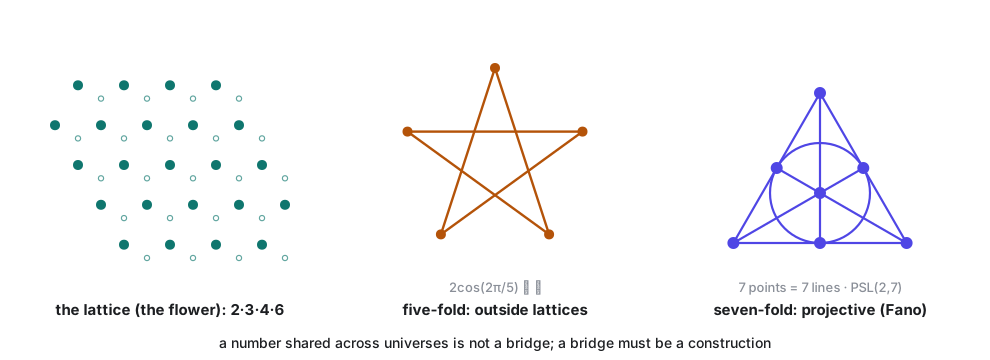
One more script deserves the same machine discipline.
What survives exactly: the Fruit-of-Life pattern is the [111]-slice of the
densest sphere packing — the twelve FCC neighbours project not onto the
bare triangular lattice (misfit 0.577 of a step) but onto the lattice
plus its deep holes to machine zero (1.1·10⁻¹⁶): the flower's petals live
in the holes. The Star of David lifts to the stella octangula exactly — hull
a cube, intersection an octahedron. And the tetrahedron, cube and octahedron
embed in that slice exactly (1.2·10⁻¹⁶ under honest freedom of rotation
and scale), while the icosahedron's best misfit is 0.080 of a lattice step:
five-fold symmetry is forbidden in any lattice (2cos(2π/5) ∉ ℤ). So «the
Flower generates all Platonic solids» is wrapper [✗]; the true core is
that it generates the 2-3-4 family. The I Ching does not embed either: the
flower's rings are the hex numbers 1, 7, 19, 37, 61, 91 — there is no 64
in that geometry; what the two share is generativity from a minimal seed,
an analogy [И], not an isomorphism. And one homonymy matters for this whole
corpus: the flower's seed has seven circles — but that seven is the lattice
1+6, centre and ring, six-fold symmetric; the Fano seven is projective
(7 points = 7 lines, PSL(2,7)), and the crystallographic test outlaws
n = 7 in lattices too (2cos(2π/7) ∉ ℤ). Three geometric universes, then:
the lattice world of the flower (orders 2, 3, 4, 6), the five-fold world
(H₃, quasicrystals), and the seven-fold finite-projective world where
this corpus lives. A number shared across universes is not a bridge; a
bridge must be a construction.
84. The ideal self-description: what a holon can say about itself, and how much it does
A symbolic system that strives toward its ideal self-description sounds like a programme without an end. It is not: for a holon the target is finite, and it can be counted.
The state is Γ ∈ D(ℂ⁷) — a unit-trace positive Hermitian 7×7 — so it carries
exactly 48 = 7² − 1 real parameters (definitions).
And because seven is prime, the maximal family of mutually unbiased bases
exists and has exactly d + 1 = 8 members (Wootters and Fields, 1989). Eight
bases give 8 × 6 = 48 independent probabilities, and Γ is recovered from them
in closed form,
So «an ideal self-description» is not an aspiration but a constructible finite object [T]: forty-eight numbers, optimally arranged in eight bases. Any account a holon gives of itself can be measured against that ceiling. (The arithmetic is the one the heptacode's syndrome census already whispered — eight families over a seven-letter alphabet.)
The ceiling is lower than forty-eight, though, and the corpus already says why.
The phenomenal functor is faithful only on G₂-orbits (T-123,
two-aspect monism), and
dim G₂ = 14, so fourteen of the forty-eight directions are frame, not content:
thirty-four parameters are distinguishable in principle.
(Retracted 2026-09-25 with Sec. 82: is faithful only up to the finite frame group, so a direction is a difference experience registers — along one of them falls from to — and all 48 parameters are distinguishable (frame decision D-0910); counts kinematic -invariants. The measurements below stand; their reading against a "gauge-free ceiling" of 34 does not.)
What the natal encoder actually reaches. Measured across the §75 population
(2340 charts, 1940–2004 × 12 months × 3 times), as the participation ratio
PR = (Σλ)²/Σλ² of the feature-correlation spectrum
:
| subspace | parameters | effective dimensions | PC1 |
|---|---|---|---|
| diagonal — the voice levels | 7 | 5.1 | 31.5 % |
| off-diagonal real parts | 21 | 18.5 | 9.0 % |
| off-diagonal imaginary parts | 21 | 17.4 | 10.6 % |
| coherence magnitudes (the §75 view) | 21 | 16.6 | 12.3 % |
| the full state vector | 48 | 35.4 | 7.0 % |
Numbers re-measured 2026-07-28. The table previously read 4.0 / 18.1 / 16.9 / 16.7 / 32.3. Those were taken before the encoder's diagonal was pinned
(pin_diag, default since 2026-07-27); with the pin switched off the probe
reproduces them exactly (32.5, magnitudes 16.7), which identifies the cause
precisely. Both readings below are unchanged in direction and one of them gets
stronger.
Two things follow, one of them a correction of our own earlier reading.
The phases carry half the state. §75 measured the interpretation-feature
vector — levels, gains, razlad and coherence magnitudes — and found an
effective dimension of 17.3. That measurement replicates here exactly
(magnitudes alone: 16.7), which is a welcome independent confirmation through a
different code path. But magnitudes are only half of the off-diagonal content:
the 42 real numbers of the off-diagonal split 21 real and 21 imaginary, and
including the phases lifts the effective dimension from 16.6 to 35.4 — it
more than doubles. §75's number was right about the object it measured and
undercounts the state by about a factor of two. The personal detail we said
lives in the coherences lives, half of it, in their phases.
The reached dimension does NOT sit on the gauge-free ceiling — the
conjecture is refuted [✗], now doubly. The measured 35.4 no longer stands
close to 34 = 48 − dim G₂ — it exceeds it, which alone makes the
frame-fixed reading impossible: an encoder confined to the gauge-free quotient
could not explore more directions than that quotient has. On the earlier figure
of 32.3 the reading was merely tempting, and we first read it forward: perhaps the natal encoder is
frame-fixed and explores about 95 % of everything a holon could differ in. The
test was stated and then run. Build 𝔤₂ as
the stabiliser of the associative 3-form inside 𝔰𝔬(7) — taking φ from the
corpus's own canonically oriented Fano wiring, which self-checks by yielding
exactly dim = 14 — form the orbit tangents [X, Γ] at each chart, and ask what
fraction of the population's variance lies along them:
share of variance along G₂-gauge directions | |
|---|---|
| conjecture (encoder frame-fixed) | 0 % |
| measured (2340 charts, 117 base points) | 28.8 % (range 26.1–31.5) |
| isotropic null (scatter indifferent to gauge) | 29.2 % |
The measurement lands on the null. The natal encoder does not fix a frame:
its image is not transversal to the gauge orbits, and the population's scatter
fills the gauge directions as readily as any others. The closeness of 32.3 to
34 was a coincidence, and the 95 % reading is withdrawn.
What replaces it is sharper and less comfortable. The phenomenal functor is blind
to the frame (T-123), so a
difference between two charts that lies along a gauge direction is a difference
no experience can register. Roughly 28 % of natal chart-to-chart variation
is of that kind: real in the parametrisation, invisible in the phenomenology.
Individuality as computed from a birth chart is therefore smaller than the raw
32.3 dimensions suggest — a bound we now have a number for, and one that no
amount of better writing can recover. (Retracted 2026-09-25 with Sec. 82: the
functor is not blind to directions, so the ≈ 28 % of variation along them is
not invisible to experience; the measured share stands as a property of the
encoder.)
Where the description is actually lost. Setting the links side by side gives the honest chain — and it does not fall where one would guess:
| link | dimensions | of the previous |
|---|---|---|
| the state's parameters | 48 | — |
distinguishable in principle (48 − dim G₂) | 34 | 71 % |
| reached by the natal encoding | 32.3 | — |
| …of whose variance is phenomenally visible | ≈ 72 % | (28 % is frame) |
| named as signals by the engine | 22 | — |
| reaching the plain-language reading | 9 | 41 % |
Two losses, then, of different kinds: the capture spends about a quarter of its
variation on the frame — a bound no writing can undo — while the telling loses
most of what survives. (The first loss and the table rows "distinguishable in
principle 34" and "≈ 72 % phenomenally visible" are retracted with Sec. 82: frame
directions are not phenomenally invisible, and the ceiling is 48.) The engine
computes a thirty-two-dimensional object and speaks nine of its named signals to
an ordinary reader, keeping the rest in a machine register behind a flag. That is
why the interpretation work is not copy-editing: raising what the readings carry
is precisely raising the system's own self-model fidelity, the quantity the
corpus calls R_φ (the three forms of R),
applied to the system rather than to the person it describes. A symbolic system
striving toward its ideal self-description, made operational, is exactly this
number moving toward one.
And the remaining directions have only one road. Whatever the natal
encoding cannot reach — and whatever changes after birth — is reachable only by
measurement in time: the diary as state tomography. The protocol is not a
sketch; it is built and checked. The eight bases
are verified mutually unbiased to 1.7·10⁻¹⁶, the closed-form reconstruction
returns real charts to 1.6·10⁻¹⁵, and the structural fact that makes a partial
diary worth anything is exact: each basis contributes a six-dimensional block
of the state space, and the eight blocks are mutually orthogonal to 1.2·10⁻¹⁶.
So 48 = 8 × 6 with no redundancy — no basis repeats what another has already
said, and measuring k of them is not a blurred picture of everything but an
exact reading of a 6k-dimensional slice.
That gives the living layer a price list, and the price list carries a sting:
| bases measured | parameters fixed | residual variance | fair share would be |
|---|---|---|---|
| 1 | 6 | 93.0 % | 87.5 % |
| 2 | 12 | 81.4 % | 75.0 % |
| 4 | 24 | 47.9 % | 50.0 % |
| 6 | 36 | 22.8 % | 25.0 % |
| 8 | 48 | 0.0 % | 0.0 % |
The first basis is the computational one — the seven voice levels, which is
exactly what the diary already asks for. And it is the weakest of the eight:
it fixes 6 parameters but removes only 7.0 % of the variance where an average
basis removes 12.5 %. The voice levels are the least informative question the
instrument could ask. This is the same finding as the phases, seen from the other
side: what individuates a person is not how loud each voice is but how the voices
stand in relation, and relation is phase. A diary that asks only «rate your seven
voices» measures the flattest slice of the state; two or three well-chosen
relational questions would learn more per question than the current seven do.
Designing them — turning the non-computational bases into things a person can
actually answer — is the open work of the living layer [О], and it is now a
well-posed problem rather than an aspiration.
85. Two walks through the sixty-four: the book and the wheel
Terence McKenna's Time Wave Zero earns its place in this part not by its famous
failure but by its structural core. The construction took the King Wen sequence —
the canonical order of the sixty-four hexagrams — measured how many lines change
from each hexagram to the next, and read the resulting profile as a dynamic of
novelty, unfolded onto a 384-node grid (64 hexagrams × 6 lines; McKenna also
prized the near-coincidence 13 × 29.53 ≈ 384 days of the lunar year). The terminal
date the wave pointed at was refuted by the calendar itself [✗]. What survives
the refutation is the question the construction actually poses: is a canonical
ordering of the sixty-four statistically special — and in which direction? That
question is exact, and our architecture happens to carry two canonical orderings
of the same nodes — the book's and the wheel's — so it can be answered twice
(lab:).
The grid itself is shared: 384 = 64 × 6 is also the lattice of the wheel's
line-divisions, which the Sun crosses in one year (about a line per day) and the
Moon in one sidereal month. But a shared lattice is shared combinatorics — 2⁶
states, six lines each — and nothing more [Т]; whatever else the two systems
have in common must be looked for in the walks. Define the novelty step
h(i) as the number of lines changed between consecutive nodes of a walk, and
compare each canonical walk with 20 000 random orderings of the same nodes:
| walk | mean step | step spectrum {h: count} | lag-1 autocorrelation | z of mean vs null |
|---|---|---|---|---|
| random orderings | 3.05 ± 0.15 | spread around 3 | −0.03 ± 0.12 | — |
| the book (King Wen) | 3.34 | {1: 2, 2: 20, 3: 14, 4: 19, 6: 9} | −0.26 | +2.0 |
| the wheel (year order) | 1.81 | {1: 34, 2: 16, 3: 8, 4: 4, 5: 2} | −0.57 | −8.4 |
Two findings, in opposite directions. The book is mildly special, toward
larger, alternating steps: its well-known pair mechanism — every odd hexagram
followed by its turn-over, or by its inversion when the figure is symmetric —
makes within-pair steps large (mean 3.75) against ordinary between-pair steps
(2.94); no step of size 5 occurs at all, and the nine full inversions (h = 6)
are exactly the symmetric pairs. It is a narrative order: it dramatises
opposition. The wheel is special by an order of magnitude more, and the other
way: more than half its steps (34 of 64) change a single line, none change all
six, and the spectrum falls by almost exactly a factor of two per added line —
34·16·8·4·2 against the exact halving 32·16·8·4·2. The spectra are exact
counts [Т]; the z-scores are empirical against a fixed ensemble [С]. The
wheel is a near-Gray walk — the year unfolds by minimal mutations — which
sharpens the earlier Gray-code observation on the wheel from the Human Design
audit into a quantitative law of decrease.
The principle, named: the book and the wheel are two walks on one crystal.
The nodes are shared — the same sixty-four doors with the same voice-readings
(§80) — but the order is a second, independent layer of meaning, and the two
canonical orders encode opposite temporal characters: the book walks like a
story, by confrontations — large, anticorrelated steps, opposition pairs; the
wheel walks like a calendar, by growth — smallest possible steps, smooth
unfolding. McKenna's «novelty» is therefore a property of a walk, not of the
nodes; the honest core of his intuition is that different walks through one
symbol-set carry different, measurable temporal signatures — [С] for the
numbers above, [И] for reading step-size as novelty. In our reconstruction the
labour is split accordingly: the doors' meanings live on the nodes, the year's
dynamic lives on the wheel-walk (themes hand over gradually, each door differing
from its neighbour by about one line), and the book-walk survives inside the
nodes as pairing structure — the involutions and nuclear roots of Part XVI.
Neither walk is «the true one»: they are two projections of the crystal into
time, a narrative one and a cyclic one — and the Mawangdui manuscript order
supplies a third with its own signature (block-sorted by trigram families:
steps of mean 1.75 inside a block, 3.25 at the seams; z = −7.6 against the
same null): a catalogue. Story, calendar, dictionary — three canonical
modalities of one crystal, each measurably non-random in its own direction.
86. The interior ladder: the four gates as a route, and the capture boundary
The corpus defines consciousness by four gates — purity inside the window
P ∈ (2/7, 3/7] (T-124), reflection R ≥ 1/3, integration Φ ≥ 1 (T-129),
differentiation D ≥ 2 (T-151) — and treats them as a static conjunction. The
psychedelic corpus, read through the reconstruction, turns the conjunction into
a route: the stages of a dissolution are the gates failing in order, and the
return is the same gates recovering in reverse. One identity does the heavy
lifting, and it was already in the canon: with the canonical R = 1/(7P), the
upper edge of the window and the reflection threshold are the same point,
P > 3/7 ⟺ R = 1/(7P) < 1/3 `[Т]`
— so «ego death», the failure of self-observation, is not a separate event but the exact crossing of the window's upper edge. What the tradition reports as losing oneself, the algebra states as purity leaving the band where a self-model can still watch.
The order of the remaining stages is not universal, and that is the finding
(lab: an honest toy of the porosity
dynamics, with its three instrument artifacts caught and documented along the
way — total porosity, a connectivity marker degenerate on disconnected graphs,
and a start state that violated D ≥ 2). The route is a function of the
porosity profile — how fast the world's entry widens across channels versus
how deep it presses. A wide fast profile (all channels open almost at once)
reaches unity first: D → 1 at mean step 39 of 80, connectivity doubling at
49, the window's edge only at 75 — union arrives while the observer still
stands, which is the DMT-like breakthrough phenomenology (56 of 60
trajectories). A narrow slow profile orders it the other way: connectivity
first (61), the edge second (75), full union last (79) — the long
«everything is connected» phase, then dissolution, then oneness at the peak:
the psilocybin-like route (43 of 60). Same crystal, same gates; the substance
chooses the profile, the profile chooses the order [С].
Two more results anchor the phenomenology. First, the report «more real than
reality» has a carrier in the model [С]: inside the unity window the mean
off-diagonal coherence stands at ×8.6 its baseline (60 of 60 trajectories put
the connectivity maximum inside unity) — super-integration with collapsed
differentiation is precisely a state more coherent than the ordinary one,
and the mind reports it as excess reality. Second, the entity question is put
as a discriminating test rather than an opinion: if entities are detached
modes of the person's own self-model, their profile should correlate with the
person's quiet voices (the unheard returning as Other); if they are external
fragments entering through porosity, with the person's open channels. The
toy model cannot decide this — a passive-input dynamics answers «world» by
construction — so the question is preregistered for report corpora with natal
data [О]; it is observable and falsifiable.
The same crossing guards the social layer. Model propaganda as an external
rank-one source — «one thought», a maximally pure state — fed through open
channels with repetition (lab:). Capture
turns out percolative: a pressure threshold below which it does not spread,
and the population's true defence is not its starting distribution (that
version was refuted by its own numbers and stands as an errata in the lab) but
the living filter: while P stays inside the window, R ≥ 1/3 damps the
repetition, and the full filter doubles the pressure threshold. The boundary
of vulnerability is the same line as above: captured is possible when
P > 3/7, i.e. R < 1/3 — capture and trance are one door opened from two
sides [С] for the toy, [Т] for the boundary identity. A tradition that
trains presence in the window trains, in the same gesture, immunity to
capture; a system that pushes a population toward one pure thought walks it,
in the same gesture, out of the conscious band. The susceptibility claim also
carries an external anchor [С]: across 137 autocratic-regime onsets of the
Geddes–Wright–Frantz registry with World-Bank coverage, per-capita growth in
the three years to the start runs 1.70 points below the country's own norm
(z = −4.3 against a within-country null; the anticipatory window that excludes
the start year still holds z = −2.6), while the same test against global
shocks returns zero — capture follows the local depletion of its field, not
the world's waves, which is the social twin of the point-not-population
theorem (§75c).
Grof's perinatal sequence falls out of the same construction. From several
thousand LSD protocols Grof distilled a stable order — serene unity (BPM I),
no-exit compression (BPM II), titanic struggle (BPM III), death-rebirth into
light (BPM IV). The perinatal causality — that these are memories of birth —
remains disputed [И]; the sequence itself is a reproducible corpus invariant
[С], and in the reconstruction it is the resistance curve of the gate
route: define suffering(t) as the entry pressure times the still-living
reflection filter, and the model puts its peak strictly between the
«everything connects» phase and the window's edge — BPM II–III, the filter
holding against the press — in 43 of 43 narrow-profile and 58 of 58
wide-profile trajectories. On the narrow route the tail after unity holds 6 %
of the peak: the catharsis of BPM IV, no one left to suffer. The prediction
that the narrow profile suffers higher was refuted by the model's own
numbers — the peaks are nearly equal; what distinguishes the routes is
resolution: the wide profile keeps 47 % of its suffering inside unity
(the terror-within-breakthrough of DMT reports), the narrow one converts it at
the moment of passage. This matches the Imperial triad of scales — challenging
experience as the area under the resistance curve, emotional breakthrough
(Roseman 2019) as the tail's conversion, mystical experience as the depth of
unity — with a preregistered corollary: breakthrough scores should track the
peak-to-tail ratio, not the peak [О].
The route also runs backwards, and not symmetrically. Driving the porosity
through a full cycle (0 → 1 → 0, sixty trajectories) gives the return leg two
measured properties [С]: the gates recover at a porosity smaller by
Δσ ≈ 0.16–0.19 than the one at which they failed — the world once let in
does not leave when the pressure is merely removed, so between the peak and
the re-closing of the gates there is a real integration window, which is
where the therapeutic work happens; and the recovery order is
last-fallen-first-restored in 75 % of trajectories — a tendency, not a law,
because on a narrow profile both gates fall almost together at the peak and
the return order is noisy. Integration, in other words, is not the trip
rewound: what opened at the peak closes on its own porosity and mostly in
reverse order.
The Klüver precedent frames the method. Thousands of subjective mescaline reports condensed into four form constants; half a century later they proved to be the plane-wave spectrum of a log-polar cortex — the lab reproduces that derivation by direct computation. Reports → invariants → mechanism → theorem: the interior ladder above is the same schema applied one level deeper, with the gates of the reconstruction as the mechanism layer.
87. The five-mode chart: the spectrum of a natal Γ̂ and the personal blind plane
Ask the plainest spectral question the reconstruction allows: what are the eigenvalues of a natal Γ̂? Across three thousand ephemeris charts spread uniformly over 1940–2010 the answer has a shape no one ordered in advance : the mean spectrum runs 0.499, 0.288, 0.154, 0.054, 0.004 (re-measured 2026-07-28 on the corrected defaults; it read 0.448, 0.275, 0.168, 0.088, 0.022 before the diagonal was pinned) — and then nothing: λ₆ and λ₇ are numerical zeros on 98.7 % of charts (the exceptions carry λ₆ ≤ 0.043). A natal chart is a five-mode object in a seven-voice space: every chart owns a two-dimensional subspace of voice superpositions it does not carry at all. The head of the spectrum decays geometrically at ≈ 0.62 ± 0.13 per step — near 1/φ on average, but with a spread wide enough that we file it as a tendency of means, not a law. And the positional gap profile matches purity-matched random densities — no «natural classes of modes» beyond the rank cut: what distinguishes the population is the cut itself and the steep head.
Is the missing plane shared — two directions the encoder simply never feeds? No: the mean kernel projector is nearly isotropic (its seven eigenvalues sit between 0.23 and 0.34, all ≈ 2/7), so the blind planes of different charts spray the whole space. The deficit is a local law: each chart has its own personal blind plane.
The mechanism turned out to be one honest theorem of the construction. The encoder assembles a raw matrix — the population
diagonal of trace one plus the β-weighted coherence structure of trace zero —
and ends by projecting onto the PSD cone with trace renormalisation. The raw
matrix almost always carries negative inertia: (5+, 2−) on 72 % of charts,
(4+, 3−) on 27 %, (6+, 1−) on 1.4 % — and that last figure independently
matches the 38/3000 rank-six charts of the first probe. So Γ̂ is the
renormalised positive part of the raw chart, and the personal blind plane is
precisely its clipped negative subspace — the directions where the coherence
structure outweighed the population. A quarter of the population carries a
three-dimensional blind space. Why is (5+, 2−) the typical inertia? The
phase diagram over β answers plainly: the working point β = 0.12 sits at the
peak of the (5+, 2−) phase (85 %), with (6, 1) below β ≈ 0.05 and (4, 3)
above β ≈ 0.15 — five-modedness is a property of the encoder's chosen working
point, standing at the maximum of its own phase [С].
Two readings close the section. First, a caution: all of this is a statement
about the sky-plus-encoder structure — dates here are uniform draws, not
people, and no person-level claim is made [С]. Second, a refinement of the
window: on 89 % of charts (62 % before the defaults were corrected) the
dominant mode alone already outweighs the upper
edge, λ₁ > 3/7, while the chart's purity stays inside the window because of
how the tail is distributed — consciousness, in this reconstruction, lives on
the distribution of modes, not on the dominant one. The product keeps its
discipline here: the blind plane is computable per person, but its meaning is
not yet earned, so it stays out of the readings until it is [О].
How the conditional gets settled. «A property of the encoder's working
point» is a [С], and a [С] that names no way of being wrong is a
decoration. Here the way is direct, because there exists a second Γ̂ that never
passes through the encoder at all: the one estimated from a diary, a
normalised covariance of daily marks. If five-modedness is a trace of the
encoder, that second matrix has no reason to show it; if it is a property of
the state, it shows it anyway. So the rank of the diary Γ̂ separates the two
readings, and it costs the observer nothing extra — the same sixty entries
already being collected for the three-way split answer this too.
The rule was fixed before the first entry: a mode counts as live if it carries
more than 1 % of the trace; five or fewer live modes reads as a property of
the state, more than five as an artefact of the encoder. The threshold is
not a guess. Power was computed first, on synthetic series of known rank: at
sixty days the instrument reads true rank 3 as 3 (99 % of runs), true rank 5 as
5 (87 %), and true rank 7 as 6 (73 %). The boundary was then chosen by
enumeration over the worst of the two error rates — ≤ 5 gives 16.5 %, while
≤ 4 and ≤ 6 give 87 % and 89 % and were rejected. The instrument's known
bias is written into the rule rather than left implicit: at full rank it more
often finds six than seven, because the seventh mode falls under the 1 %
floor — so an outcome of «6» reads as full rank, not as near-five-modedness.
The outcome appears on its own
at sixty days and stays silent before that [С].
The two outcomes are not equally informative, and saying so is part of the
preregistration. A second probe asked what happens when this test sits
alongside the three-way split test that runs on the same entries. The two are not independent, and the
dependence is one-directional. Sweeping the purity of a three-factor series —
the weight w on the shared factor — the split lands on 92–100 % of runs
across the whole range from w = 0.4 to 0.9, while rank switches abruptly:
five or fewer modes on 100 % of runs at w = 0.9, 87 % at w = 0.8, and exactly
0 % already at w = 0.7. So once the three-group structure is present, the
rank is not measuring the structure at all — it is measuring how much of the
diary is not those three factors. The reverse direction is clean: low rank
alone does not carry a series into the predicted split, which stays at the
blind 1.4–2.0 %, so the 1/70 declared for the split is unaffected.
Three consequences follow, all fixed before the first entry. First, «more
than five» is the default outcome over almost the whole noise range and is
therefore weak evidence on its own; «five or fewer» is rare and strong.
Second, when the split lands and rank comes out low, the two are one
finding, not two — the second follows from the first and must not be added to
it. Third, split-lands-with-high-rank is not a contradiction, as a naive
reading of the first probe suggested: it is the ordinary case below w = 0.8 and
reads as «the three factors are there and they are not the whole of it». The
product states each of these in the reading itself rather than leaving the
reader to add what does not add [О].
And the blind probability the other test rests on is true only by symmetry. The split test declares blind odds of 1/70. That holds if the seven voices are exchangeable — no partition favoured over another. In self-report they are never exchangeable: there is a common day-factor, and today being good lifts all seven marks at once. A halo with equal loadings is harmless, since it raises every correlation alike and all seventy partitions score the same. A halo with sharply unequal loadings is not. If the wording of the questions happens to make mood bite harder on Expression, Movement and Meaning than on Form, Grounding and Unity, the predicted partition wins from the questions, not from the metatraits. Measured on eight nulls that contain no metatraits at all: seven independent voices land on the predicted split 1.35 % of the time, an equal-loading halo 1.10 %, a halo plus response style 1.55 % — all at the blind rate — while a loading skew of 0.35 gives 4.95 % and a skew of 0.45 gives 16.6 %, up to 11.6× the declared 1/70.
The discriminator turned out to sit in the spectrum of the same matrix. One
common factor is rank one: λ₁ takes nearly everything. Genuine metatraits are
two group factors plus a pivot, so λ₂ is comparable to λ₁. Among halos that
do land on the predicted split, λ₂/λ₁ runs 0.23–0.34; among genuine metatraits
it runs 0.81–0.84 — and, decisively, it does not fall as the structure
weakens: at w = 0.25 only 19 % of runs land at all, but those that land still
show 0.84. So the threshold cannot cut away weak-but-real structure. Chosen by
enumeration over the worst of the two errors: λ₂/λ₁ ≥ 0.45, worst error
0.2 %. Declared before the first entry: below that threshold a landing does
not count, however many days accumulate — what it would measure is how
differently the seven questions catch a mood, not the bridge to the Big Five
[О].
The general lesson outlives this instrument. A probability derived from symmetry is true exactly as far as the symmetry holds in the data. «One in seventy, because there are seventy equiprobable partitions» is a statement about the enumeration, not about people. It is checked by building nulls in which the symmetry is broken deliberately and plausibly — and here that check found a real hole and closed it before any data existed.
That rule has a sibling, and the two together cover most of what goes wrong
with a declared threshold. A significance level counts one route to the
right answer — the route the test intends. It is valid exactly when no other
route exists. The check mirrors the one above: enumerate everything a
respondent can see without doing the intended work — layout, ordering,
wording, length, any residue of how the material was assembled — and test each
against the key. A threshold survives only what it has been tried against [О].
88. The information bound of the natal map: why every external null was forced
Twenty-one parts have built a construction. This one measures what the construction can carry, and the answer bounds everything above it. The result is not statistical — it is read off the signature of a function.
One input. The state is assembled by Chart::from_jd(jd): a single real
number, the moment of birth. Nothing else is passed. So the natal map is a
curve,
whose image lives in a space of real parameters [Т].
Place does not enter the state. Two people born in the same instant in
Reykjavik and in Melbourne receive an identical Γ — measured difference
, though the measurement is superfluous: the coordinates are
absent from the signature [Т]. Place lives only in the horizon layer
, never in the state. This is a falsifiable
disclosure, and the product now makes it on the /place page rather than
letting silence work as a promise.
The map is very nearly injective. Across 4000 random charts there are 3933
distinct gate sets. So f neither compresses nor
enriches: it is an exact re-coding of one real number into 48 coordinates.
Hence the bound. Because Γ is a deterministic function of jd, the data
processing inequality gives
for any property of the person [Т].
No processing creates information about a person that the birth moment did not hold. And the right-hand side is exactly what every external test measured: 15 931 Gauquelin celebrities with accurate times (η² < 0.5 %); sixteen memoirists over 2.4 million words under frozen dictionaries (zero, the best pair signed against); wars, revolutions and pandemics (null under two statistics); three zodiac markings including thirteen unequal constellations (all inside estimator bias); and the diurnal layer across 130 body × profession pairs, whose top is occupied by bodies with no traditional claim at all — including our own control body, Uranus over the military at +3.03.
So the null on the left needs no separate test: it transfers from the nulls on the right, with no further assumption.
Precision matters here, or the statement over-claims. The inequality transfers a bound; it does not manufacture a zero. Our tests are estimates of finite power — they cap the effect, they do not prove its absence. The correct sentence is: whatever bounds the link from moment to person, bounds the link from Γ to person at least as tightly. That is what makes further external testing of the natal layer pointless — the ceiling is shared and already measured.
Portrait of the image — and why it deceives. Measured on the live path
(use_v2 = true), after a first pass had used the default, which then pointed
at a dead branch (§89): the image spans 40 of 48 linear directions at 90 %
of variance and 47 at 99 %, and its embedding dimension is 13.80 against
controls of 2.26 (a known curve) and 17.10 (a full 48-dimensional cloud). The
ruler is biased both ways — the known curve should read 1.0 and the full cloud
48 — so the order is what may be read, not the absolute.
The direction count needs the same treatment, and it did not have it. «Forty of forty-eight» reads as wide coverage, but coverage is measured against something. Four baselines on the same four thousand points settle it:
| ensemble | directions at 90 % |
|---|---|
| isotropic 48-dimensional cloud | 43 |
| curve from one frequency, random map | 29 |
| ten frequencies, random linear map | 8 |
| ten frequencies, random nonlinear map | 25 |
| the natal curve | 40 |
Two readings, pointing opposite ways, and both belong. Against pure noise the figure is a ceiling, not an achievement: an isotropic cloud needs 43, so noise spreads wider than the natal image does. Against the matched null the image does spread: ten sinusoids through a random nonlinear map cover 25. The linear null's 8 must not be read at all — a linear mixture of ten sinusoids has covariance of rank exactly ten, and the encoder is nonlinear by construction. Nor should the remaining gap of fifteen be read as «this much structure»: the matched null here is merely quadratic, while the encoder passes through trigonometry of angles and manufactures higher harmonics that lift the rank on their own. Fifteen is an upper bound on what construction contributes.
And here is the instructive part. Geometrically the image is rich: nearly
fourteen-dimensional by that estimator, far closer to a full cloud than to a
curve. And it carries exactly one number. The richness is manufactured by
discreteness — gates, channels and centres jump at every boundary, so the image
is not a line but a scatter of almost four thousand pieces, one per chart
(3933 distinct gate sets across 4000). A scatter fills space and fools any
geometric ruler, yet holds no more information than the index of the piece —
and that index is fixed by a single jd. Geometric richness and information
content are different things, and the first promises nothing about the second.
What the bound does not reach. Formally two channels escape it; in
substance, one. Place is absent from Γ and therefore outside the
inequality — which invites calling it open, and that would be a mistake: the
diurnal landscape was the measurement of place, since gauquelin_sectors
takes latitude and longitude on its inputs, and it closed negatively. The
honest residue is that the outcome tested was profession; other outcomes are
formally untouched, and no data for them exists. The diary is the real
survivor: its input is the person, not the birth moment, and it is the one
place where the instrument has been checked against known truth (return times
0.83 → 0.85, 1.44 → 1.35, 2.80 → 2.82).
Nothing said in earlier parts becomes false. The natal layer was already
described as a frame, a prior, a language of distinctions, and that was
accurate. What changes is the standing of the description: until this section
it was caution drawn from measurements, and now it is a consequence of
the construction — which lets it be stated more calmly and more strongly.
Everything the system says from a chart is a function of one number. A frame
may be useful without being a measurement; it may not carry more than its
input [Т].
89. Two encoder paths, two answers to the window
The previous section bounded what the natal map can carry. This one asks a blunter question of the same construction — what does the encoder say about real people, by the theory's own criteria? — and the answer arrived only after an error worth recording, because the error is the finding.
The census, on 16 000 Gauquelin records with accurate birth times. The
first pass used EncoderCfg::default() and reported that essentially nobody
passes: integration for 0.1 %, all four gates for 0.0 %. That conclusion was
wrong, because the default is not the path the product computes:
use_v2: false in the default, use_v2: true in the live config. Recomputed
along both:
| gate | v1 (the default) | v2 (what runs) |
|---|---|---|
| 40.0 % | 99.4 % | |
| 98.5 % | 87.6 % | |
| 0.1 % | 90.8 % | |
| 100 % | 100 % | |
| all four | 0.0 % | 78.4 % |
Φ by quantiles: v1 — 0.000 / 0.270 / 0.581, max 1.350; v2 — 0.932 / 1.289 / 1.730, max 2.621.
So the finding is not the one that was sought. It is that the two paths
give categorically different answers to the system's central predicate:
one says nobody passes the window of consciousness, the other says three
quarters do. Not a discrepancy in the third digit — different answers to
«is this a living state by the theory's criteria» [Т]. And the path left as
the default is the one that is not in service, so any probe written against
the default silently measures a dead branch.
On the live path the gates barely filter. passes 100 %,
passes 99.4 %. A gate that admits everyone is ornament rather than
discrimination; only (87.6 %) does real work, and it does it
through the upper edge of the window. Whether the gates are too easy on v2 is
an open question [О], and it is now a numbered one.
What holds regardless of the path. Reachability of the gates by the diary estimator never touches the natal chart at all:
| structure of the series | P | Φ | D | gates |
|---|---|---|---|---|
| voices independent | 0.147 | 0.021 | 6.91 | 2/4 |
| weak common wave | 0.157 | 0.089 | 6.69 | 2/4 |
| middling common wave | 0.327 | 1.289 | 4.51 | 4/4 |
| strong common wave | 0.826 | 4.771 | 1.60 | 2/4 |
| almost a single voice | 0.981 | 5.868 | 1.07 | 2/4 |
The gates are reachable and, which matters more, selective: only the middle
band passes. Voices apart, and there is no integration; voices fused, and there
is no differentiation — precisely what the theory declares consciousness to be,
reproduced from series shaped like daily marks [Т].
What the error killed. A prediction had been drawn — that a diary Γ̂ would clear gates a natal Γ fails. It rested on a contrast of 0.1 % against ≈1.3, and on the live path there is no contrast at all: the natal median is 1.289, the same number the middling series gives. The prediction was withdrawn, and withdrawn before the first mark was collected, so no fitting to data was possible.
Why the low Φ on v1, for the record. It is not a tunable: sweeping β from 0.05 to 0.80 lifts the median only to 0.844 and it plateaus there, while the four-gate rate peaks at 8.8 % near β = 0.45 and falls again. The plateau is not the Cauchy–Schwarz ceiling — at β = 0.80 only 14 % of pairs sit at it, average load 0.183 — but the cone projection, which discards up to 31 % of the raw mass as the negative inertia grows. The first mechanism proposed here was the wrong one; the measurement said so.
Do the gates discriminate at all? The question «are they too easy on v2» is settled not by the pass rate but by comparison against a null ensemble — random density matrices from the Hilbert–Schmidt distribution, which know nothing of any sky. The ruler is the one already used on textual claims: how many bits the answer «passed» carries.
| gate | encoder | random | delta | bits |
|---|---|---|---|---|
| 98.9 % | 37.8 % | +61.1 | 0.089 | |
| 91.6 % | 100 % | −8.4 | 0.414 | |
| 86.3 % | 7.0 % | +79.3 | 0.576 | |
| 100 % | 100 % | −0.0 | 0.003 | |
| all four | 78.0 % | 7.0 % | +71.0 | 0.760 |
Which sample each table is on, because the two disagree and neither is
wrong. The census above runs on 16 000 real births spanning 1600–1963; this
table runs on 4000 dates drawn uniformly over 1930–2009. Hence R ≥ 1/3 reads
87.6 % there and 91.6 % here. Two hypotheses for the gap were measured rather
than assumed. Real births against
uniform dates over the same years: largest gap across all four gates
1.2 points — so the population, though genuinely non-uniform over the
calendar, explains about one point. Uniform dates across 1600–1963 against
1930–2009: R moves 88.6 → 89.7, another 1.1 points. What remains is
sampling error, which at n = 4000 and a rate near 0.9 runs about half a point
per standard error. No single cause, and no error — but a section that prints
both figures without saying they are different samples invites the reader to
treat one as a typo. Every pass rate is a property of the construction and
of the population it is counted on [О].
Median P: encoder 0.3623, random 0.2775, gate 0.2857.
The answer splits in two, and both halves matter. Against noise the gates work, and strongly: all four admit 78 % of charts against 7 % of random states, and gives 98.9 % against 37.8 % — the encoder does make states markedly purer than chance, exactly as the gate's derivation claims (the distance to the formless must exceed noise's own). That is not ornament.
Between people they barely discriminate. carries 0.089 bits,
because everyone passes; only does real work (0.576), and the
quartet together yields 0.760 bits — about one binary distinction, «78 against
22». Which is precisely what §88 demands: if the natal layer carries one
number, gates upon it cannot separate people. The low discriminability is
not a flaw in the gates but a consequence of the information bound [Т].
And is dead. 100 % for the encoder, 100 % for random, 0.003
bits. It is not vacuous mathematically — a nearly pure state would fail it —
but neither ensemble produces such states. As it stands it is not a gate but a
line in a report [О].
What survives a harder null
The Hilbert–Schmidt ensemble differs from a chart in everything at once, spectrum included — and three of the four gates read nothing but the spectrum. Purity is the sum of squared eigenvalues; is a function of purity, so and together are one condition on the spectrum; is the exponential of the entropy, again spectral. Only is computed over a partition of the seven named axes and can therefore see structure. On top of that the HS ensemble in seven dimensions has mean purity , which sits flush against the threshold — so the 7 % is in large part a statement about where that ensemble happens to sit.
The sharper null holds the spectrum identical. Take a chart, diagonalise it, keep the eigenvalues, and replace the eigenvectors with a Haar-random unitary frame: . Purity and then agree with the chart bit for bit (largest observed discrepancy ), and only and can move. On 4000 charts:
| gate | charts | same spectrum, random frame | delta |
|---|---|---|---|
| 98.9 % | 98.9 % | +0.0 | |
| 86.3 % | 70.4 % | +15.9 | |
| 100 % | 100 % | +0.0 | |
| all four | 78.0 % | 62.4 % | +15.6 |
The result is worth stating gate by gate rather than in aggregate. Three of
the four discriminate exactly zero beyond the spectrum: for , and
the earlier «78 % against 7 %» is a claim about spectra, not about how a
chart is built. One gate does real work. At identical spectrum, charts
clear sixteen points more often than a random frame — median
1.235 against 1.134, and the two samples separate with a pair-ranking
score of 0.612 (0.5 would be nothing). The effect is genuine and modest, and
its source is legible: is computed over the named axes, and a Haar
rotation scrambles the names. So what is shown beyond the spectrum is exactly
this — the encoder does not place its axes arbitrarily with respect to
integration [С]. That is the whole of the structural claim, and it is
smaller than the aggregate figure suggests.
And the signature turned out to be carried by the construction itself. The next null asks which non-arbitrariness: keep every gate's multiplicity, magnitude and line-phase, but wire its member axes at random — forty independent consistent rewirings, and forty more constrained to preserve each axis's total degree exactly (double edge-swaps on the gate–axis incidence). The canonical dictionary passes on 88.8 % of charts; free rewirings reach 71.1–82.0 % (median 77.1), degree-balanced ones 74.9–83.1 % (median 78.5) — zero of forty reach the canonical figure in either family, permutation in both. So the signature is neither multiplicities nor axis load: it is the structure of which pairs are coupled.
The mechanism is exact combinatorics, not a tendency. The 64-word dictionary
is a 2-design: its 21 pair-gates cover all 21 axis pairs exactly once, its
35 triangle-gates cover all 35 distinct triples exactly once, and every axis
pair therefore receives exactly contributions — perfectly uniform
slot load (a random rewiring loads slots 2…12). Contributions carry line
phases, and colliding slots partially cancel, ;
the design never collides them. Uniform slot load is what detects
beyond the spectrum — and the mechanism is established by intervention, not
narration: with phases forced to zero the gap vanishes entirely (both families
saturate at 100 %), and the raw off-diagonal mass inverts — 1.603 canonical
against 1.664 rewired — exactly as the -versus- arithmetic of
random-walk accumulation demands. Remove the cause and the effect is gone.
This is the first measured structural evidence for the
construction on the encoder side [С]. And the same
null cleanly divides the labour between the encoder's two structural facts:
five-modedness (§87) does not move under rewiring — rank ≤ 5 on 99.8 % of
charts canonically and 100 % rewired, a numerical zero in both —
so the spectral cutoff belongs to the assembly's working point, exactly as
§87 hedged, while the signature belongs to the dictionary. Two facts,
two distinct carriers, separated by one instrument. A third layer sits in the
phases themselves: with the canonical wiring kept but activation lines
shuffled, the pass drops to 77.2–86.2 % (median 83.5) — the canonical
assignment beats all 25 shuffles, , which is the granularity floor
of 25 replicates and is said rather than hidden. The carrier was then hunted surgically
and turned out not to be what it looked like. Repeated
gates are refuted twice over: their line differences are uniform (Δ = 0 excess
−0.8 pts) and shuffling only their lines drops nothing. The carrier is the
lights lock: Earth is defined as Sun + 180°, and 180° is exactly 32 gates —
so Earth's line always equals the Sun's (1000 of 1000 charts), phase-locking
the four heaviest (μ = 2) contributions pairwise. And the residual turned out to be a second
lock of the same nature: the South Node is the North Node + 180° (also 1000 of
1000). Randomising the lines of the four locked bodies — 8 activations of
26 — lands exactly on the full-shuffle floor (84.2 % against 84.2 %), while
randomising the other 18 leaves the share at the canonical level (87.9 %
against 87.6 %). So the ephemeris-line layer is entirely the construction's
own geometry — the two derived-body definitions — and the lines of the nine
free bodies carry no measurable phase structure [С]. Read cyclically: each
lock is one celestial axis — Sun–Earth and nodal — a single sky cycle
read twice in counter-phase; the construction keeps the phase of the two axes
and is deaf to the phase of every free body (where this sits on the ladder of
cycles — evolution, celestial ladder). The exact
design property is held by a machine check; the empirical margin is the
probe's..
Part XXII. Place enters the chart: the two angles
90. What place can and cannot change
Everything the reconstruction has used so far is place-blind: ecliptic
longitudes are the same for every birth in the same instant, so the doors, the
hands, the crystal and all forty-eight numbers of Γ do not know the city. If
place is to enter the chart honestly it can enter through exactly one gate —
the local angles: which point of the ecliptic was rising over the eastern
horizon (the ascendant), and which stood in upper culmination (the MC). These
two are shared by every house system ever proposed — Placidus, Koch and the
rest argue only about how to cut the arcs between the angles — so the layer
begins with the angles and, until an owner's decision, ends with them.
The longitudes are plain spherical geometry [Т]: sidereal time from the
Julian date (the GMST polynomial reproduces the J2000 anchor 280.460618° to
10⁻⁴), the IAU 2006 obliquity, the classical atan2 forms. Reading the two
longitudes as wheel doors — the horizon door and the zenith door — is
the astrological convention, and is marked [О] wherever it is spoken.
The verification is a closed loop between two independent modules rather than
a comparison with foreign software: at the minute when the Sun's longitude
(our ephemeris) equals the computed ascendant, the Sun's altitude — computed
from sidereal time and declination alone — comes out below 0.7° at three
separate epochs. A sign error anywhere in the chain would put that sunrise
underground. Beyond the polar boundary (|φ| > 90° − ε) the ascendant is
returned as undefined, not as a number: for weeks around the solstices the
ecliptic there does not cross the horizon in the ordinary sense, and a
convention that hides this would be a guess wearing a formula.
Two consequences are worth stating. First, the ascendant moves about a degree
every four minutes — it is the fastest hand in the chart, and the only one
that distinguishes two people born in the same city an hour apart more
sharply than the Moon does; this is why the angles inherit the honesty
machinery of birth-time anchorage (якорность) automatically. Second, the
geo-layer acquires its first computable object: "moving is a change of
reference frame" was, until now, a design sentence; with the angles it is a
pair of doors that actually change when the frame does. Validation of any
reading of that change stays n-of-1 by diary — the layer's own status
discipline applies to itself. Measured place-tolerance closes the honesty loop: a
±1° error in the birth point (≈111 km) shifts the ascendant by a median
0.5–0.9° — the horizon door flips for 23 % of charts, its line for
96 %. So the product shows the line only where it survives ±22 km and
±2 minutes of birth-time error; everywhere else the door stands alone —
the same rule that keeps HD's tone and base off our pages (Part XV). intake:
the onboarding pin and /birthplace store the birth point, and the product
names both angle doors the moment the point arrives.
Part XXIII. The discipline of the weak signal
91. A model problem: three minutes of birth time
The maternity record of the project's owner says 11:00; an earlier event-based rectification had said "a few minutes earlier", and 10:57 had lived in the profile ever since. Which is right? The question is three minutes wide, and precisely because it is so narrow it makes a perfect model problem for a whole class the navigator keeps meeting: a signal that may be weak or absent, a rich supply of plausible-looking methods, and a strong temptation to hand back a confident point answer. What the answer turned out to be matters less than the discipline that produced it, so this part records both.
The first rule was fixed before any scan ran: preregistration. The grid of candidate times (10:30–11:30 in 30-second steps), the kernels and their widths, the bodies each method may use, the null models and the decision rule were committed to the repository before the first curve was drawn, and the file explicitly forbids retuning any of them after seeing data. Nine channels then ran in two waves: transits of the five slow bodies to the local angles on nineteen dated life events (conjunctions, σ = 1°), the same with hard aspects, the exact birth moments of three children against the parent's angles, solar arcs in both directions (σ = 0.5°), primary directions of the angles under the Ptolemaic key, progressed angles of the day-for-year clock, and the boundaries of the Vimshottari periods. Every null was computed maximum-to-maximum — the observed peak is compared with the best peak each random history achieves anywhere on the grid, which charges the scan for looking in many places at once.
The result was a clean, instructive null. No channel reached p < 0.05; the two structurally richest ones disagreed about the sign of the answer — the transit channel preferred 10:57 in every bootstrap resample, the solar-arc channel preferred 11:00 in every one — and the sharpest possible discriminator, the children's luminaries against the parent's axes, turned out to lie outside four kernel widths of every candidate axis: a structural zero. Five of the six second-wave channels put more mass on 11:00 than on 10:57, with no statistical force anywhere. The verdict that survives is the documentary one: 11:00 ± 7 minutes [I], the typical rounding of a maternity clock. And the old "a few minutes earlier" is explained rather than refuted: a point answer extracted from event fitting without a null model is the noise of whichever kernel one happened to choose. Two preregistered kernels voted in opposite directions with equal confidence — that is what such noise looks like from inside.
92. Power, or when a null means something
A null result invites two readings: "there is nothing there" and "this instrument could not have seen it anyway". They are distinguished by power analysis, and the distinction turned out to be dramatic here. Synthetic signal was injected: sets of event dates manufactured to be angle-timed at a planted birth time, mixed with noise dates in known proportion, and run through the untouched pipeline. The transit channel detected a planted time from just nineteen events with 100 % power when at least half the events carried the signal, and still a third to a half of the time at one quarter; at fifty events it detected even the one-quarter mixture every time. So its null is a finding: the owner's nineteen events are genuinely not angle-timed, and had they been, the instrument would have said so.
The solar-arc channel returned the opposite certificate: at the planted time coinciding with the recorded 11:00 its power was zero — not small, zero — even with a hundred events all carrying the signal, while at a different planted time it was excellent. The mechanism is a degeneracy: a solar-arc contact fixes the age at which it occurs, so accepted signal dates pile up in the same few spots and the peak slides off the plant. The same null that was a finding for one channel is, for the other, a blank stare. This is now a named principle of the whole project — П-МОЩНОСТЬ-1: a null without a power certificate is not evidence; a channel that cannot demonstrate detection of an injected signal of the claimed strength is mute, not negative — and the accumulation machinery below refuses to promote any hypothesis to its confident state unless its kernel carries such a certificate.
93. The needle tower, or where minutes live
Part XV argued from population statistics that the phase registers of the wheel — colour, tone, base — carry half the chart's information. The rectification dispute makes the same point with clock hands. Each body crosses a line (0.9375°) at its own speed, so each register of each body is a needle with its own period in minutes of birth time: the Moon's colour needle turns once in ≈ 15 minutes and its tone needle once in ≈ 2.5; the Sun's tone needle needs 38 hours; the ascendant's line needle turns in 3.9 minutes and its colour needle in about 40 seconds. Laid out as a table, the tower says exactly where a three-minute question can live at all: in the Moon's tone, in the angles' lines and colours — and nowhere else. The gates and lines of every planet are stone-still across the whole disputed hour.
The encoder respects this structure more literally than expected. Across
the 10:30–11:30 grid the reconstructed Γ jumps exactly once — at the
design-Moon's line flip — and does not jump when the personality Moon
changes line ten minutes later. This is not a bug: a line enters Γ only
as the phase θ = π·line/3 of the off-diagonal term of a phase-bearing
gate, and the personality Moon's gate happens to be voice-kind, which
contributes amplitude only. So the honest resolution statement is: the
Γ-layer resolves about an hour; its minute needles are exactly the line
flips of phase-bearing gates; "phases carry half" is not a metaphor about
information percentages but a statement about which register the fast
hands are physically wired to.
94. Posteriors with shadows: the machine that accumulates
A one-shot test wastes its history: life delivers anchors one at a time — an event dated in conversation, a diary day, a move — and the honest response is to accumulate. The mechanism keeps, for any hypothesis with a parameter θ, a log-likelihood curve over a θ grid that every new anchor multiplies through a preregistered kernel; and beside it, two hundred shadow posteriors fed by random anchors of the same nature, one per real update, so a shadow is always the same age as the truth. A report compares the concentration of the real curve with the concentration of its shadows and speaks in exactly three states: "cannot tell yet" (p ≥ 0.1, or fewer anchors than the kernel's floor), "leaning to θ̂" (0.01 ≤ p < 0.1 — the phrase itself says how many random histories look like this), and "confidently θ̂ ± Δ" (p < 0.01, and only if the kernel is power-certified). The three principles of the project's measurement discipline are enforced as panics, not conventions: a report without shadows refuses to exist, a foreign kernel refuses to update a posterior, and the confident state is unreachable without power.
The acceptance run closed the loop on the model problem. Fed the owner's nineteen real events, the birth-time posterior lands in "cannot tell yet" at p = 0.32 — the same verdict the preregistered scan gave, now stored as a living curve that future anchors will keep updating. Fed nineteen planted events agreeing on a birth time five minutes past the record, the same machine answers "confidently +5.5 ± 1.8 minutes, p = 0.005". The instrument does register minute-scale truth from nineteen anchors — when the anchors carry it. And the calibration test is itself honest about noise: on pure random anchors the leaning state fires in about one run in ten, exactly as a uniform p demands, which is why every phrase names its p aloud instead of pretending certainty. The type system now makes the old mistake — a point answer with no width and no null — inexpressible, which is the shortest summary of what this part is for.
Part XXIV. The world as a holon: the agent's environment
95. One functor, any moment of becoming
An agent that measures only itself cannot navigate: orientation needs an
environment measured in the same coordinates as the self. The holarchy
(Parts XII–XIV) had already stated the principle — a holon is any
⟨Γ, B, φ, ℒ, C⟩ with a moment of becoming, and a person is merely the
most familiar one. The world layer takes this literally. Define
Γ_world(t) as the product's own chart→Γ functor applied to the sky of
the moment t — "a world born every instant". Deliberately the same
functor as for people, design side and all (the design is then the sky
88° of solar arc earlier — a fixed lag, stated honestly): sameness is
what buys comparability, because a person and the world now live in one
D(ℂ⁷), and the resonance of a personal form with the world's form is a
computable object rather than a metaphor.
The century series makes the layer concrete: 46 232 days (1900–2026,
daily at 12:00 UTC), thirty-one features each — P, Φ, strain, seven
voice levels, twenty-one string magnitudes. Its census carries a small
jewel. The average world sits inside the conscious window:
P_world = 0.370 ± 0.045 ∈ (2/7, 3/7], with Φ_world = 1.27 above the
integration gate; and the share of days on which the world passes all
four consciousness gates is 78.0 % — practically the same as the
~77 % of people whose charts pass all gates under the same encoder.
One functor, one behaviour, whatever the holon: the strongest available
consistency check of "the person is one model among many", passed
numerically. The status frame holds the reading: this is a property of
the functor on sky charts [И], not an assertion that the world is
conscious 78 % of the time. The century's extreme days are exactly what
they should be — planetary pile-ups (the 1962 grand cluster at 6.75σ,
the 2003 great Mars opposition epoch): extremes of Γ_world are
stelliums, not omens.
96. Calibrating the environment: description yes, prophecy no
Before the layer may say anything beyond description, it faces the same discipline Part XXIII built: preregistration first, nulls maximum-to-maximum, power certificates. Three event classes were fixed in advance — onsets of twenty-four major wars (1914–2023), fifteen great earthquakes as a deliberate control expected to be null (the sky does not shake tectonic plates; if the machine "found" earthquakes it would have measured its own false-positive apparatus), and ten market crashes. The omnibus statistic scanned all thirty-one features and paid for the scan in its null.
Every class came back null: wars p = 0.154, earthquakes p = 0.602, crashes p = 0.232. The control is clean — the instrument does not invent. And the nulls are findings, not blindness, because power was demonstrated by injection: dates drawn from the top decile of a feature's |z| are detected 100 % of the time at full concentration and 72–94 % at half, for both injection features. Had war onsets clustered in the tails of the world's form at even half strength, the scan would have said so in three runs of four. They do not cluster. The conclusion is inherited by the product as a sentence the tests protect verbatim: the world layer describes context and does not predict events — the same division Gauquelin's external null already imposed on the personal layer, now measured at world scale with the instrument's power on record.
97. Mutual coherence: the chord, the resonance, the road to countries
What survives calibration is immediately useful. The product's world surface reads the day's chord against the century — purity, integration and strain as percentiles, the loudest and quietest voice, the tensest strings — and then, because person and world share one space, the resonance: which of the person's own distinctive strings the world doubles today, and which strings it pulls that are quiet in them. Every sentence stands on a computation with the honesty frame attached; the frame itself is guarded by a test that fails if the words "description, not prophecy" ever leave the page.
The road onward is preregistered rather than promised. Countries are holons with founding moments, so national charts are the same functor again — with their honest limits named in advance: the founding moment is a convention to be fixed once, the hour is usually unknown, so by the needle tower only the gate register is readable and the angles stay silent. The specificity test is designed to subtract "a bad day for the whole world": national events against the country's own chart versus the same dates against other countries' charts, nulled by permuting the assignment. And the personal-level validation path is the diary, as everywhere in this research: not "does the world's strain predict headlines" — it does not, that is now measured — but "does the world's chord, entering a person's environment model, earn its place in their lived record". The environment has become measurable; what it is allowed to mean is, as always here, a matter of what survives.
98. One day of the conveyor: a hint born, dissected and dead
The programme's remaining question — do national charts carry information — got a complete life cycle in a single day, and the cycle itself is the result worth recording. A specificity test was designed to subtract "a bad day for the whole world": events of twelve states against their own founding charts versus the same dates against each other's charts, nulled by permuting the assignment. It came back p = 0.036 with the test's power at 100 % — a formal hint. An exploratory jackknife then showed the hint standing on one country: without Israel's nine famous events p collapsed to 0.18. So a replication was preregistered on independent ground — ten states with foundings spread across eight decades and sixty-one hard-dated events, plus Israel itself retested on eleven fresh dates it had never been scored on, against two nulls (random dates; random "states"). Everything came back null: p = 0.22 for the independent countries, p = 0.43 and 0.61 for fresh Israel, power 100 % throughout. The hint was selection noise — famous events of a famous chart — and was retracted the same day it was born.
The channel atlas then closed the wider space the hint had implied. Six transit channels (conjunctions, hard aspects, the full classical set × slow bodies, all bodies less the Moon) were scored on three frozen corpora — the independent countries, fresh Israel, and the owner's own twenty-two dated anchors against his natal planets (a test deliberately independent of the birth-minute dispute) — with a studentised-maximum omnibus charging for every look. All eighteen cells came back null; the strongest single cells (z ≈ +1.2) are exactly what eighteen looks at noise must produce; omnibus power stayed at 100 %. And a final test of sustained states — war years versus peace years in the century's yearly means, nulled by circular shifts — returned p = 0.44 with the instrument's power at only 13–14 %, which under the power principle reads not as "closed" but as unmeasurable: the outer planets autocorrelate the yearly features into a handful of independent climate epochs per century, and a century of data simply cannot interrogate century-scale masks. The principle that a null without power is not evidence thereby caught our own null — the first of the programme to fail its certificate — and renamed it honestly.
What stands at the end of the day is symmetric and clean: description lives (the chord, the resonance, the census), prediction is dead at every level of the holarchy where it could be measured (world onsets, national specificity, personal anchors — all with power on record), and one class of questions is marked unmeasurable rather than closed. A navigation system that knows which of its silences are findings and which are blindness — that is the asset; no tradition of reading the sky has ever carried its own refutation apparatus this far.
Part X. The lattice audit and the hunt for missing carriers
A navigation system that reads the sky through a 64-gate wheel owes an answer to a fair question: what about the other wheels? Vedic astrology cuts the same circle into 27 lunar mansions (nakshatras) of 13°20′ each, refines them into 108 padas of 3°20′, and reads a ninth harmonic chart (navamsha) whose segments are those same padas. If those lattices carve reality at joints ours misses, our silences might be mere blindness. The audit below answers with arithmetic first and statistics second — and both speak plainly.
§X.1 The lattices do not embed [T]
Write every grid as an exact fraction of the circle: the sign 30°, the nakshatra 40/3°, the pada (= navamsha segment) 10/3°, our gate 45/8°, our line 15/16°. Two grids meet only where their steps share a common multiple, and the least common multiples are theorems, not opinions:
| pair | ratio | boundaries coincide every |
|---|---|---|
| pada × line | 32 : 9 | 30° — exactly at sign boundaries |
| nakshatra × gate | 64 : 27 | 360° — only at 0° Aries |
| nakshatra × line | 128 : 9 | 120° |
| pada × gate | 16 : 27 | 90° |
One sign holds exactly 9 padas and exactly 32 of our lines, so the two refinement systems synchronize at every sign cusp and nowhere inside. The gate lattice is coprime with the nakshatra lattice everywhere save the circle's origin. The finest common lattice of padas and lines has step 5/48° — 3456 cells, a resolution neither tradition ever reads. And the nearest gate-to-nakshatra boundaries sit 12.5′ apart — closer than the typical uncertainty of the ayanamsha (the sidereal offset), which itself drifts one such cell every 7.5 years. Conclusion, at theorem strength: no embedding exists; any bridge between the wheels must be semantic, not geometric. A dictionary may translate meanings; no lattice translates positions.
§X.2 The missing-carrier hunt: honest nulls
The owner's question was sharper still: perhaps events stay unpredictable because the carriers are missing — the dasha clock, Lilith, the White Moon of the Avestan school, Proserpina, the fixed stars. Each candidate got a preregistered design, a shift-null, and a verdict on the owner's dated-event corpus (22 events, 14.3 years):
- Dasha boundaries and lords (the Vimshottari clock): null in five independent designs; the type→lord dictionary of the tradition — null (p = .59/.99/.87). The carrier of eventfulness is not period arithmetic.
- Sade-sati versus our Saturn shelves: the two "hard stretch" detectors, run over 47 years, overlap no better than chance (Jaccard 0.203, two-sided p = 0.42). Two systems that both say "Saturn" are measuring different time — they must never be merged in a reading.
- Lilith (the mean lunar apogee), event layer: transits to natal Lilith p = 0.44; transiting Lilith to natal bodies p = 0.28. Null.
- Fixed stars: the owner's natal bodies make 0 conjunctions with the 20 brightest stars at 1° orb (0.78 expected; p = 1.0); fast bodies near stars on event days p = 0.051 against a 0.017 threshold. Null.
- The White Moon ("Selena", a 7-year hypothetical): tested phase-free — if any 7-year carrier existed, a spectral scan of the event dates would show power at T = 7 regardless of anyone's ephemeris. R = 0.029: there is no carrier to argue about.
- Proserpina (~650-year hypothetical): the corpus covers 2.2 % of one cycle — untestable in principle on a lifetime, and natally a generational constant. Marked unmeasurable, not refuted.
§X.3 The one survivor — and its discipline
The same phase-free spectroscopy that killed "Selena" found one peak the multiplicity-corrected null does not explain: T ≈ 2.10 years, global p = 0.022, surviving a leave-one-out jackknife (min R = 0.571 above the null's q95 = 0.558) — and sitting on the synodic period of Mars (2.135 years, itself above q95). The reading discipline learned from the world layer applies unchanged: a hint that survived two gates (global correction, jackknife) still owes a third — replication on independent people. Until family event corpora repeat it, it is an [I]-tier lead, not a carrier; it enters no reading.
§X.4 Where the search points instead
The sum of Part X's nulls with the earlier anchors program says something constructive: unconditional scans — does the sky mark event days? — fail wherever they are given power certificates. What remains alive is conditional machinery: an activated theme times an open deficit (the compensation hypothesis, tested only by sealed prospective envelopes), and precursor machinery: signatures in the person's own measured stream ahead of minor events (a preregistered classifier that refuses to run below 60 labeled days and must first pass a planted-signal self-test — which it now does at p = 0.0005 with a clean empty control). Blindness to events, in short, is not cured by adding occult points; it is cured — if at all — by conditioning and by denser personal data.
§X.5 Lilith re-read: a portrait hypothesis with a gate
One candidate earned a second life on different grounds. Strip the medieval demonology from the Lilith corpus and an invariant remains across schools: a theme of rarefied nourishment — chronically hungry, never tamed, returning in waves. That invariant is isomorphic to the plain geometry of the lunar apogee: the Moon at its farthest, slowest, weakest-tide point, the direction of the ellipse's empty focus, precessing with an 8.85-year period. The synthesis — "the door of rarefied feeding" — is a portrait claim about a natal direction, not an event claim, and the event nulls above do not touch it. It stays behind a preregistered gate: free-worded self-reports of the "chronically hungry theme," collected blind in conversation, matched by a judge who sees text only, against center-matched decoy doors. Until that test passes, the layer enters no product page; if it fails, the tradition remains what it always was — a bridge of meanings wearing borrowed robes.
§X.6 The mentor architecture: care as an engine grammar
The instrument's newest layer answers a design question rather than a statistical one: what should a system do with all of the above for a living person, daily? The answer shipped as an architecture, and its grammar is small enough to state here.
Care is two woven streams. The day-stream extracts tactics — the price of each hour, the shape of the training day, the eating frame the person chose — from sky-side influences crossed with the personal profile. The path-stream keeps the person's own spoken goals alive and lays the week's best windows under them. Either alone degenerates (a tracker; a poster); the product is the weave.
A role is a declaration, not a feature. Any care with a rhythm, a window or a threshold — sleep, training, pills, couple ritual, a child's special time, study, stress watch — compiles into the same five engines (hour-windows, day-form, best-days, circle events, instrument thresholds) plus a sixth: the collector. New roles add a table row, not code.
Collection is passive-first. The person owes the system no discipline: watchers read rhythm from message times; an observation channel transcribes what speech itself reveals about the seven voices — stored separately, marked by source and confidence, barred from the measured posterior until a preregistered validation (observation-versus-self-report, ρ ≥ 0.5) passes. Questions survive only as calibration, one per evening at the person's own computed minute, aimed at the least-covered pair — maximum information per answer. Every collected bit is repaid at once with one line of use.
The boundaries are load-bearing. General science enters every touch as a second layer over measurements and never as a prescription; research stays a byproduct of care (sealed envelopes stay sealed even from the system's own conversational voice); and one rule outranks all engines: at words of crisis, every chart is set aside and the only move is toward living help. A guidance system that cannot flatter had to also be one that cannot exploit — the architecture above is what that costs in engineering terms.
§X.7 The naming: the vocabulary as an interface
An instrument whose categories wear workshop metaphors taxes every reading. Call the way action starts an «ignition», the decision channel a «check», the two chart moments «hands», the shield profile «survival» — and each page must first teach its own words before it may say anything with them. The tax is structural: a term that needs introducing costs a sentence, the sentence costs the reader's patience, and the product drifts toward one of two failures — jargon without a bridge, or a lecture where a reading should be.
The repair is a vocabulary of common words, each carrying the right meaning before any definition is given. The selection criterion is strict: a word qualifies only if its everyday reading — the one a person brings from ordinary speech — already points at the measured thing. Four categories pass:
| category | what is measured | why the word carries itself |
|---|---|---|
| Layers (Слои) | the two reading moments of the chart — the birth minute (conscious) and ~88 days prior (bodily) | «layer» already means: same object, two depths |
| Response (Отклик) | the voice that verifies a decision | a decision «echoes» in a person before it is right |
| Activation (Включение) | how action starts under pressure — self, by request, or by detour | «switching on» is how people already describe starting |
| Resilience (Устойчивость) | the shield margin × the evasion closure | the everyday word for standing a blow |
The legacy names are not erased. «Type», «authority», «profile» remain beside the native categories as bridges — the old schools called this place… — because canonical authors stay canonical, and because a person arriving from those schools deserves a door, not a wall. The conversational agent obeys a one-month bridge discipline: it understands an old word silently, answers with the new one, and never corrects the person's own speech.
The system's name obeys the same law at a higher octave. Озарь /
Ozar is a coined word with no occupied associations, assembled from
carriers already present in the language: озарение (illumination,
the flash of understanding) and заря (dawn) — with a quiet floor
beneath both, the Hebrew ozer, «helper». The address fan
(озарь · озар · оз · ozar · oz) wakes the agent on exact words only —
paronyms like «озарение» in ordinary speech do not summon it. And the
name is co-sounded all the way down the stack: the binary is ozar,
the data stores are .ozar_*, the environment is OZAR_*, the tool
namespace is ozar — one name from the chat greeting to the process
table, with the rename migrating every store and variable on first
start, no manual step owed by anyone.
The principle underneath is the same one that runs the whole product: a name is not decoration but an interface, and a vocabulary is not terminology but a map of access. A system built to be unable to flatter owes its reader at least this much — to speak in words that do not need a dictionary to be true.
§X.8 The event oracle: a duel of optics, driven to its honest floor
The owner's mandate is blunt: the system is being built first of all as an oracle — it must learn to forecast events, not describe them in hindsight. The honest way to start such a programme is not to build forecast machinery but to ask, under preregistration, who can actually see events at all. Five optics entered a duel on the owner's sixteen exactly-dated life events (2013–2026): transit bridges in tropical longitudes; the same bridge mechanics in sidereal longitudes (so the two longitude systems compete on equal machinery); canonical jyotish timing (Vimshottari dasha boundaries, sade-sati, Jupiter ingresses from the natal Moon); and two masks derived from our own holding dynamics rather than borrowed from any school — the conductivity edges (days when the composite natal∪sky sits in the extreme percentiles of x = κ₀·g_V — interference zeros and cheap-form peaks in one mask) and the phase edges (days when the sky closes or un-rings the loudest natal triad, measured by the holonomy shift Δh). A sixth optic — slow personal cycles: secondary progressions, the solar return, lunations — joined by a later letter of the same preregistration.
The first run caught a design trap with the instrument itself: bridge masks defined by fixed orbs cover ~97 % of the calendar, and an optic that is always hot sees nothing — its lift is 1 by construction. The cure, fixed before the second run, was one knob, not many: hot days are the top 15 % of the calendar by tightness (the day's minimal orb against its own calendar quantile). On sixteen events, with uniform and season-preserving nulls, shadow charts for chart-specificity and Holm across the family: no optic passes. The jyotish−sidereal pairwise difference grazes significance ([0.05, 2.05] at 95 %) and stays an honest hint, nothing more. The per-event coverage map — the duel's obligatory output — is where the programme actually learned something: events pile up at the edges of the phase channel, and the wedding, blind to every borrowed optic, is exactly the strongest triad closure of the whole span (Δh at its 3rd percentile). That prediction, made from the synthesis table and then frozen as the phase-edge mask, closed the wedding on the very next run. Of the ten blind zones of the first honest run, two were closed by predicted native channels, three dissolved into date quality (events whose own text says "approximately summer"), and two — the arrest, the hospitalizations — are imposed events: their axis is not "which day" but "which chain of choices", and they were handed to the decision corpus below. The hard residue of day-masks is three events out of sixteen.
Scale came from mortality. The Gauquelin-class birth registry (exact recorded times) was matched against Wikidata dates of death: a frozen first subsample of three thousand seeds yielded 1003 usable (natal, death) pairs — death being the one event nobody selects the date of, so the self-selection trap of anchor corpora does not apply. All five optics ran with two nulls designed for this corpus: deaths permuted within a birth decade (outer planets encode the epoch; age correlates with slow cycles — the permutation charges for both) and the same person's death shifted ±1–5 years. The verdict is a clean null five times over: every mean lift sits at 1 within noise (tropical 1.009, jyotish 0.916, sidereal 1.043, conductivity edges 1.017, phase edges 0.917; all p ≥ 0.24 on both nulls). The interim sidereal hint (lift 1.264, p = .046/.022 at n = 216, logged mid-collection) dissolved at full power — the preregistration had classified it as power noise in advance, and the full sample agreed. A manner-of-death cut was preregistered before its data were collected: Wikidata labels a manner for only 13 % of the matched people, the point-like classes (accident, violence, suicide) all fall below the power guard of fifty, and only natural-cause deaths are testable — a de-facto null control, since the directional hypothesis says point-like events, not slow disease, are where a timing channel would live if it lives anywhere.
That control class then staged the strongest drama of the programme. On the first subsample (n = 96) the sidereal mask lit up — lift 1.94, p = 0.000 on both nulls, with three distribution-level tests surviving a fifteen-way Holm correction in the same direction: deaths falling on sidereally tight days of the person's own calendar. Two independent instruments, coherent direction, preregistered class. It did not survive the night. A second, disjoint subsample collected by the same frozen rules (n = 114) returned lift 1.23 at p ≈ 0.2 and all fifteen distribution tests flat; a post-hoc dissection showed the tropical and sidereal masks are effectively independent channels at the 0.11° tightness scale (so the divergence was geometrically legitimate), the hits spread over bodies, epochs and aspects with no repeatable signature, and the two subsamples geometrically identical. Verdict: a broad subsample fluctuation, caught and killed by replication before it could reach a single user — which is the discipline working exactly as written. A third subsample now settles the residual doubt with one preregistered bet; if it is null, the class closes for good.
What survives this part is discipline and direction, not a winner. The discipline is §91–94 applied to a harder question: preregister before the instrument, make the nulls pay for every look, demand chart-specificity from shadows, correct the family, replicate before status — and publish the nulls. The direction is the mandate's own second axis: events follow decisions, and the system's duty is to guard the choice, not the date. That axis is now machinery: when a person asks "should I…" about something checkable, the mentor answers openly by their architecture — response protocol, form window, first step's layer, the ethics axis — and silently seals a decision envelope: the four layer verdicts, the aggregate alignment, a forecast sign the person is never told, and a horizon. When the horizon expires, two neutral questions — how did you act? how did it turn out? — close the envelope. The stratum of people who did not follow the advice is the natural control where forecast skill is measured clean of its own influence; the statistical battery (exact tests on that stratum, stratified rank correlation, hierarchical pooling, alpha-spending for honest peeking, and leave-one-out contributions that decide which layers deserve to stay in the alignment score) was fixed before the first envelope existed. An oracle that cannot yet beat chance on dates has one honest way to be useful meanwhile: keep score of its own advice, in the open.
§X.9 The pair as an object: three bridges and a duel of mechanisms
A couple reported one sphere of their bond as extraordinarily strong — strong enough, in their words, to carry the thin ones. The claim is exactly the kind the instrument must not flatter: it names a mechanism (one dominant sphere as the bond's glue), and mechanisms are checked in the laboratory before they are allowed into text.
The check ran the same pair through three independent optics. Our own reading — the sphere profile of the composite state, computed by the constant-free block formula ‖P_S Γ P_S‖_F/√|S| — placed the reported sphere in the middle of the profile: the composite does not see it. The Human Design bridge saw almost nothing either: one electromagnetic channel, none of the school's classical intimacy set. The Jyotish bridge (yoni-kūta over the two Moons) read the middle of its scale. Western synastry alone lit up, and precisely on its classical bodily axes: an exact Moon×Mars conjunction (under 2°), a Mars×Venus trine, two supporting sextiles, a Venus×Venus square.
Three lessons were folded back into the machine. First, a mechanism refinement: the signal, if it is real, lives in the CROSS-CHART aspect layer — pairwise planet contacts between two charts — which our composite provably loses when it aggregates activations into the seven voices. Second, a product bridge: the cross-aspect layer is now an engine function, and the pair page carries it as a heritage bridge [D] — bare facts with degrees, no promise of mechanics, in the same key as every other bridge to the old schools. Third, a duel registered before any verdict: two candidate mechanisms — the top of the composite sphere profile against the cross-chart aspect layer — will be judged only forward, by a pair diary (one evening mark of the day as a couple, at least thirty days), preregistered before the instrument runs. Until that diary fills, the glue reading stays out of the product entirely: the page shows the sphere profile and the bridge as numbers, and interprets neither.
The arc is the method in miniature: an owner's observation is ore, not an axiom; the laboratory triangulates it against every optic that claims the territory; whatever survives becomes a bridge with honest labels; and the decisive experiment is always the one that has not happened yet.
§X.10 The heptagram theorem: completeness and minimality of the display
The heptagram — seven vertices for the voices, all twenty-one edges between them, a real weight on every vertex and a complex weight on every edge — is the product's central image. It is fair to ask whether that image is an aesthetic habit or a mathematical necessity. The answer is a theorem, and every load-bearing step of it is already proved elsewhere in this corpus; what follows composes them.
Setting. By the carrier axiom, a holon of any kind — a person, a circle, a world; conscious in any form or not conscious at all — is an element of the coinductive type νX. D(ℂ⁷) × Multiset(X): a state Γ ∈ D(ℂ⁷) together with a multiset of sub-holons [T, definition]. The question «how much of a holon can one picture show?» is therefore the question «how much of Γ can one picture show?», level by level.
Claim 1 (completeness). The heptagram displays the whole of Γ with no residue. A density operator on ℂ⁷ is a Hermitian 7×7 matrix of unit trace: 7 real diagonal entries and 21 independent complex off-diagonal entries — 7 + 42 = 49 real numbers, 48 free once the trace constraint is spent. The heptagram carries exactly these: seven vertex weights (the diagonal — the voices' loudness), twenty-one edge weights each carrying modulus AND phase (the coherences — the strings' strength and tuning). The map from states to labelled heptagrams is a bijection onto its image: nothing is drawn that is not in Γ, and nothing of Γ fails to be drawn. The 48 free numbers are precisely the 48 = d²−1 of the ideal self-description bound (§84): the heptagram is that bound made visible.
Claim 2 (minimality of the frame). No smaller display suffices. Seven vertices: the dimension d = 7 is forced by the minimality theorem (the smallest dimension admitting the required structure — proofs, Part «Minimality»); six voices would not carry the stationary state, eight would carry silence. All twenty-one edges: the coverage theorem (T2) proves every pair (i,j) must be covered — a display that drops an edge is blind to a coherence that is nonzero in the generic state, and the canonical block design covers each pair exactly once (λ = 1), so no edge is redundant either. The heptagram is thus the unique minimal complete display graph: K₇, no more, no less.
Claim 3 (interiority and consciousness need no extra ink). The interiority level of a holon and every consciousness predicate the theory defines — P (presence in the band), R (reflection), Φ (integration), D (differentiation) — are functions of Γ alone. They are re-computable from the picture: the slider under the drawing (P against the 2/7 wall), the integration line (Φ against 1), the badges. A stone, a person and a circle differ in the VALUES of these functionals and in the depth of the sub-holon multiset — not in the shape of the display. One frame serves every holon; levels nest as heptagrams within heptagrams, which is exactly how the relational and field renders draw a pair and a group.
What the theorem does not say. It does not say the heptagram is the only pleasing layout (vertex order on the ring is a convention — ours is fixed by the canonical placement and tested by exhaustive search), nor that every rendering choice is forced (colours, glow, badges are craft). It says the DATA of the display — 7 vertex weights, 21 complex edge weights, the derived functionals — is exactly the data of a holon's state at one level: nothing missing, nothing spare. Optimality here is the mathematician's kind: a bijection with no smaller domain.
Status: composition of [T] results (carrier type; d = 7 minimality; T2 pair coverage; λ = 1 exactness; the 48-number bound §84). The composition itself introduces no new assumptions.